
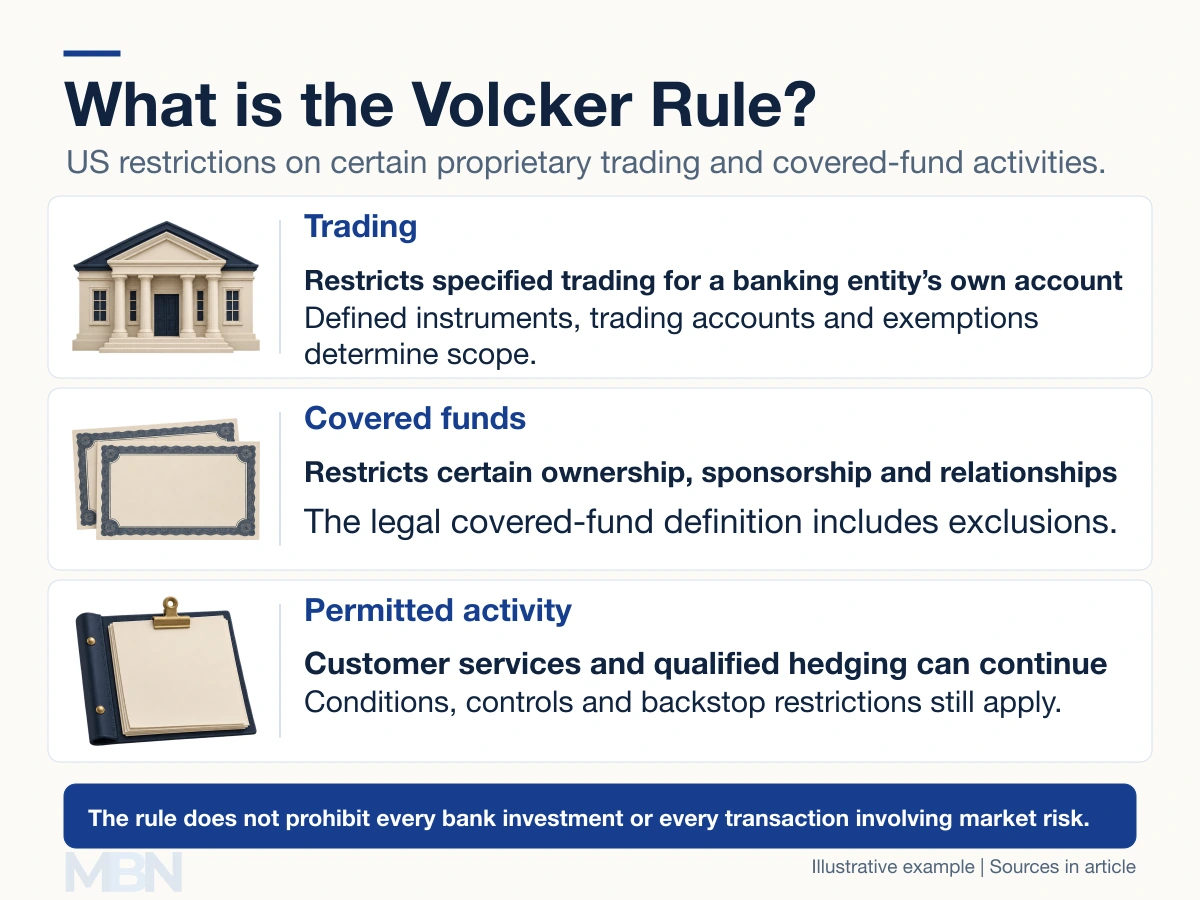
The Volcker Rule is a US restriction on certain proprietary trading and covered-fund activities by banking entities. It generally limits trading for the entity’s own account and ownership, sponsorship or specified relationships with covered funds, subject to detailed exclusions and exemptions.
The Federal Reserve identifies five agencies responsible for the regulations: the Fed, OCC, FDIC, SEC and CFTC. The rule implements section 13 of the Bank Holding Company Act, added by section 619 of the 2010 Dodd-Frank Act.
What is proprietary trading?
In this context, proprietary trading means acting as principal for a trading account when buying or selling specified financial instruments. The regulation defines the trading account, instruments and excluded activities. A principal acts for its own account, rather than solely as an agent for a customer.
The restriction does not depend simply on tracing a purchase to customer deposits. It is also not a ban on every investment carrying market risk or every activity of an investment bank.
Which activities can continue?
Conditional exemptions include underwriting, market making, risk-mitigating hedging and trading in specified government obligations. Underwriting helps issuers sell securities; market making involves standing ready to buy and sell to meet market demand.
For example, holding bond inventory to serve customer demand may qualify as market making when the conditions are met. Taking a separate short-term position solely to profit from an expected price move may fall within the proprietary-trading prohibition.
The Fed’s supervision manual explains the exemptions and backstops. An exemption cannot be used for activity involving prohibited material conflicts, high-risk exposures or threats to safety and soundness or US financial stability.
What are covered-fund restrictions?
Covered funds are a defined category associated with certain private investment funds. Not every fund is covered. Exclusions and conditional permitted activities matter, and the 2020 amendments revised the covered-fund provisions.
Certain community banking organizations meeting asset and trading-activity conditions are excluded from the banking-entity definition. This is another reason a statement that the rule applies identically to every bank is misleading.
What does the 3% limit mean?
Under the organizing-and-offering exemption, section 248.12 imposes both single-fund and aggregate investment limits. The single-fund limit is generally 3% of the fund’s ownership interests after the applicable seeding period. The aggregate limit uses 3% of the banking entity’s Tier 1 capital for relevant holdings.
For a simplified illustration with uniform interests, 3% of $100 million in fund ownership value is $3 million. Separately, 3% of $1 billion of Tier 1 capital is $30 million. Different denominators produce different limits.
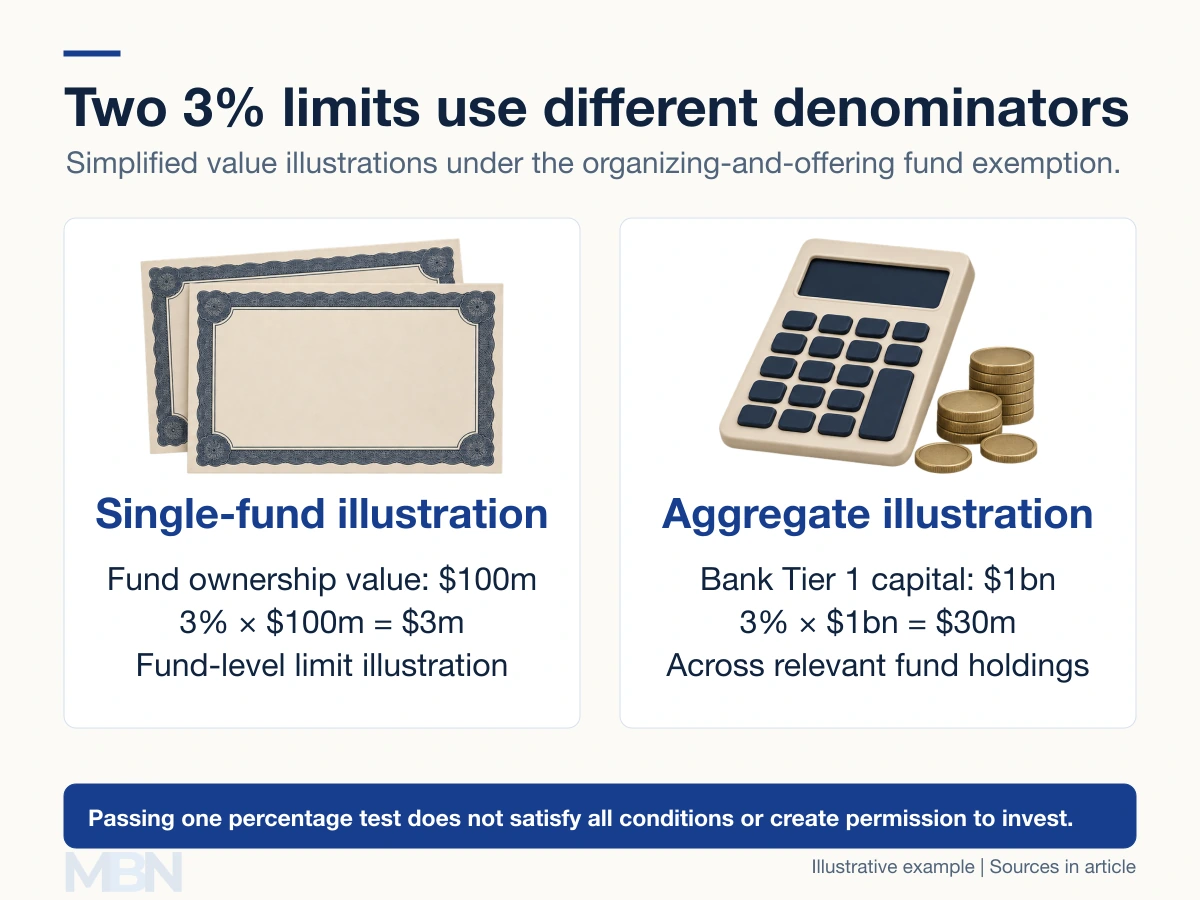
These calculations do not establish compliance. The aggregate calculation uses cost-based measurement rules. Attribution to affiliates, timing, capital deductions, other conditions and exceptions also matter. The original rules took effect in 2014 and were later amended; a 2014 description alone does not explain the current framework.
Last checked and updated on November 4, 2026 by the MBN editorial team.