
Privatization, also known as denationalization, is the selling of state-owned companies to the private sector – it is the opposite of nationalization. When a state-owned business, industry or service is privatized, it is transferred from public to private ownership and control. When privatization occurs, the country’s government creases to be the owner and controller of the business or entity.
Privatization may also refer to the purchase of all outstanding shares of a company that is listed on a stock exchange by private investors – when a publicly-traded business becomes a non-publicly traded business or private company.
People who do not believe that the private sector should own companies, especially strategic industries, such as utilities, say that to privatize a state-owned business is the same as ‘selling the family silver’.
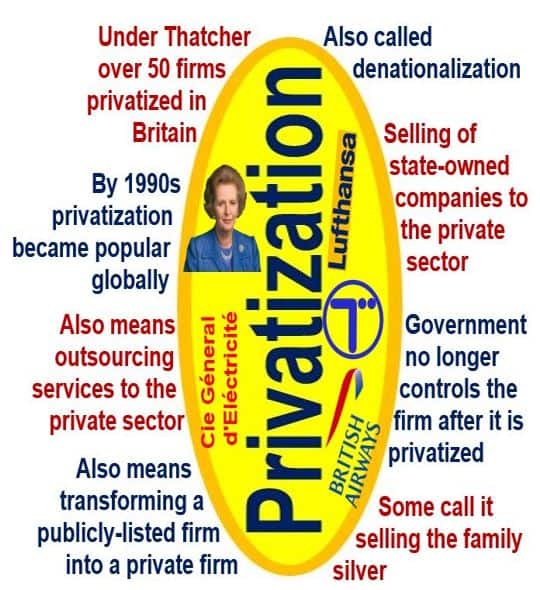 Privatization is the sale of government-owned businesses to the private sector, typically through a stock market listing. In the 1980s, UK Prime Minister Margaret Thatcher started a movement that spread across the world. In the image you can see the logos of British Airways, British Telecom, Lufthansa and France’s largest electricity company at the time – just a few of the hundreds of firms that were privatized.
The term may also mean the government outsourcing of functions and services to the private sector, for example prison management, law enforcement or revenue collection.
According to britannica.com, privatization is the:
“Transfer of government services or assets to the private sector. State-owned assets may be sold to private owners, or statutory restrictions on competition between privately and publicly owned enterprises may be lifted.”
“Services formerly provided by government may be contracted out. The objective is often to increase government efficiency; implementation may affect government revenue either positively or negatively.”
Privatization and Margaret Thatcher
Privatization was associated initially with the government of British Prime Minister Margaret Thatcher in the 1980s, which privatized over fifty state firms, including public utility businesses such as Brtish Gas, British Telecom, and all the water and electricity generating and distributing companies.
Privatization in the UK in the 1980s was accompanied by widespread labor unrest and the loss of tens of thousands of jobs.
However, there was some improvement in the people’s overall standard of living and the country’s ability to compete in the international marketplace during Thatcher’s tenure.
In general, the south of the UK fared much better than the heavily-industrialized regions of northern England, Belfast, and the West Midlands.
Mrs. Thatcher’s policy spread internationally, and by the mid-1990s, governments across the world had transferred hundreds of state-owned businesses and services to the private sector.
By the end of the 1980s, sales of state companies across the world had reached a total of more than $185 billion. More the $25 billion in state-owned enterprises was sold just in 1990.
The United Kingdom saw the largest single sale, with investors paying more than $10 billion for twelve regional electricity firms.
In the same decade, emerging nations quickly jumped on the privatization bandwagon, either because they needed to raise revenue or in pursuit of a political and economic ideology. Argentina sold its telephone monopoly, petrochemical company, and national airline for over two billion dollars, while Mexico raised $2.4 billion.
The term ‘privatization’, with its current meaning of transferring a state-owned business to the private sector, was first used by Ruth Dudley Edwards in her article – The Pursuit of Reason: The Economist 1843-1993 – in the 1930 when writing about Nazi German economic policy.
Privatization – pros and cons
Economists, sociologists, anthropologists, and politicians have been forever arguing and disagreeing about the benefits and harms of privatization.
Potential benefits:
– Efficiency: a private company, with a profit incentive, is driven to cut costs and become efficient. People working in government departments and state-run organizations do not have this pressure.
Since British Telecom, British Airways and other state-run enterprises were privatized in the UK, they have demonstrated varying degrees of improved efficiency, greater productivity, and higher profitability.
– Free of political interference: governments are not good economic managers. They are motivated by political issues rather than sound business sense.
For example, if a state-owned company has too many employees, politicians may not be willing to do what is required – reduce the size of the workforce – because of the negative publicity they would receive, especially when elections are near.
State-owned companies usually employ too many workers and suffer from poor productivity.
– Shareholder pressure: the directors of a company in the private sector have to answer to their shareholders. If they perform badly, their shareholders replace them, or the company runs the risk of being acquired by a competitor.
State-owned businesses do not have this kind of pressure, so it is safer and easier for their directors to be inefficient.
– Competition: if the state-run enterprise is a monopoly, it has no rivals against which to compete – no reason to provide consumers with the best product or service possible.
– Privatization Raises Revenue: if the government wants to reduce a budget deficit, lower taxes, or implement a major infrastructure program, selling state-owned companies is an effective way of getting money. However, it is a one off benefit.
Potential Disadvantages:
– Public Interest: healthcare, public transport, education for example, are industries which perform key public services. Many people believe that in these industries, the primary objective of the suppliers should not be profit.
Many people in Europe argue that privatizing health care would result in a large percentage of the population having no access to medical treatment or medications, as is the case in the United States. In the United Kingdom, the vast majority of voters are in favor of keeping health care in the public sector.
– No Dividends for the Government: many privatized companies are very profitable today. The dividends from these companies, rather than going to wealthy shareholder, could be going to the government, which would lead to lower taxes.
An obvious counter-argument to this claim is that these companies are only profitable today because they are in the private sector.
– Private Monopolies: if a state-owned monopoly is privatized, and the result is a private monopoly, the same lack of competition exists, but now rich people are making lots of money instead of the government.
Privately-owned monopolies need regulating to make sure they do not abuse their power, which means that as was the case under state ownership, government involvement does not go away completely.
– Short-Termism: politicians are criticized for seeing only as far as their next elections. However, shareholders want their dividends and tend to push directors into strategies that produce short-term profits.
In an article – Privatization and Its Benefits: Theory and Evidence – CESifo Econ Stud (2003) 49 (3): 429-459, Eytan Sheshinski and Luis F. López-Calva wrote:
“Empirical evidence shows a robust corroboration of theoretical implications: privatization increases profitability and efficiency in both competitive and monopolistic sectors.”
“Full privatization has a greater impact than partial privatization and monopolistic sectors show an increase in profitability that is above the component explained by increases in productivity, which reflects their market power. From the macroeconomic perspective, no conclusive evidence can be drawn, but the trends are favorable.”
Video – Privatization under Margaret Thatcher
This video explains how British Prime Minister Margaret Thatcher changed the country’s economic landscape.