
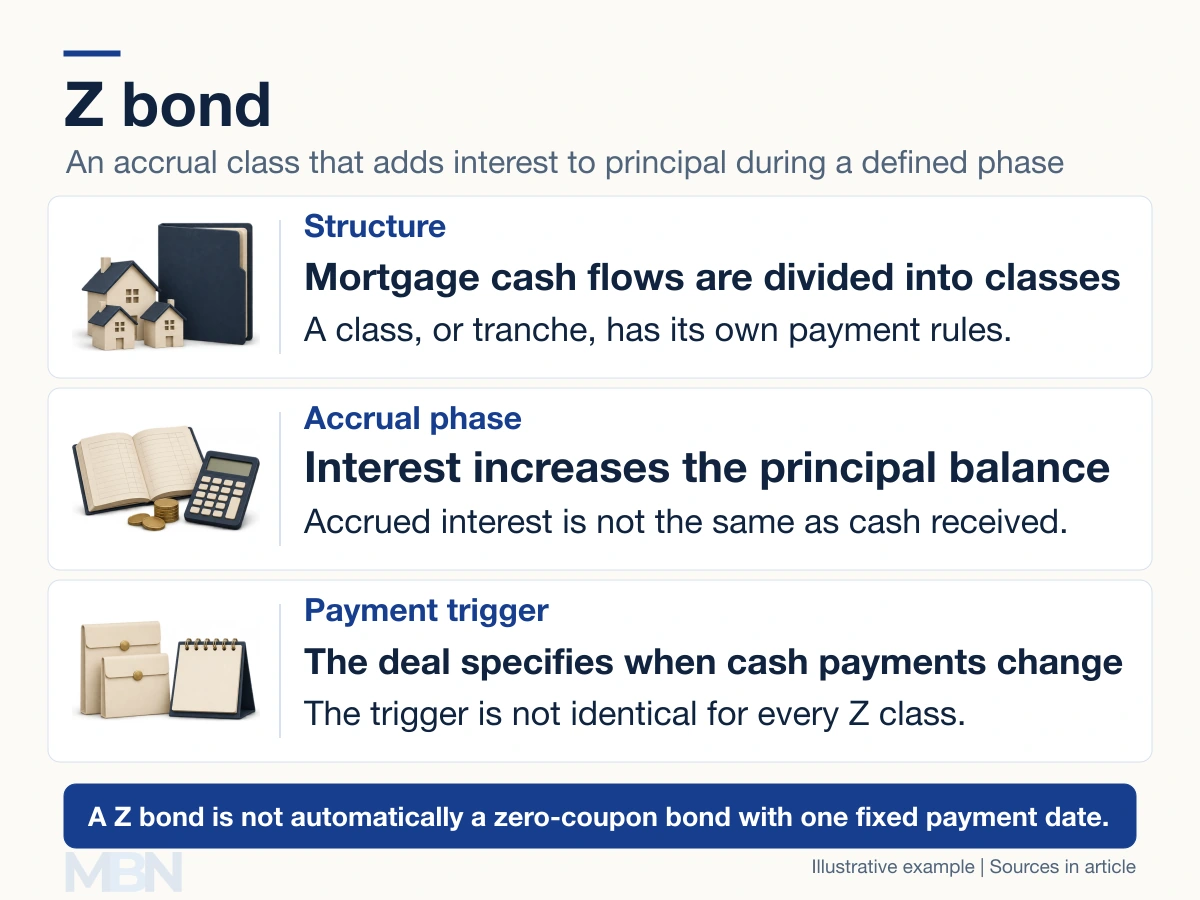
A Z bond is an accrual class of a structured mortgage security. During its accrual phase, interest is added to its principal balance instead of being paid to the investor in cash.
Z classes are often found in collateralized mortgage obligations (CMOs). A CMO divides mortgage-related cash flows among classes, also called tranches, with different payment priorities and timing.
How does the accrual phase work?
The security’s documents specify the interest rate, calculation method and allocation of cash flows. Interest that would otherwise be distributed to the Z class increases its outstanding principal instead. Cash can be directed to other specified classes under the deal’s payment rules.
Fannie Mae’s prospectus defines an accrual class by this addition of interest to principal. Accrual continues until a specified event or another outcome set out in the documents. Retirement of earlier classes is a common trigger, rather than a rule that every other class in every deal must be paid off first.
What does the balance calculation look like?
Suppose a hypothetical Z class starts with $100,000 and capitalizes interest monthly at 0.5%, equivalent to a stated 6% annual rate divided by twelve. Assume there are no principal payments or other adjustments.
In month one, $500 is added, giving a $100,500 balance. In month two, 0.5% of that larger balance is $502.50, giving $101,002.50. The investor has received no cash interest during those two months.
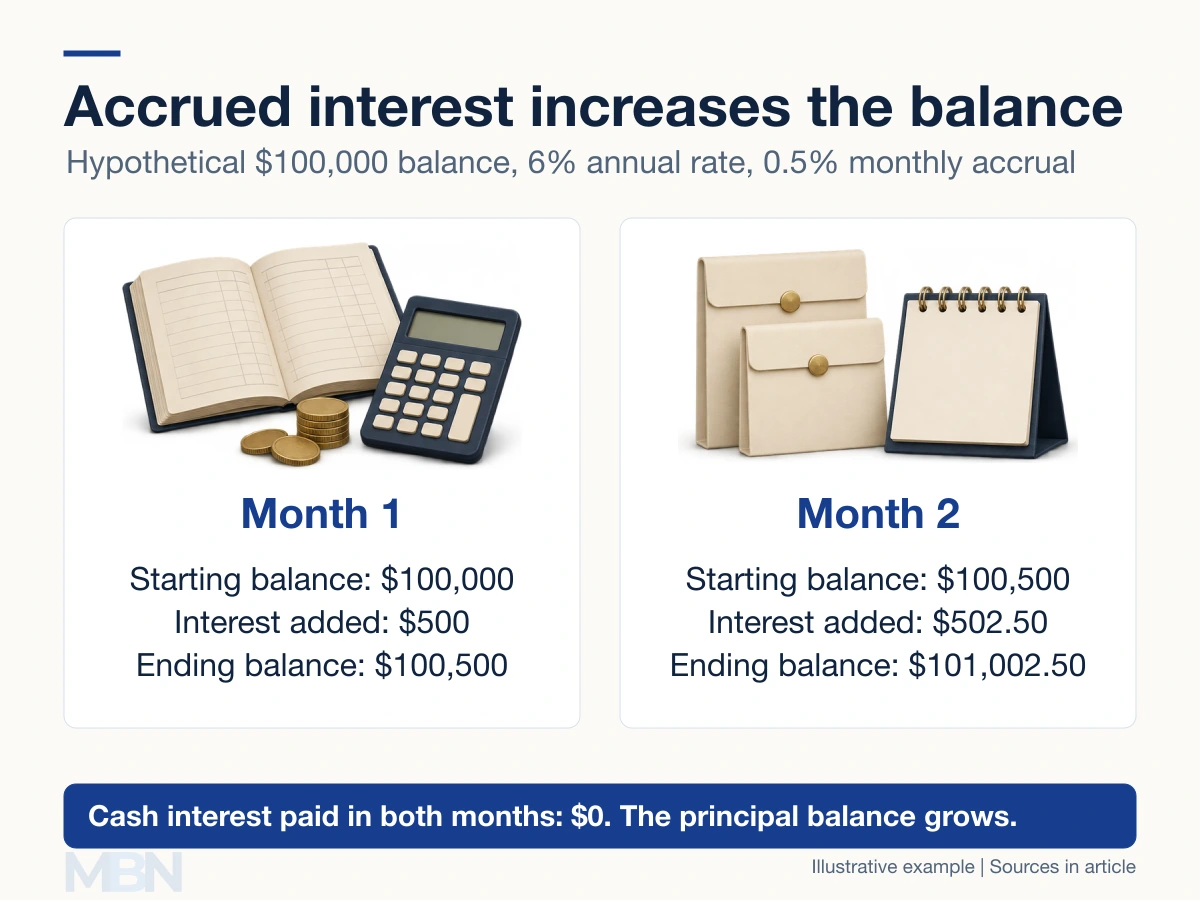
The growing balance records an entitlement under the contract. It is not a realized cash gain, a market-price quotation or proof that the security could be sold for that amount.
How does it differ from a zero-coupon bond?
A conventional zero-coupon bond makes no periodic coupon payments over its life. A Z class can begin paying current cash interest after its accrual phase ends, subject to its terms. Its payment schedule can also depend on mortgage cash flows.
Freddie Mac says classes with the letter Z generally represent accrual classes. “Generally” matters: class letters alone do not establish the full payment rules, credit protection or exact maturity. Partial-accrual and other structures can have different terms.
What affects the timing and risks?
Mortgage borrowers can repay early, refinance or repay more slowly than assumed. Those changes can alter how quickly preceding classes are retired and when a Z class receives cash. Faster repayment can create prepayment risk; slower repayment can extend the investment’s life.
Interest-rate changes and revised repayment expectations can affect market value. Credit protection depends on the issuer, guarantees and structure. A guarantee, where applicable, should not be read as a guarantee of market price or a particular payment date.
Accrued income can also have tax consequences before cash is received. The IRS explains original issue discount and special reporting for mortgage-related interests. The treatment depends on the instrument, holder and account, rather than the Z label alone.
Last checked and updated on November 10, 2026 by the MBN editorial team.