
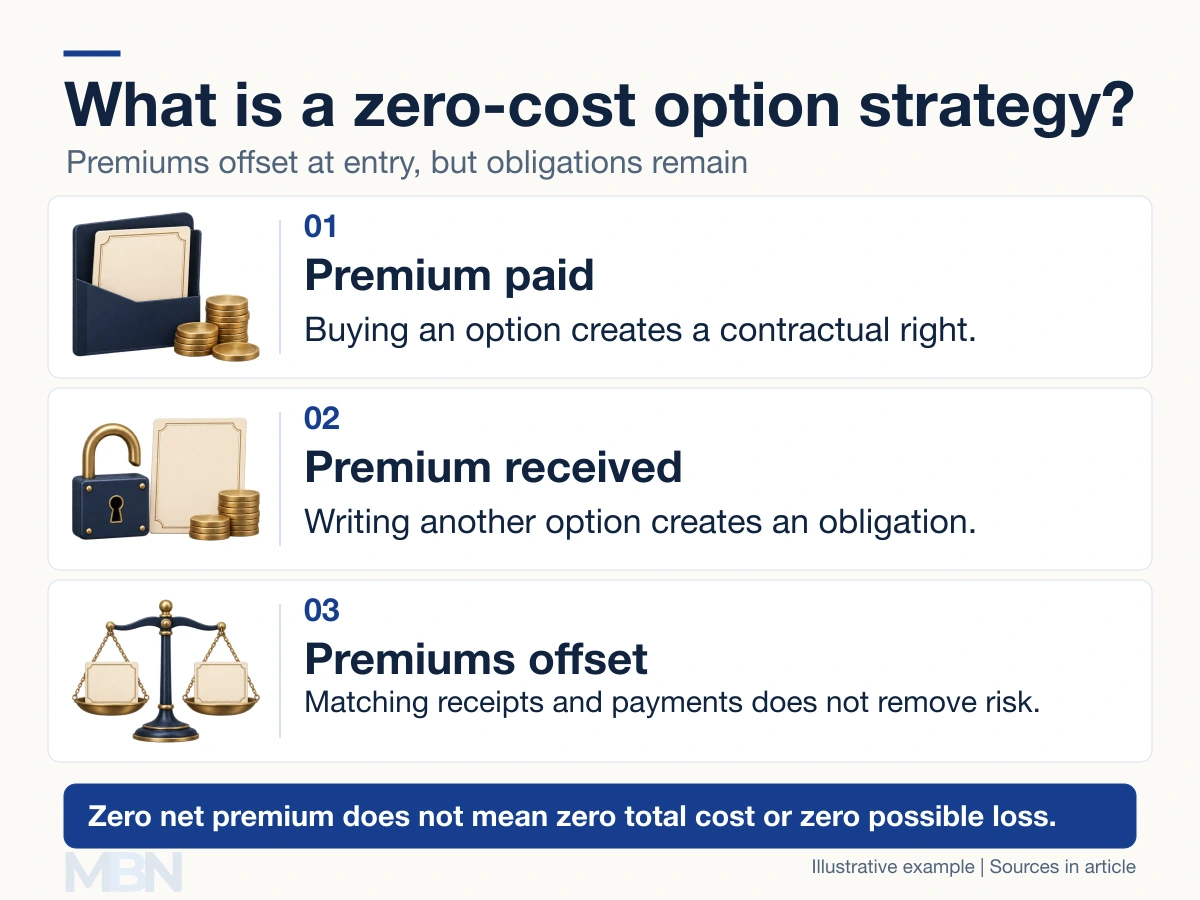
A zero-cost option strategy combines purchased and written options so that the premium received offsets the premium paid at entry. “Zero cost” describes the net option premium, rather than the total economic cost or possible loss.
Buying an option creates a right under its terms. Writing, or selling to open, an option creates an obligation. Equal premiums do not cancel those rights and obligations. Commissions, bid-offer spreads, collateral requirements and financing costs can still matter.
Why a risk reversal is not always zero-cost
A bullish risk reversal commonly buys an out-of-the-money call and writes an out-of-the-money put on the same underlying with the same expiration. Out-of-the-money means the option would have no exercise payoff at the current underlying price.
A bearish version reverses those option positions. Nasdaq’s risk-reversal explanation notes that the initial combination can produce a debit, a credit or a near-zero net premium. Its name alone does not establish equal premiums.
For a hypothetical bullish combination, suppose a $110 call costs $200 and writing a $90 put receives $200, with each contract covering 100 shares. The initial net premium is zero. If the stock ends at $70, the call expires worthless and the put creates a $2,000 loss before costs: ($90 minus $70) multiplied by 100.
Potential losses depend on the structure
For an ordinary stock that cannot fall below zero, that bullish combination has substantial but bounded downside at expiration. With the assumptions above, a zero stock price produces a $9,000 loss before costs. Its long call has theoretically unlimited upside.
An uncovered bearish combination containing a written call has theoretically unlimited upside loss exposure as the stock rises. Its purchased put’s payoff is bounded by the stock reaching zero. The Options Industry Council explains the different loss limits of written calls and puts. These limits cannot be generalized to every commodity, currency or futures arrangement.
A zero-premium collar is different
A collar includes an underlying holding. A shareholder buys a protective put and writes a call, generally with the same expiration. The OIC’s collar guide explains the exchange of downside protection for capped upside.
Suppose 100 shares cost $10,000. A $90 put costs $200 and a $110 call receives $200. Ignoring costs and dividends, the combined position’s expiration value is bounded between $9,000 and $11,000. Its loss or gain relative to the initial share purchase is therefore bounded at $1,000 in either direction.
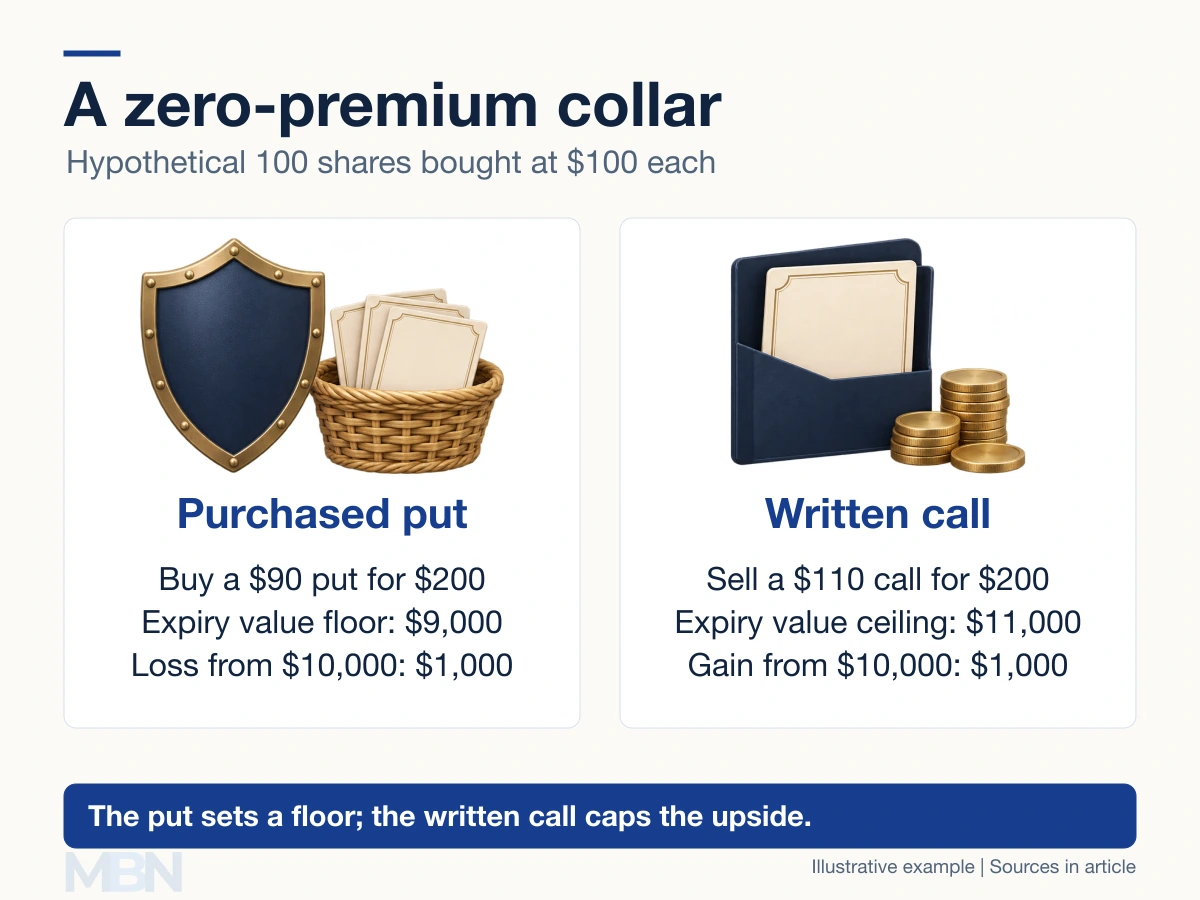
The underlying shares still required $10,000. The put protects only to its stated strike and expiration, while the written call can require delivery of the shares. Early assignment and corporate actions can complicate the path before expiration.
What the label leaves out
Equal quoted premiums may not be available at the desired strikes, expiry and size. Actual execution prices determine whether the premium offsets. A position can also require margin despite producing no initial premium payment.
“Zero-premium” is often the clearer description. Understanding the full position, including any existing holding and written obligations, explains more than the initial cash receipt or payment alone.
Last checked and updated on November 5, 2026 by the MBN editorial team.