
Would you like to see the world’s giant multinationals paying tax at the proper rate, like billions of salaried people have to? That is what the G20 ministers say they would like to see as they call for more stringent tax rules to prevent the runaway tax avoidance that currently occurs among the world’s 100 or so largest corporations.
The G20, also called Group of Twenty, is a global forum for the governments and central bank governors from the world’s twenty major economies including the United States, the European Union, China, Japan, Argentina, Australia, Brazil, Canada, France, Germany, India, Indonesia, Italy, South Korea, Mexico, Russia, Saudi Arabia, South Africa and Turkey.
Finance ministers said on Saturday that the world’s 20 major economies need to cooperate more deeply regarding tax collection and data sharing as multinational companies try to reduce to a minimum the amount of tax they pay to governments.
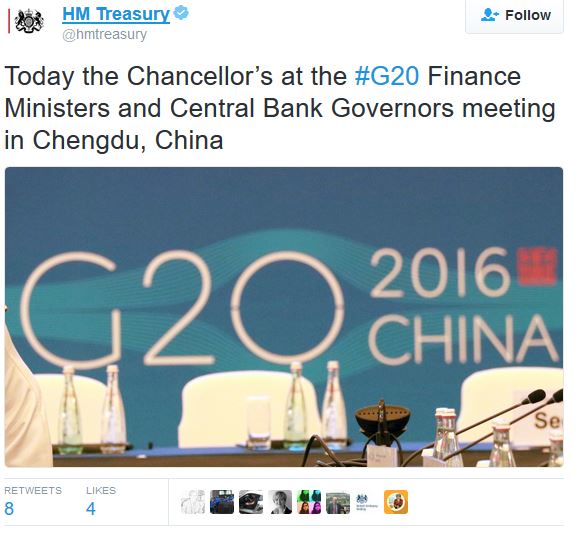 The UK Chancellor Philip Hammond and finance ministers of the G20 nations are meeting in China. (Image: twitter.com/hmtreasury)
Multinational companies such as Starbucks and Google have hit the headlines with the tiny amount of tax they pay in several parts of the world, such as the European Union, compared to their huge revenues. There is growing antipathy to how these companies behave by the hundreds of millions of salaried taxpayers across the world.
At the current meeting of G20 finance ministers at Chengdu, China, US Treasury Secretary Jacob Lew said at a high-level symposium on tax policy:
“When the current cross-border tax rules were developed they were tied to concepts that reflected geography and national boundaries.”
“When we look at technology a lot of that has become harder to define. There needs to be a common standard across countries on important issues of transfer pricing.”
Structural reforms can provide powerful lift to growth. See IMF advice to #G20 by countries. https://t.co/Ux15kznOD7 pic.twitter.com/GvujOGmPBd
— IMF (@IMFNews) July 22, 2016
If the loopholes that currently exist are plugged, the choices businesses currently made would change, he added.
The world’s leading economies have previously backed proposals requiring government agencies to share the identities of shell corporations, and supported creating a list – a blacklist – of tax havens that refuse to cooperate with data-sharing programmes.
These discussions, however, have been more comprehensive, and have covered BEPS – Base Erosion and Profit Shifting. BEPS refers to accounting methods multinational corporations use to migrate their profits to no-tax or low-tax jurisdictions, thus dramatically reducing their tax liabilities.
Luxembourg and Ireland, for example, have attracted dozens of giant companies to set up subsidiaries or headquarters in their territory because of their incredibly attractive tax rules. Much of Ireland’s miraculous economic growth over the past 12 months has been due to giant corporations moving there.
Angel Gurria, Secretary-General of the OECD (Organisation for Economic Co-operation and Development), said:
“In the 21st century, talent, capital, and even physical infrastructures are increasingly mobile So, a global conversation on these issues, on tax policy, is obvious, critical, important,” he said, later naming Google, Apple and Starbucks as example companies.”
He acknowledged however, that tax policy always has been and will remain a sovereign issue.
On its website, the OECD wrote regarding tax reforms:
“The OECD suggests that further analysis be undertaken to identify the scenarios where tax reforms stimulate inclusive growth and those where they do not, and how such tax reforms will interact with a country’s existing tax policy settings, its level of inequality and its stage of development.”
Video – G20 Summit in Chengdu, China
The 3rd G20 meeting of Finance Ministers and Central Bank Governors is underway in China. Economic leaders are discussing new formulas for global economic growth.
