

GE Q2 net income increased by 13 percent, driven by strong sales in its oil & gas and aviation divisions. The American multinational conglomerate said orders were strong, especially in the emerging economies, while the global business environment continues to improve.
The company is also spinning off its credit card business.
Q2 2014 profits rose to $3.55 billion, or 35 cents per share, compared to $3.13 billion or 30 cents per share in Q2 2013.
General Electric (GE) posted revenue of $36.23 billion, 3.2% more than the $35.12 billion registered in the same quarter last year.
Jeff Immelt, GE’s Chairman and CEO, said
“GE had a good performance in the quarter and in the first half of 2014, with double-digit industrial segment profit growth, 30 basis points of margin expansion, and nearly $6 billion returned to shareholders. The environment continues to be generally positive.”
Industrial divisions did well
Below are some data from different industrial divisions of GE in Q2 2014 compared to Q2 2013:
- Excluding GE’s financial division, revenue increased by 7%,
- overall profits from the company’s industrial divisions, specifically those that manufacture medical equipment, oil & gas drilling equipment, aircraft engines, locomotives, and gas turbines increased by 9%,
- profit from oil & gas jumped 25%,
- profit from aviation increased by 12%,
- profit in the transportation division declined by 14%.
Alstom deal
During the quarter, GE’s $17 billion offer for the Power and Grid business of Alstom was accepted by the French conglomerate’s board and approved by the French government.
GE wrote:
“It (the Alstom deal) is proceeding to works council consultations and is subject to Alstom shareholder approval and customary regulatory approvals. The deal is targeted to close in 2015. GE expects Alstom to be accretive to earnings in 2015, and add $0.06 to $0.09 per share in 2016. This will accelerate the Company’s portfolio strategy to achieve 75% of earnings from its Industrial business by 2016.”
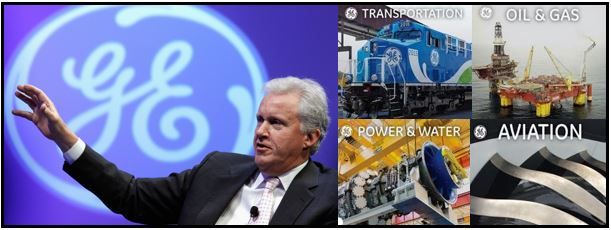
Jeff Immelt promised investors GE would focus on its core businesses.
Spinning off North American Retail Finance business
GE confirmed its previously announced plan to spin off its credit card business (Synchrony Financial) with an IPO (initial public offering) set for the end of this month, expected to be the biggest of a US company so far this year.
The company says it expects to raise $3.1 billion in the sale of a 15% shareholding in Synchrony Financial, according to documents filed at the US Securities and Exchange Commission. The expected price range of the 125 million shares has been set at $23 to $26 each, and will be listed on the New York Stock Exchange under the ticker symbol SYF. It will retain about $17 billion’s worth of shares in the business, thus valuing Synchrony at c. $20 billion.
The company might sell an additional 18.75 million through the over-allotment to its underwriters. Morgan Stanley, Citigroup, JP Morgan Chase and Goldman Sachs were listed as lead underwriters.
According to Synchrony financial, it is America’s number 1 provider of private-label credit cards, with a purchase volume of $94 billion in 2013. After the IPO, GE will own 85% of Synchrony. It will then distribute the remaining shares to GE shareholders in tax-free transactions. The company plans to be completely out of any type of financial business by the end of 2015.
Before the global financial crisis, GE’s financing operations used to generate more than half its earnings.
The Fairfield-based company is set to become more focused on the industrial side of its business. It has already shed its NBC Universal media unit, and is in the process of spinning off its banking and real estate division.
GE getting rid of its appliance business
The GE board is stepping up efforts to find a suitor for its appliance business. The company tried to sell the operation in 2008, but then scrapped the plan.
Although its appliance business makes a profit, its margins are very low and labor costs are high, and according to GE, are not a suitable fit for its plans to concentrate on its lucrative heavy industries, such as gas turbines and jet engines.
GE’s appliance and lighting division earned $381 million in 2013, a little more than 2% of the company’s total operating profit, and generated revenues totaling $8.3 billion, less than 6% of the conglomerate’s total revenue.
Mr. Immelt made a promise to investors that the company would expand its industrial businesses and get rid of non-core segments.
The Wall Street Journal quoted an unnamed person who is familiar with the matter who claimed the company has recently renewed efforts to sell its appliance operation. “They are out there talking to people trying to get something done,” the person said.
Analysts suggest the following companies may be ideal suitors: Eletrolux of Sweden, Controladora Mabe of Mexico, Haier Electronics Group of China, and Samsung of Korea.
