
German factory orders increased by 4.6% in July compared to June, after declining during the previous two months, according to figures published today by the country’s statistics agency Destatis. The results are adjusted for inflation and seasonal swings.
In June, factory orders had declined by -2.7%. July’s increase was the strongest in 13 months and was driven by a surge in foreign (non-Eurozone) demand.
The Federal Ministry for Economic Affairs and Energy wrote:
“After economic uncertainty due to geopolitical developments and cyclical weakening in the second quarter, the strong order increase provides an encouraging signal for the industry.”
Orders in manufacturing in July rose by:
- within Germany: +1.7%,
- from abroad: +6.9%.
- from the Eurozone: +1.7%,
- from abroad (non-Eurozone): +9.8%.
Producers of intermediate and capital goods posted +0.3% and +8.5% growth respectively, while those of consumer goods saw orders decline by -2.9% in July.
Economists believe that the marginal increase from the Eurozone shows that Germany’s real risks are more due to the currency bloc’s economic weaknesses than the geopolitical problems in Ukraine and the Middle East.
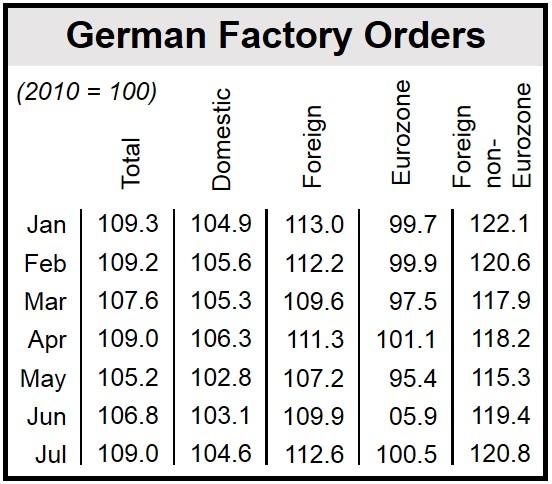
(Data source: Destatis)
A summer of pessimism
German business confidence has suffered as the Eurozone increases economic sanctions against Russia and the world’s largest nation responds with tit-for-tat bans of agricultural products and food imports.
The Munich-based Ifo Institute reported that the German Business Climate Index for trade and industry had declined to 106.3 in August from 108 in July. Ifo said German firms were less satisfied with the current business situation and that the economy was losing steam.
In August, Destatis reported that German GDP contracted by -0.2% in Q2 2014, also commenting that “The German economy is losing momentum.” Economists said its Q1 growth (+0.4%) was probably due to abnormally mild winter conditions.
Bloomberg Businessweek quoted Carsten Brzeski, chief economist at ING-DiBa AG in Frankfurt, who said “Ahead of today’s ECB meeting, German new order data should give some relief that not everything is gloom and down. (Data are) providing evidence that the Eurozone’s largest economy should return to growth in the third quarter.”
