
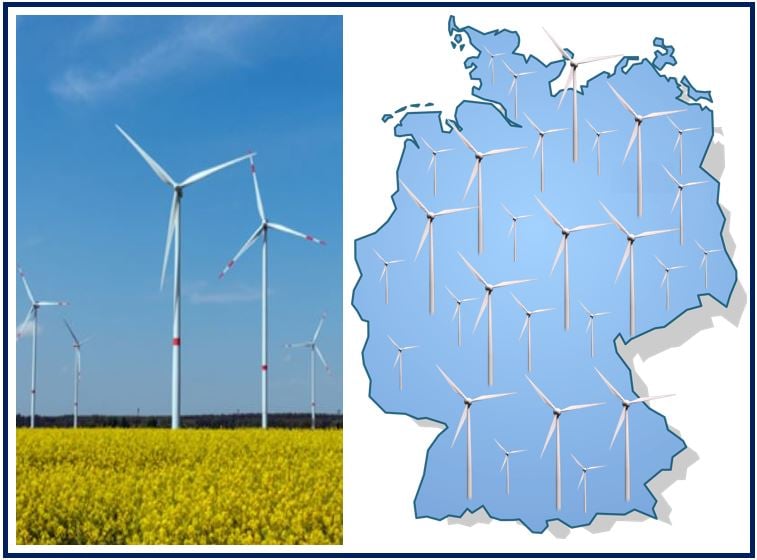
Wind power should cover 65% of Germany’s electricity needs by 2030, alongside biomass and solar energy, as well as hydropower. According to a team of researchers, wind power is a key pillar in the country’s energy policy turnaround.
Dr. Christopher Jung, Dr. Dirk Schindler, and Leonie Grau carried out a study on wind power. They say that wind power alone could cover 40% of Germany’s current electricity needs by 2030.
The researchers, from the University of Freiburg, wrote about their study in the journal Energy Conversion and Management (citation below).
Wind power – distribution is crucial
The authors say that to achieve the 40% target, there is an important prerequisite. Wind power operators must distribute their plants optimally across the German mainland.
The researchers developed a new 3-dimensional model to estimate usable wind power. They used the number of new installations in 2017 as a basis for their calculations.
If the construction of new installations remains constant until 2030, the 40% target is achievable, the authors wrote.
Improving wind power efficiency
While developing their model, the researchers focused closely on increasing wind power efficiency.
They showed that repowering enabled significant increases in yield. In some cases, increases of several hundred percent. Repowering means replacing old, small plants with newer, larger ones.
As a result of repowering, the cost of converting energy into electricity is significantly reduced. In the world of power generation, repowering can even make wind power as cost effective as brown coal.
An article on the University of Freiburg’s website says the following regarding the current expansion targets:
“However, in order to meet the current expansion targets of the Federal Government, a significant portion of the 30,000 wind turbines must be renewed, and 6,000 additional systems must be additionally installed.”
Model ideal for planners and researchers
The researchers’ model can determine the available wind resources for all common types of wind power plants. Also, planners can adjust the expansion target whenever they wish.
With their model, researchers can develop and assess scenarios with different plant densities and expansion strategies. They can also include a variety of repowering intensities. Additionally, the model allows for a balanced spatial distribution.
Dr. summarized:
“In principal, we can avoid a disproportionate concentration in certain regions.”
The algorithm also takes into account that there will be a minimum number of new installations. In other words, the number will be kept as low as possible.
Dr. Schindler added:
“This would minimize disruptions in the landscape while taking the landscape and nature conservation into account.”
Wind power – renewable energy
Wind power is renewable energy. Renewable energy is energy that comes from an everlasting source. In other words, the source of that energy never runs out – we cannot use it up completely. By ‘everlasting’ in this context, we mean in a human timescale.
Solar energy, hydropower, biomass energy, and geothermal energy are also types of renewable energy.
Solar energy, for example, captures the Sun’s energy and converts it into electricity. The energy from the Sun, in a human timescale, never depletes, i.e., it is always there. Therefore, solar energy is renewable energy.
Wind energy means the same as wind power.
Citation
“Achieving Germany’s wind energy expansion target with an improved wind turbine siting approach,” Christopher Jung, Dirk Schindler, and Leonie Grau. Energy Conversion and Management, Volume 173, 1 October 2018, Pages 383-398. DOI: https://doi.org/10.1016/j.enconman.2018.07.090.
