
The Breakthrough of the Year 2016 went to the discovery of gravitational waves – ripples in spacetime – which shook the scientific community this year. The discovery fulfilled Albert Einstein’s prediction made over a century ago and capped a four-decade quest to detect the infinitesimal ripples.
However, scientists at the Laser Interferometer Gravitational-Wave Observatory (LIGO) in Hanford, Washington, and Livingston, Louisiana, said this is not the end of the story. Rather, it is the birth of a brand new field – Gravitational Wave Astronomy.
One-hundred-and-one years ago, Einstein explained that gravity exists because gigantic celestial bodies warp space and time – spacetime – causing free-falling objects to follow curved paths such as the elliptical orbit of Earth around the Sun or the arc of a ball after it is thrown.
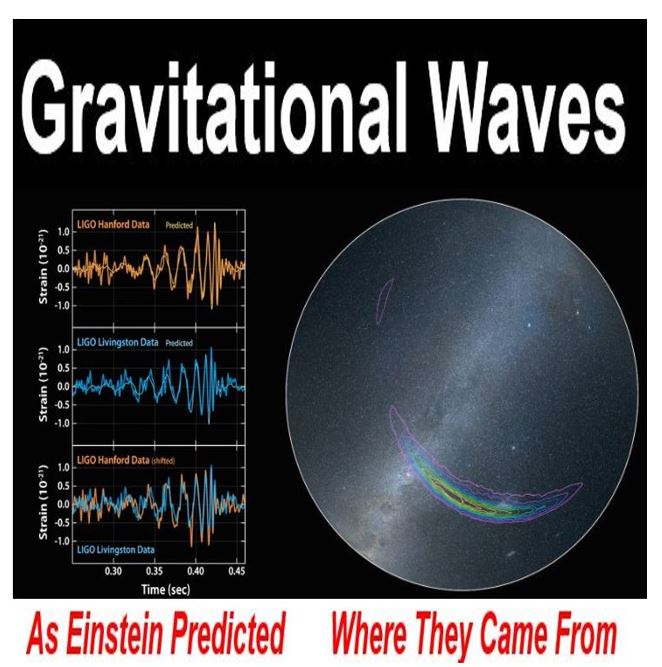 The plots on the left show the gravitational wave signals detected by the two LIGO observatories, which came from merging black holes, each approximately 30 times our Sun’s mass. The right image shows the approximate location of the source of the gravitational waves. (Image: mediaassets.caltech.edu/gwave)
Gravitational waves prediction comes true
According to Einstein’s subsequent calculations, a barbell-shaped distribution of mass rotating end-to-end like a whirling baton should radiate spacetime ripples that zip along at the speed of light – these are gravitational waves.
On February 11th, 2016, LIGO physicists announced that they had observed exactly what Einstein had predicted: “A burst of waves created as two black holes spiraled into each other 1.3 billion light-years away.”
It was a hard-earned triumph. Even Einstein spent several decades vacillating over the existence of gravitational waves. If their existence was possible, Einstein said the only source he could imagine were two orbiting stars, whose waves would be too weak for us to detect.
However by the late 1960s, scientists knew of considerably denser concentrations of mass. They had detected neutron stars and dreamed up black holes – the mega-dense gravitational fields left behind when a pair of massive stars collapses to nothing.
In theory, such things spiraling together should be able to produce observable waves.
 By the 2020s, there will be six gravitational wave observatories across the world. In the bottom image, you can see part of a computer simulation of a collision between two black holes – an event first detected by LIGO. (Image: Top: mediaassets.caltech.edu. Bottom: mediaassets.caltech.edu.)
Half-century old gravitational waves quest
In 1972, an MIT physicist, Rainer Weiss, set out to detect them with interferometers – a series of L-shaped optical instruments – sowing the seed for LIGO.
LIGO’s interferometers each have two 4-kilometer-long arms fitted with mirrors at each end, housed in a gigantic vacuum chamber. Laser light is bounced between the mirrors. Scientists compare the arms’ lengths to within one-ten-thousandth of the width of a proton. The arms would be stretched by different amounts when a gravitational wave passed through them. This is what the LIGO researchers spotted.
In a news article in Science, Adrian Cho wrote:
“The tight fit between that first signal and computer modeling validated Einstein’s theory of gravity, known as general relativity, as never before.”
The LIGO team members, as well as physicists across the world, are eagerly anticipating what will come next, because gravitational waves should provide us with a completely new way to observe the cosmos.
More events expected to be spotted
Physicists say they hope to detect several more events. At LIGO, they have already detected a second black hole merger and a third, slightly weaker signal.
In November, the interferometers resumed gathering data, and if they can reach the sensitivity levels for which they were designed, they should be able to observe a black hole merger on average once each day.
We will soon see other instruments joining the hunt. In Italy, the upgraded VIRGO detector is scheduled to be switched on early in 2017. Japanese scientists are building a detector called the Kamioka Gravitational Wave Detector, while LIGO researchers say they will add a detector in the early 2020s in India.
Using triangulation, at least three detectors combined should be able to pinpoint a source in the sky. This will help telescopes home in on the same events, and maybe detect other signals from it.
For example, if gravitational wave detectors detect two neutron stars merging, and telescopes pick up the event’s x-rays, the signals combined might offer us clues about the exotic matter in neutron stars.
These detectors may even test wilder ideas regarding black holes. According to quantum theory, a black hole may contain a hidden ‘firewall’ that would destroy anything that falls into it. If this is the case, some theorists suggest that merging black holes should generate gravitational wave echoes.
Others predict that a spinning black hole might generate a cloud of axions – hypothetical particles – which could generate gravitational waves by annihilating each other en masse.
Catching #GravitationalWaves – @CBCNews The National chooses @LIGO discovery as top science story of 2016 https://t.co/ff8N7D0lK3
— LIGO (@LIGO) December 24, 2016
A different quest for gravitational waves
Some scientists are using a different approach to detect gravitational waves. Supermassive black holes weighing up to billions of solar masses lurk within the hearts of large galaxies. When two such beasts merge, they radiate massively-powerful waves with light-year-long wavelengths – thousands of times longer than the LIGO-like instruments can detect.
To detect these waves, astronomers are turning to millisecond pulsars – spinning neutron stars. Pulsars emit super-regular pulses of radio waves. As long-wavelength gravitational waves hit Earth, they should push our planet away from some pulsars and toward others.
That motion would, in turn, either stretch or shorten the time between pulsar pulses in different directions, a bit like the Doppler shift.
 Readers of Science Magazine voted the discovery of gravitational waves as the Breakthrough of the Year 2016. (Image: twitter.com/ligo)
The resulting differences and correlations among pulsars’ timing should reveal a cacophony of long-wavelength gravitational waves. The spectrum of shorter and longer waves would help scientists trace the rate at which galaxies were formed and merged throughout the history of the cosmos.
Teams of scientists in Europe, North America and Australia hope to see a signal within the next two to three years. Unfortunately, America’s effort is threatened by plans at the NSF (National Science Foundation) to defund the two radio telescopes it uses.
LISA was originally proposed in the 1990s as a joint mission between the European Space Agency and NASA, but in 2011 the US pulled out, citing budget constraints. NASA now wants back in.
Video – Hawking congratulates LIGO team
In this video, you can see Prof. Stephen Hawking congratulating the LIGO team for their discovery of gravitational waves.
