
The latest edition of a report that benchmarks travel and tourism competitiveness in 136 economies shows that for the sixth consecutive year, the growth of the industry has outperformed that of the global economy.
The 2017 edition of the Travel and Tourism Competitiveness Index (TTCI) reveals that in 2016, travel and tourism:
– accounted for 10.2 percent of global GDP (an amount equal to US$7.6 trillion)
– generated 292 million jobs, or 1 in 10 jobs worldwide
– reached a total of 1.2 billion international arrivals (46 million more than the previous year)
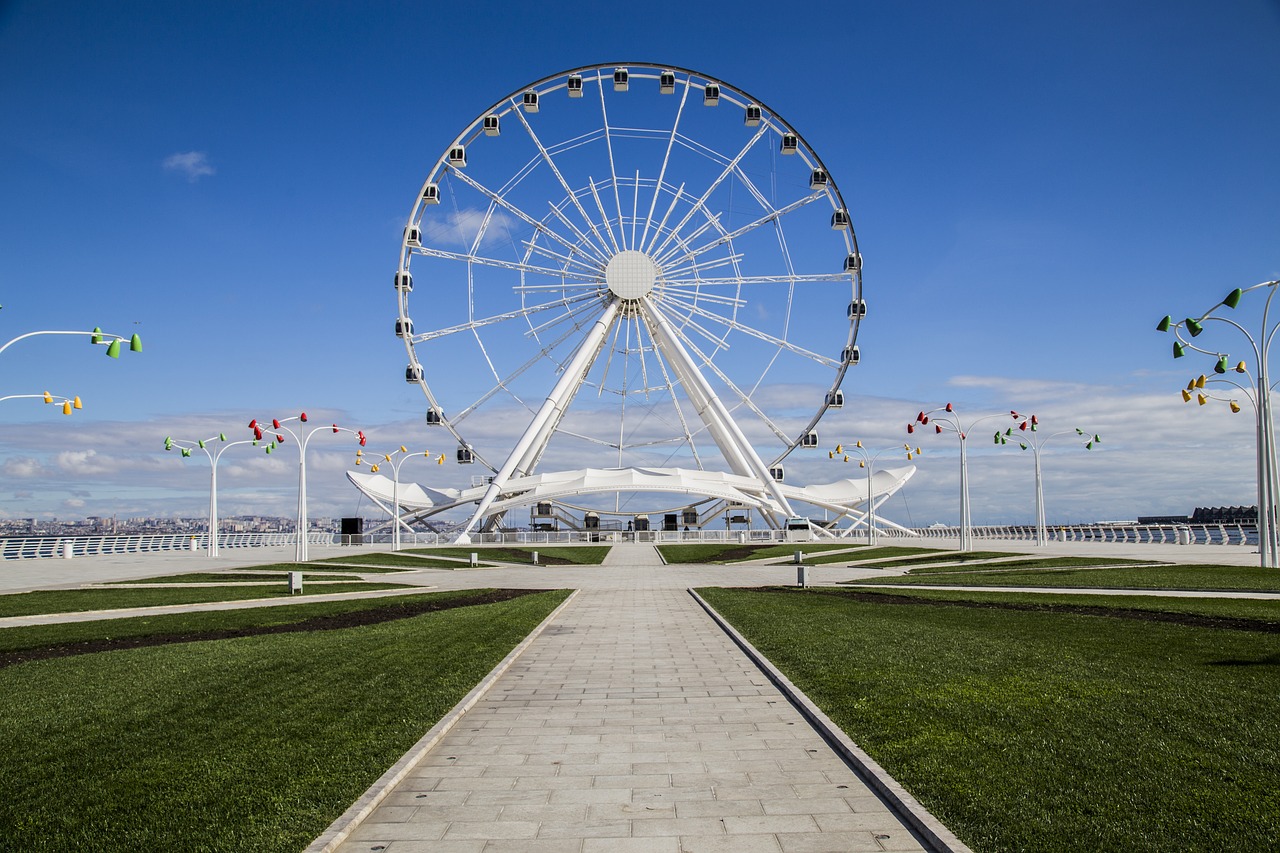
 Azerbaijan is one of the top 10 most improved nations for travel and tourism in the 2017 issue of the TTCI, rising 13 places to position 71. Image: Ferris wheel in Baku, pixabay-2007903
The World Economic Forum, who have been publishing the Index every 2 years since 2007, say they also expect these promising figures to continue rising over the next 10 years. In the new report, they note that:
“In 2017, the travel and tourism industry continues to make a real difference to the lives of millions of people by driving growth, creating jobs, reducing poverty and fostering development and tolerance.”
The structure of the Index
The Index measures a set of factors and policies in each country that enable it to develop its travel and tourism industry in a sustainable way – which in turn helps the development and competitiveness of the country as a whole.
The Index is compiled from 90 different indicators across four different categories of assessment, as follows:
– Enabling Environment: Business environment, Safety and security, Health and hygiene, Human resources and labour market, and ICT readiness
– Travel and Tourism Policy and Enabling Conditions: Prioritization of travel and tourism, International openness, Price competitiveness, and Environmental sustainability
– Infrastructure: Air transport, Ground and port, and Tourist service infrastructure
– Natural and Cultural Resources: Natural resources, Cultural resources and business travel
The top 10 nations and the most improved
In 2017, Spain takes the top position for the second time. In second place is France, then Germany in third place, followed by Japan in fourth place (rising five places since the last report) and the United Kingdom in fifth place.
The United States is in sixth place (falling two places), Australia is in seventh place, Italy in eighth, then Canada is in 9th place (up one place) and Switzerland drops four places to rank in tenth place.
The 10 most improved nations (in order of the percentage improvement in their Index scores since 2015) are:
1 – Japan (performance score improved by 6.18 percent, up 5 places since 2015 to rank position 4 in 2017)
2 – Azerbaijan (5.98 percent, up 13 places to position 71)
3 – Tajikistan (5.01 percent, up 12 places to 107)
4 – Vietnam (4.80 percent, up 8 places to 67)
5 – Israel (4.79 percent, up 11 places to 61)
6 – Algeria (4.68 percent, up 5 places to 118)
7 – Bhutan (4.52 percent, up 9 places to 78)
8 – Republic of Korea (4.33 percent, up 10 places to 19)
9 – Egypt (4.32 percent, up 9 places to 74)
10 – Peru (3.93 percent, up 7 places to 51)
Key findings
The report highlights a number of key findings:
– Travel and tourism competitiveness is improving, with developing nations showing the biggest improvements – especially in the Asia-Pacific region.
– More and more international travellers are departing from and arriving at emerging and developing countries.
– As increasing protectionism hampers global trade, travel and tourism appears to be bucking the trend, as evidenced by an increasing volume of travel across borders and a general tendency to reduce visa restrictions.
– As countries develop their digital strategies, connectivity is becoming an increasing necessity for travel and tourism, the report notes that “Countries not integrating technology and enhancing their connectivity will be left behind.”
– Despite increasing awareness about sustainability and the importance of the environment (and that progress has been made on several fronts), the natural environment continues to degrade and this will have a serious effect on the travel and tourism sector.
