
A physics paper which attempts to present a more precise estimate for the combined Measurement of the Higgs Boson mass has been published in Physical Review Letters with a record 5,154 authors. No scientific paper in history has had so many collaborators.
The article is 33 pages long, of which 24 are the names of the authors and the institutions where they work.
It is the first joint paper written by the two scientific teams – the ATLAS Collaboration, and the CMS Collaboration – that operate the two huge detectors at the LHC (Large Hadron Collider) at CERN, the largest and most powerful particle collider in the world, and also the world’s biggest single machine, located near Geneva in Switzerland.

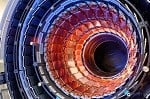
Many thousands of engineers and scientists have worked on CERN’s Large Hadron Collider. (Image: CERN)
Each team comprises several hundreds of scientists from several institutions and countries. By combining their data, they were able to obtain the most precise estimate to date of the Higgs Boson mass.
The Higgs Boson
The Higgs Boson, also known as the Higgs particle, is a type of particle which is a part of The Standard Model of particle physics. This is a set of rules that lays out the fundamental building blocks of the Universe as we understand it. Put simply, the Higgs boson is a particle that gives mass to other particles.
Robert Garisto, an editor with Physical Review Letters, explained that dealing with the article presented challenges above and beyond the mega-task of dealing with the giant teams.
Davide Castelvecchi, writing in Nature News, quoted Mr. Garisto, who said:
“The biggest problem was merging the author lists from two collaborations with their own slightly different styles. Every author name will also appear in the print version of the Physical Review Letters paper.”
Citation:
 G. Aad et al. (ATLAS Collaboration, CMS Collaboration). Phys. Rev. Lett. 114, 191803 – Published 14 May 2015. DOI: 10.1103/PhysRevLett.114.191803.
