
The International Monetary Fund (IMF) has revised down its growth forecasts for emerging Europe to 1.2% for 2014, due to the Ukraine-Russia tensions. The IMF notes that inflation rates across the region, i.e. Central, Eastern and Southeastern Europe (CESEE) have diverged.
For part of the region, falling energy and food prices plus low imported near-deflation from the Eurozone have pushed down inflation, while in Russia, the rest of the CIS (Commonwealth of Independent States) and Turkey price rises have increased.
GDP growth in emerging Europe is expected to improve to 1.7% in 2015, assuming tensions gradually become less intense and sanctions plus tit-for-tat responses are lifted or expire.
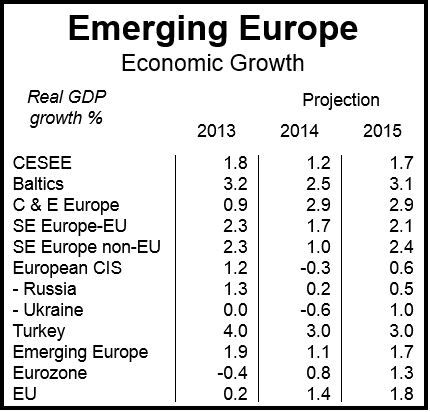 (Data source: IMF)
Several near-term downside risks exist
If the Ukraine-Russia tensions continue, they could have a strong negative impact on emerging Europe by undermining confidence and harming export demand from Russia. Reliance on natural gas imports from Russia, which make up a considerable part of total energy consumption of several nations, is a major concern.
If the Eurozone’s slowdown persists, economic growth in CESEE will be affected. With non-euro EU countries now importing low inflation from the Eurozone, the risk of a more protracted slowdown in the whole of the EU is greater.
Emerging Europe relies heavily on funding from abroad. Tighter global financial conditions and greater volatility in worldwide financial markets could undermine financing conditions.
Global oil production could become disrupted if the conflicts in the Middle East escalate. With the exception of Russia, an increase in the price of oil would harm CESEE economies.
Ensuring recovery important
Securing a strong economic recovery must be the number one near-term priority for the region, with the medium-term goal being raising potential growth, says the IMF.
According to the IMF:
“Recovery in corporate credit and investment is essential for robust and balanced growth. To that end, some countries (including many in Southeastern Europe) need a comprehensive strategy to address corporate debt problems and the large stock of nonperforming loans. Such a strategy should include fostering more out-of-court debt workouts and addressing legal, regulatory and tax impediments to the resolution of nonperforming loans.”
A loan becomes nonperforming when the borrower has made no repayments for at least ninety days.
CESEE nations must continue reducing macroeconomic imbalances by maintaining fiscal and external accounts in order.
Serbia and Croatia urgently must take action to reduce their fiscal deficits, while Turkey, Ukraine and Belarus need to bring down their current account imbalances.
The IMF wrote:
“In the event of external funding shocks, countries should use monetary and exchange rate flexibility where possible, and let automatic stabilizers operate where there is fiscal space.”
CESEE economies need to take measures to become more resilient to potential rises in energy prices (or declines in supply) over the medium term. A more integrated energy market to boost low natural gas and oil reserves would mitigate the impact of energy shocks on individual nations, the IMF says.
In order to ensure medium-term growth, the IMF says CESEE’s policymakers must simplify regulations, reduce barriers to entry, and have a better-functioning labor market, especially in Southeastern Europe.
The transition agenda still has a long way to go for many countries in the region. These countries need to increase the role of the private sector, speed up the restructuring of poor-performing state-owned businesses, and improve governance and transparency.
For the emerging economies that are members of the EU, they should increase their utilization of EU funds, which would improve infrastructure and subsequently bolster competitiveness, the IMF said.
