
The Internet of Things (IoT) is a term which refers to the idea of hooking up virtually everybody and everything to the internet, even animals, some people believe. All individuals and things would then communicate electronically without having to do so face-to-face or via a computer.
The “Things” that the IoT refers to can include almost anything, such as heart monitoring implants, biochip transponders, and built-in sensors (to name a few).
The first phase would include medical devices, home electronic goods, kitchen appliances, and various wearable and portable electronic devices. Objects in the IoT will not only be those with sensory capabilities, but also those with actuation capabilities.
The interconnection of all these things is thought to push forward automation in nearly every field.
An example of the Internet of Things already being implemented is the use of smart thermostat systems that use wifi for remote monitoring.
There is a fear that the “Internet of Things” would eventually strip us of all our privacy and possibly some of our basic human rights.
It isn’t a new concept though. About two decades ago MIT professors talked about a world where “things” (devices or sensors) are connected and able to transfer data. Harnessing and analyzing the data that is transmitted is what the Internet of Things is all about.
Even though the Internet of Things is not a new concept, over the past few years technology experts have accelerated the adoption of IoT scenarios. At the moment the Internet of Things is closely associated with with machine-to-machine (M2M) communication in manufacturing and power, oil and gas utilities. Products with M2M technology are often considered to be “smart”.
According to Microsoft, “the advancements in connectivity, processing power, form factors, operating systems, and applications, among other technology breakthroughs, are key elements to unlocking value from the Internet of Things. And with these advancements, the impact of data and the cloud is paramount to using the power and potential of the Internet of Things.”
Objects in the IoT need to have an IPv6 address because of the the extremely large address space required, which IPv4 cannot offer. The global adoption of IPv6 is important for the successful development of the IoT in the future.
Kevin Ashton, cofounder and executive director of the Auto-ID Center at MIT, said:
“Today computers — and, therefore, the Internet — are almost wholly dependent on human beings for information. Nearly all of the roughly 50 petabytes (a petabyte is 1,024 terabytes) of data available on the Internet were first captured and created by human beings by typing, pressing a record button, taking a digital picture or scanning a bar code.
The problem is, people have limited time, attention and accuracy — all of which means they are not very good at capturing data about things in the real world. If we had computers that knew everything there was to know about things — using data they gathered without any help from us — we would be able to track and count everything and greatly reduce waste, loss and cost. We would know when things needed replacing, repairing or recalling and whether they were fresh or past their best.”
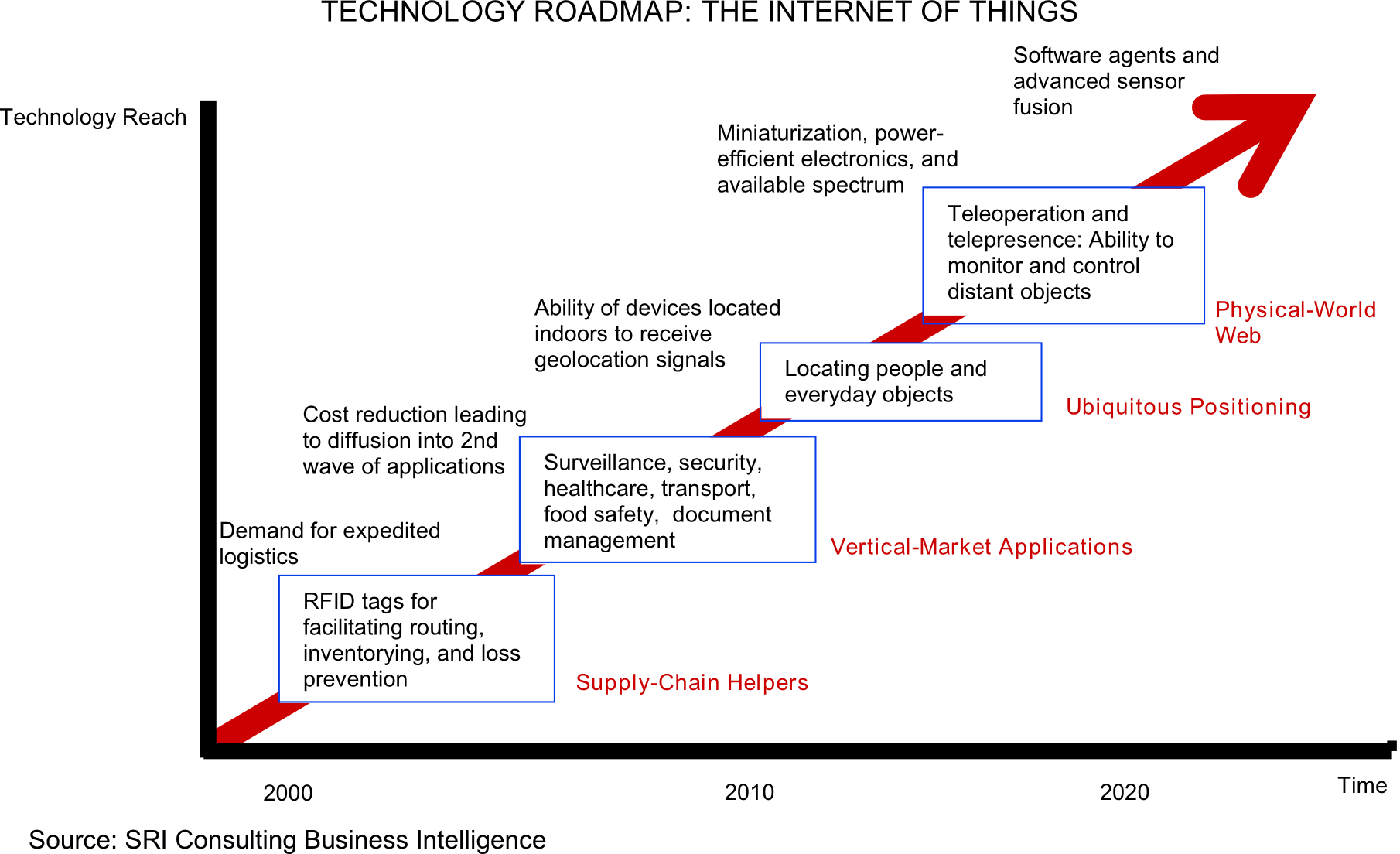
A technology roadmap of the Internet of Things
The Internet of Things requires collaboration and openness to succeed
BK Yoon, Samsung Electronics’ CEO, said that the Internet of Things requires openness and industry collaboration in order to succeed.
“The Internet of Things has the potential to transform our society, economy and how we live our lives,” said Mr. Yoon. “It is our job to pull together – as an industry, and across different sectors – to make true on the promise of the Internet of Things.”
“Expanding the devices in the IoT ecosystem and the components that power them is the first step in fulfilling the promise of the Internet of Things. Samsung already has a broad range of IoT devices. Last year, Samsung delivered more than 665 million products, and this number is set to increase. We have already begun to unlock the value hidden in connected devices and all the everyday objects around us.”
Alex Hawkinson, CEO of SmartThings, said:
“For the Internet of Things to be a success, it has to be open,” said Hawkinson. “Any device, from any platform, must be able to connect and communicate with one another.”
“We’ve worked hard to accomplish this, and are committed to putting users first, giving them the most choice and freedom possible. The SmartThings ecosystem is now compatible with more devices than any other platform.”
