
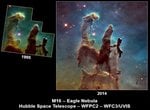
Among NASA’s Hubble Space Telescope’s images, the most breathtaking has to be the iconic view of the “Pillars of Creation”. The photograph, taken twenty years ago, revealed hitherto never seen details of three massive columns of cold gas bathed in the ultraviolet light from a collection of young, massive stars in a tiny region of the Eagle Nebula (M16), some 7,000 light years from earth.
They are so named because the dust and gas are in the process of creating new stars, while at the same time being eroded by the light of nearby recently formed stars.
While such butte-like protrusions are commonly seen in star-forming regions, the M16 structures are by far the most impressive and evocative. The Hubble image has become so popular that it has appeared in TV shows, T-shirts, pillows, movies and even on a postage stamp.
To celebrate its 25th anniversary in April, Hubble has sharpened up the images and provided a wider view of the famous pillars. They have also been photographed in near-infrared light, as well as visible light.
The infrared photographs transform the pillars into eerie, fairy tale-like silhouettes seen against a background of countless stars. This is because the infrared light penetrates a large proportion of the gas and dust, but does not make it through the densest regions of the pillars.
Hidden away within the pillars one can see newborn stars. The new images are being presented at the American Astronomical Society meeting in Seattle.
While originally being dubbed the “Pillars of Creation”, the new picture could easily assume the nickname “Pillars of Destruction.”
Paul Scowen of Arizona State University in Tempe, explained:
“I’m impressed by how transitory these structures are. They are actively being ablated away before our very eyes.”
“The ghostly bluish haze around the dense edges of the pillars is material getting heated up and evaporating away into space. We have caught these pillars at a very unique and short-lived moment in their evolution.”
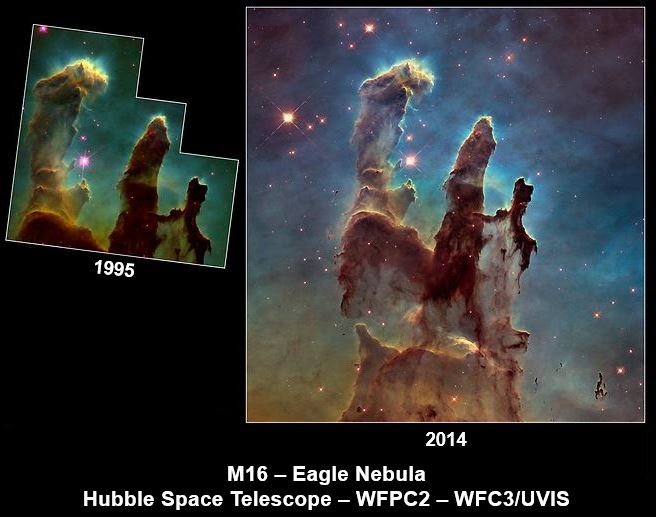
Using NASA’s Hubble Space Telescope, astronomers have assembled a larger and sharper image of the iconic Eagle Nebula’s “Pillars of Creation”. To have an idea of their immense size, the leftmost pillar is approximately 4 light years in length. Photo: NASA/ESA/Hubble Heritage Team (STScI/AURA)/J. Hester, P. Scowen (Arizona State U.).
Scowen and astronomer Jeff Hester led the original Hubble observations of the Eagle Nebula.
As can be seen from the images, the very ends of the pillars are dense knots of gas and dust. They shadow the gas underneath them, keeping the gas cool and creating long, column-like structures.
Scowen said:
“These pillars represent a very dynamic, active process. The gas is not being passively heated up and gently wafting away into space.”
“The gaseous pillars are actually getting ionized, a process by which electrons are stripped off of atoms, and heated up by radiation from the massive stars. And then they are being eroded by the stars’ strong winds and barrage of charged particles, which are literally sandblasting away the tops of these pillars.”
