


Already home to Silicon Valley, could California be about to spawn Robot Valley – a new global tech region dedicated to automation? A champion for the cause – in the shape of a professor in San Diego – certainly hopes so, as he anticipates the future of robots in our lives.
Hired in July to run University of California (UC) San Diego’s new Contextual Robotics Institute, Danish-born Professor Henrik Christensen says in a recent interview with the San Diego Union-Tribune:
“My own prediction is that kids born today will never get to drive a car.”
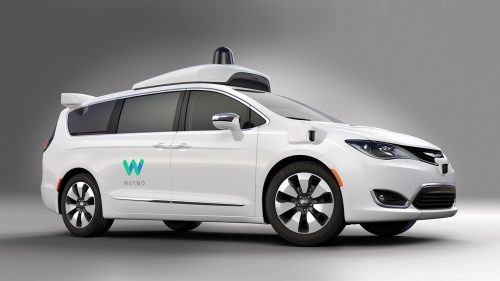 Waymo’s self-driving Chrysler Pacifica Hybrid minivans are due to appear on public roads in the United States in 2017. Image: Waymo
Christensen says he and his colleagues see advancing robotics and automation pushing two trends. One trend will be the return of manufacturing jobs to the United States – primarily from Southeast Asia.
The other trend is the displacement of workers as jobs become automated. Christensen predicts there will be fully automated, driverless transportation in the U.S. by 2020 – displacing human truck drivers and taxi drivers.
His ambition is to build a research institute that will rank among the world’s top five. “Why not see if we can make San Diego ‘Robot Valley’,” he said when he took up his new appointment.
In October 2016, over 200 engineers and social scientists met at the university to discuss some of the challenges that robotics and automation can tackle. The event also featured talks by world leaders on the potential for robotics to benefit society.
Conducting drone swarms and roving robots
Prominent among the themes discussed at the pre-nascent Robot Valley event was the problem of controlling “swarms” of drones – unmanned aerial vehicles (UAVs) – and robots.
At present, we need a group of people to control one complex UAV. The challenge is how to invert the ratio so one human can control a swarm of UAVs or roving autonomous robots.
“Human-robot interactions should resemble the relationship between an orchestra conductor and musicians,” notes Christensen, “Individual players need to be smart enough to take cues from the conductor and play on their own.”
Companion robots
Christensen also predicts – as populations in many developed countries get older – that a wave of companion robots will enter the market as health care and home companions.
For example, half of Japan’s population is over 50 years old. “We need to help the elderly stay in their homes,” he notes, “And robots can help us get there.”
The ideal home care robot should work as a walker and a wheelchair, says Christensen. It should have arms, be able to fetch medication, and perhaps even prepare meals.
For these applications, the challenge for roboticists is how to make the robots easy to control – so anyone can use them – and also appealing.
Researchers are beginning to discover companion robots should not look exactly like humans – people find that creepy. It should be obvious they are robots – for instance, they can look human, but they would have to move like a machine.
Robotics Roadmap – pushing for safe integration
Autonomous vehicles, eldercare, and manufacturing are key themes of the new U.S. Robotics Roadmap released at the end of October 2016.
In the new edition of the Roadmap, Christensen and 150 other researchers from the U.S. call for better policy frameworks to ensure these new technologies integrate safely into everyday life.
“We also want to make sure that research solves real life problems and gets deployed,” says Christensen, “We need to make sure that we are making an impact on people’s lives.”
Another meeting at UC San Diego – this time bringing together top scientists from around the world – is planned for February to discuss the toughest challenges of robotics and automation. A key theme will be how to make driverless cars safe as they become more widespread.
The call cannot come too soon – the future is closer than we might think. Waymo – formerly the Google self-driving car project – are already planning to put some of their new self-driving minivan fleet on public roads in 2017.
The Robot Valley champion predicts, “With autonomous, driverless cars, we can put twice as many vehicles on the road as we have today, and do it without improving the infrastructure.”
Automation is the technique, system or method of controlling or operating a process by highly automatic means, usually with sophisticated devices equipped with artificial intelligence.
Video – proactive firefighting drone demonstration
The following video shows a demonstration of a proactive firefighting drone that featured at UC San Diego’s Contextual Robotics Institute 2016 Forum.

Comments are closed.