
CERN’s Large Hadron Collider (LHC) is preparing for a second three-year run in March 2015 – at double its original collisional energy.
The European Organization for Nuclear Research said that the Large Hadron Collider will operate at nearly double the energy of its first run. The first particle beams are set to shoot inside the collider’s 27-kilometer tunnel in March next year.
The Large Hadron Collider has been on a two year break from smashing particles – and has been upgraded.
The superconducting machine is almost at its nominal operating temperature of 1.9 degrees above absolute zero, says CERN. 1.9 degrees Kelvin is -271.25 degrees Celsius or -456.25 degrees Fahrenheit.
The Large Hadron Collider, located beneath the ground near Geneva, Switzerland, played an important role in the discovery of the Higgs boson – a subatomic particle that had been theorized for a long time but only confirmed last year.
On December 9, 2014, the magnets of one sector of the LHC were powered to the necessary level for beams to reach 6.5 TeV – the operating energy for its second run.
The goal for 2015 will be to to produce 13 TeV collisions. This would be a record energy level never recorded by an accelerator before.
Frederick Bordry, CERN’s director for accelerators and technology, said that “after the huge amount of work done over the last two years almost like a new machine.”
“Restarting this extraordinary accelerator is far from routine. Nevertheless, I’m confident that we will be on schedule to provide collisions to the LHC experiments by May 2015,” he added.
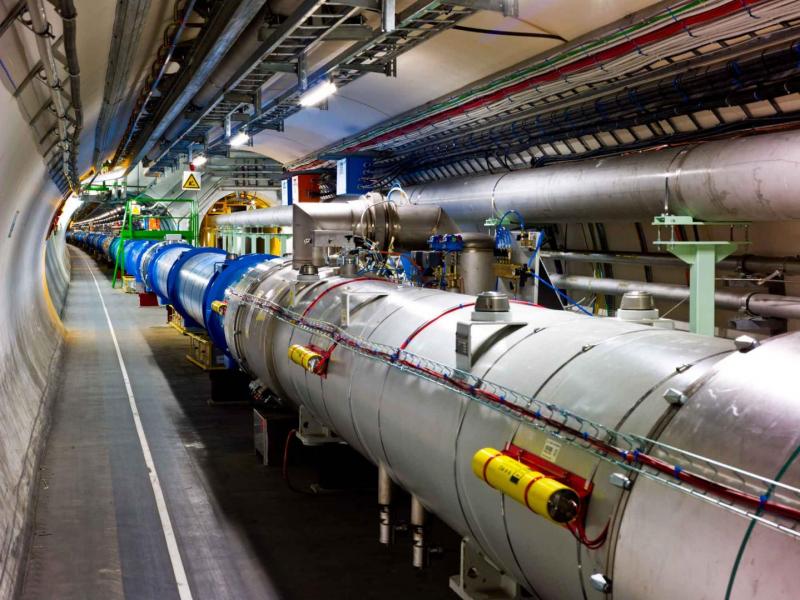
The Large Hadron Collider is preparing for running at higher energy in 2015 (Photo Credit: Maximilen Brice/CERN)
Why won’t the LHC be running at full capacity?
The LHC was designed to run at a maximum collision energy of 14 TeV, which begs the question, why has CERN decided to start the second run at a lower energy?
CERN says that it is starting the second run at 13 TeV, as opposed to 14 TeV, because “retraining to 14 TeV would take longer, taking time away from physics research.”
“That’s why the best way to get to new results quickly, at an energy considerably higher than ever achieved before, is to start operation at 13 TeV. A decision on when to go higher will be taken at a later date in the LHC’s second run.”
Reference:
“CERN’s Large Hadron Collider gears up for run 2” – by Cian O’Luanaigh on 12 Dec 2014. CERN
