
Do you remember the liquid metal, shape-shifting android assassin in the Terminator 2 movie of the 1990s? That science-fiction notion could one day become reality as researchers move closer towards a future of elastic electronics – electronics with components that move autonomously and alter shape as their functions change.
Scientists at RMIT University in Melbourne, Queensland University of Technology, both in Australia, and ETH Zurich in Switzerland, emphasized that shape-shifting, liquid metal elastic electronics has got much closer to becoming a realistic achievement, while the movie’s android assassin – T-1000 Terminator – is likely to still be ‘far on the horizon’.
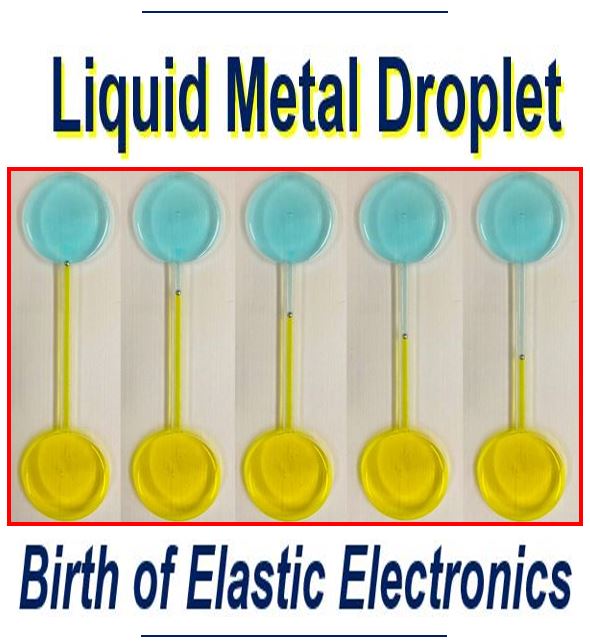 This image depicts the continuous motion of a self-propelling liquid metal droplet under a pH gradient. It is shown at different time intervals. The droplet was placed in a fluidic channel, half-way between two reservoirs filled with different electrolytes of a basic and acidic nature. (Image: eurekalert.org. Credit: RMIT University)
From solid state to liquid metal electronics
Professor Kourosh Kalantar-zadeh and colleagues, from RMIT’s School of Engineering, wrote in the prestigious journal Nature Communications (citation below) that they are setting the foundation for moving beyond solid state electronics, shifting towards flexible and dynamically reconfigurable – shape-shifting – soft circuit systems.
Smartphones, tablets, laptops, desktops, smart TVs and other modern electronic technologies are principally based on circuits that use solid state components, with rigid metallic tracks and semiconducting devices.
Solid-state electronics are circuits or devices consisting entirely of solid materials in which all the electrons or other charge carriers are confined within the solid material.
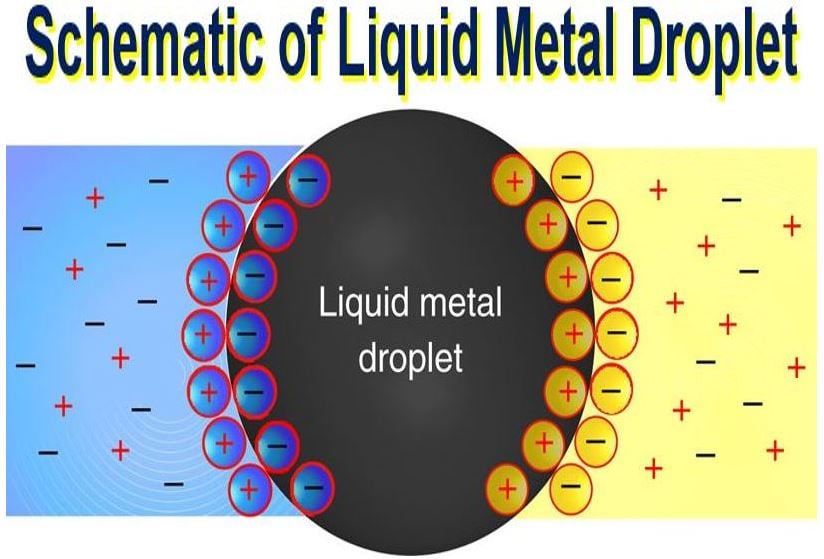 Top view schematic of the liquid metal droplet and arrangement of ions, forming the electrical double layer, known as EDL. (Image: nature.com/ncomms)
Prof. Kalantar-zadeh and his group wanted to be able to create truly bendable and elastic electronic components – soft-circuit systems that can mimic the behaviour of living cells, moving around on their own and communicating with each other to form new circuits instead of being fixed in one, unchangeable configuration.
Alloys of gallium show promise
Liquid metals, specifically non-toxic alloys of gallium, have so far offered the most promising path for viable elastic electronics.
Gallium is a chemical element with symbol Ga and atomic number 31. It is a rare, soft, silvery metallic true metal. At low temperatures it is brittle, however, when above room temperature it is liquid. Gallium occurs in trace amounts in bauxite and zinc ores.
These alloys of gallium are not only extremely malleable, the droplets of liquid metal also contain a highly-conductive metallic core plus an atomically-thin semiconducting oxide skin – both essential features for making electronic circuits.
Metal droplets moved freely in another liquid
To determine how to enable liquid metal to move on its own, the team initially immersed liquid metal droplets in water.
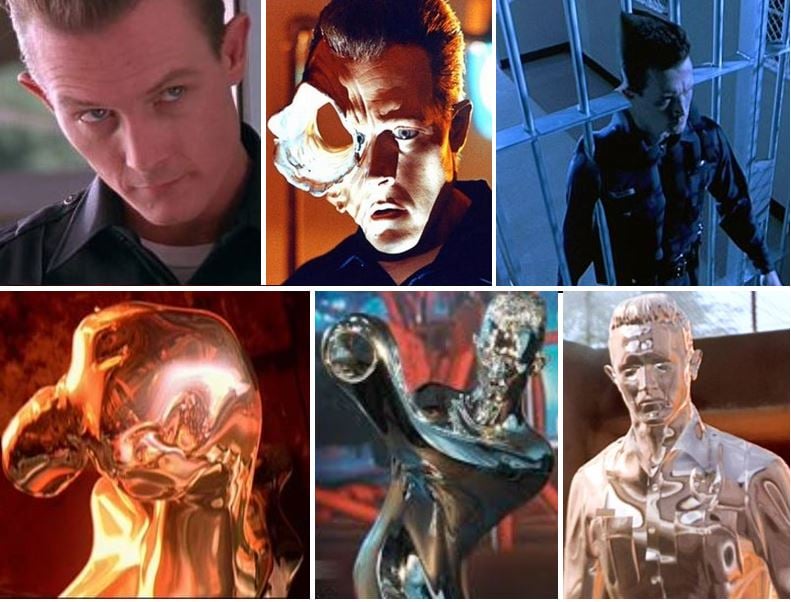 The T-1000 Terminator, a killer android in the movie Terminator 2, could shape shift, take shots from weapons with huge bullets, turn into a pool of liquid, and then gradually turn back into a humanoid form. It could assume the form of virtually anything. Making anything like the T-1000 is still a distant dream, the researchers stressed.
Prof. Kalantar-zadeh explained:
“Putting droplets in another liquid with an ionic content can be used for breaking symmetry across them and allow them to move about freely in three dimensions, but so far we have not understood the fundamentals of how liquid metal interacts with surrounding fluid.”
“We adjusted the concentrations of acid, base and salt components in the water and investigated the effect. Simply tweaking the water’s chemistry made the liquid metal droplets move and change shape, without any need for external mechanical, electronic or optical stimulants.”
This discovery meant that they were able to create moving objects, pumps and switches that could operate on their own. They are self-propelling metals that are driven by the composition of the fluid that surrounds them.
The authors claim that their research lays the foundation for being able to use ‘electronic’ liquid metals to create 3D electronic displays and components on demand, as well as create makeshift and floating electronics.
3D metal android possible one day?
Prof. Kalantar-zadeh added:
“Eventually, using the fundamentals of this discovery, it may be possible to build a 3D liquid metal humanoid on demand – like the T-1000 Terminator but with better programming.”
The researchers believe this technology has potential applications in a wide range of industries, especially biomedicine and smart engineering solutions.
In the article, the authors explain exactly how liquid metals can be moved or stretched, how the liquid on their surfaces moves around, and how they can flow in different directions.
In an Abstract that describes the main paper in the journal, the authors wrote:
“With this finding, it is possible to conceive the propulsion of small entities that are constructed and controlled entirely with fluids, progressing towards more advanced soft systems.”
Citation: “Ionic imbalance induced self-propulsion of liquid metals,” Ali Zavabeti, Torben Daeneke, Adam F. Chrimes, Anthony P. O’Mullane, Jian Zhen Ou, Arnan Mitchell, Khashayar Khoshmanesh amd Kourosh Kalantar-zadeh. Nature Communications. 4th August, 2016. DOI: 10.1038/ncomms12402.
Video – Liquid metals propel future electronics
Science fiction is gradually giving way to reality with the development of revolutionary self-propelling liquid metals – a major step towards elastic electronics.
