

manufacturing

Manufacturing output rose in October, boosted by falling pound

Written by Joseph Nordqvist

Published: 23:52, November 1, 2016

The falling pound boosted manufacturing output in the UK last month, but also sharply increased the prices of imports.

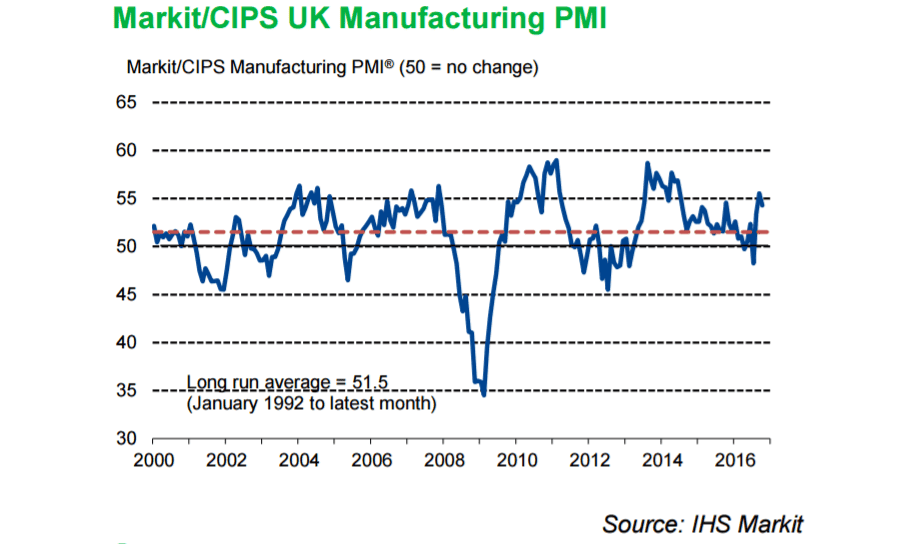
The Markit/CIPS UK Manufacturing purchasing managers’ index (PMI) dropped from a two-year high of 55.5 in September to 54.3 in October – a reading in line market expectations. Anything above 50 signals growth.

New order volumes increased for the third straight month and at a pace close to September’s recent high.
markit_pmi_october
Source: Markit/CIPS UK Manufacturing PMI

Rob Dobson, senior economist at IHS Markit, said: “The UK manufacturing sector remained on a firm footing in October and should return to growth in the fourth quarter.

“The main topic of the latest PMI survey was, however, the impact of the sterling depreciation on manufacturers.

“On the positive side, the boost to competitiveness drove new export order inflows higher, providing a key support to output volumes.”


The depreciation of the pound drove import prices up, increasing purchasing costs.

The survey revealed that 90% of companies that offered a reason for the rise in purchasing costs made some reference to the declining value of the pound sterling.

“The down-side of the weaker currency is becoming increasingly evident, however, with increased import prices leading to one of the steepest rises in purchasing costs in the near 25-year survey history,” Mr Dobson added.

“Around 90% of companies offering a reason for increased costs made some reference to the sterling exchange rate.”

David Noble, Group Chief Executive Officer at the Chartered Institute of Procurement & Supply, said:

“The sector held firm in positive territory as new orders, staffing levels and overall activity rose – though generally at a slower rate than the previous month. Growth continued to be driven by both domestic and particularly export markets buoyed by the weak pound and bringing orders from China, the US and the EU.

Joseph Nordqvist Avatar

Other News

Alibaba updates Qwen3.8 Max as Chinese AI rivals target workplace tools

Sep 3, 2026

Uber and Wayve begin supervised autonomous rides in London

Sep 3, 2026

Dutch central bank raises London share of gold reserves to 32.1%

Sep 3, 2026

Europe’s housing squeeze is becoming a labor market problem

Sep 3, 2026

Vertiv agrees $1.45 billion deal to expand onsite power for AI data centers

Sep 2, 2026

Advanced-economy bond yields are lifting borrowing costs for developing countries

Sep 2, 2026

‘Buy Now, Pay Later’ may lift prices for shoppers who pay upfront, model finds

Sep 1, 2026

Fast delivery can shield nearby sellers from competition

Sep 1, 2026

World Bank says domestic reforms could unlock more trade within Africa

Sep 1, 2026

GoPro agrees Starman merger as action-camera maker looks to AI infrastructure

Sep 1, 2026

UK opens first challenges under £100 million AI procurement scheme

Aug 31, 2026

SLB to buy Kelvion in $4.1 billion deal as it expands into data center cooling

Aug 31, 2026

EU online sellers declared €38.8 billion in VAT through one-stop systems in 2025

Aug 31, 2026

IMF says stablecoins could cut payment costs but weaken monetary control

Aug 30, 2026

Middle East energy shock drives renewables push and fossil-fuel safeguards

Aug 30, 2026

Build-A-Bear cuts outlook as retail sales fall and wholesale growth slows

Aug 30, 2026

HP raises outlook as PC revenue climbs 18% despite lower unit volume

Aug 29, 2026

OECD growth edges up to 0.5% as G7 economies slow

Aug 29, 2026

G20 trade accelerates as imports and services strengthen in second quarter

Aug 29, 2026

Free electricity may help grids use excess wind and solar power

Aug 28, 2026