

Twenty years ago the only creatures that tweeted were birds, not humans posting brief messages, while viral only referred to situations with types of microbes, not a video footage or piece of information that spreads like wildfire.
For me and many other people across the world, 1995 feels like just yesterday. It was the year Amazon was born, ‘the Rachel’ haircut was all the rage, and the Frappuccino came onto the market. However, as far as technological advancements are concerned, it was a very long time ago.
There are several words in the English language whose meanings have changed since the birth of the Web (Internet), and the leading digital resource for everything word-related, Dictionary.com is celebrating its 20th birthday by looking back at how the definitions of 20 words have expanded during its short life.
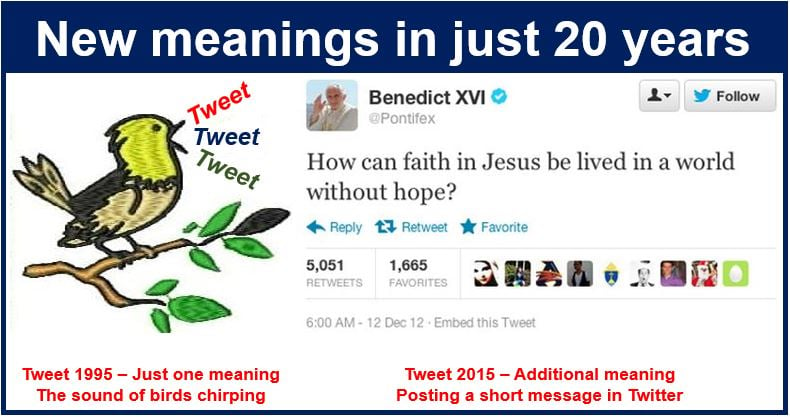 Who would have thought in 1995 that ‘to tweet’ would eventually mean sending a short message online.
Social networking has changed how we communicate with one another, and also how we use some words.
The rise of social media giants like Facebook, Pinterest, Tumblr, Instagram, Twitter and Google Plus+ have changed the meanings of words like profile, friend, tweet and timeline.
Smart devices have launched new meanings for words like glance and swipe.
Liz McMillan, chief executive officer of Dictionary.com, said:
“We are proud to celebrate 20 years of helping people all over the world unlock the power of language and apply it to their daily lives from conversations with friends to a post on Facebook. This list shows just how much the rise of technology has shaped our word use over time, and is a fun way to revisit the evolution of the English language since the dawn of the Internet era.”
Technology-related vocabulary and meanings are often so intertwined with modern life that they achieve widespread usage relatively rapidly.
Over the past twenty years, words like text, meme, footprint and bump have acquired new meanings.
Here is a list of 20 words and their newly-acquired meanings since 1995:
Bump: to move an online thread or post to the top of the reverse chronological list by adding a new post or comment to the thread.
Cloud: any of many parts of the Internet that allow online storage and processing of data and documents as well as electronic access to software and other resources.
Core: the muscles in our torso that provide support for the pelvis and spine.
Fail: to be in a humiliating situation, make an embarrassing or funny mistake, etc., and be subject to ridicule.
Footprint: a unique set of features, actions, etc. that leave a trace and serve as a means of tracking and identifying.
Friend (verb): to add somebody to your list of contacts on a social-networking website.
Glance: information on a screen that is easy to understand, i.e. understood rapidly or at a glance.
Goldilocks: being moderate or just right. Not varying drastically between extremes, such as between cold and hot.
Like: to indicate your agreement with, enjoyment of, or interested in something in a website, especially in social media.
Meme: a cultural item in the form of a phrase, video or image. It is spread via the Web and often altered in a funny or creative way.
Ping: to get in touch with somebody by sending a short electronic message, such as a text message.
Profile: related to a username or online account. A person’s personal data, user statistics, social media timeline, images, etc.
Sandbox: an environment where editors or software developers can try out new content, separate from other content on the project.
Swipe: to slide your fingers across a touchscreen.
Takeaway: impressions, action points, or conclusions resulting from a discussion, roundtable, or the like.
Text: to send a text message.
Timeline: a list of online posts or updates contained in a specific social media account. All listed in reverse chronological order.
Tweet: a very short message posted on your Twitter account.
Unplug: to stop using electronic or digital devices for a length of time.
Viral: becoming extremely popular by circulating rapidly from person-to-person, especially via the Internet.
