
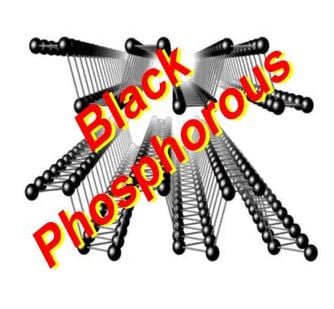
Black phosphorous nanoribbons show promise for future applications in thermoelectric, optoelectronic and electronic devices, says a team of scientists at the US Department of Energy’s Lawrence Berkeley National Laboratory (Berkeley Lab).
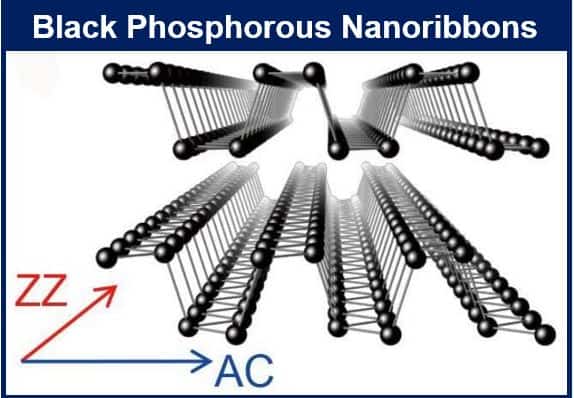
The researchers have experimentally confirmed strong in-plane anisotropy (directionally dependent) in thermal conductivity, up to a factor of two, along the armchair and zigzag directions of single-crystal black phosphorous nanoribbons.
Physicist Junqiao Wu, who works at both Berkeley Lab’s Materials Sciences Division and the University of California (UC) Berkeley’s Department of Materials Science and Engineering, said:
“Imagine the lattice of black phosphorous as a two-dimensional network of balls connected with springs, in which the network is softer along one direction of the plane than another. Our study shows that in a similar manner heat flow in the black phosphorous nanoribbons can be very different along different directions in the plane.”
“This thermal conductivity anisotropy has been predicted recently for 2D black phosphorous crystals by theorists but never before observed.”
Prof. Wu and colleagues described their research in an article published in Nature Communications.
Electrical conductance can be turned on and off
Black phosphorous, so called because of its distinctive color, is the thermodynamically stable form of phosphorus at room temperature and pressure. It is a natural semiconductor with an energy bandgap that allows its electrical conductivity to be switched ‘on and off’.
Scientists have theorized that black phosphorous, in contrast to graphene, has opposite anisotropy in electrical and thermal conductivities, i.e. heat travels more easily along a direction where electricity flow with more difficulty.
This type of anisotropy would be a boost for designing energy-efficient thermoelectric devices and transistors. However, confirming this theory proved difficult because of sample preparation and measurement requirements.

Prof. Wu said:
“We fabricated black phosphorous nanoribbons in a top-down approach using lithography, then utilized suspended micro-pad devices to thermally isolate the nanoribbons from the environment so that tiny temperature gradient and thermal conduction along a single nanoribbon could be accurately determined.”
“We also went the extra mile to engineer the interface between the nanoribbon and the contact electrodes to ensure negligible thermal and electrical contact resistances, which is essential for this type of experiment.”
The study results revealed high directional anisotropy in thermal conductivity at temperatures above 100 Kelvin (°K).
According to the researchers “This anisotropy was attributed mainly to phonon dispersion with some contribution from phonon-phonon scattering rate, both of which are orientation-dependent.”
Detailed analysis showed that at 300 °K, thermal conductivity declined as the nanoribbon thickness shrank from c.300 nanometers to c.50 nanometers. Within this thickness range, the anisotropy ratio remained at a factor of two.
Prof. Wu said:
“The anisotropy we discovered in the thermal conductivity of black phosphorous nanoribbons indicates that when these layered materials are patterned into different shapes for microelectronic and optoelectronic devices, the lattice orientation of the patterns should be considered.”
“This anisotropy can be especially advantageous if heat generation and dissipation play a role in the device operation. For example, these orientation-dependent thermal conductivities give us opportunities to design microelectronic devices with different lattice orientations for cooling and operating microchips. We could use efficient thermal management to reduce chip temperature and enhance chip performance.”
Prof. Wu and team plan to use their experimental platform to see how thermal conductivity in black phosphorous nanoribbons is affected under different situations, such as phase-transitions, domain boundaries, and hetero-interfaces.
They would also like to explore the effects of a range of physical conditions such as pressure and stress.
The study was funded by the DEO Office of Science.
“Anisotropic in-plane thermal conductivity of black phosphorus nanoribbons at temperatures higher than 100 K,” Sangwook Lee, Fan Yang, Joonki Suh, Sijie Yang, Yeonbae Lee, Guo Li, Hwan Sung Choe, Aslihan Suslu, Yabin Chen, Changhyun Ko, Joonsuk Park, Kai Liu, Jingbo Li, Kedar Hippalgaonkar, Jeffrey J. Urban, Sefaattin Tongay & Junqiao Wu. Nature Communications. 16 October, 2015. doi:10.1038/ncomms9573.
