
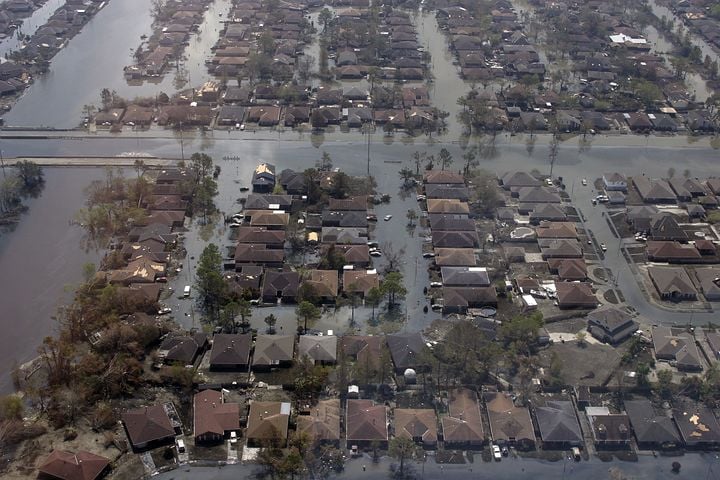
Installing microgrids in New Orleans communities that are less prone to flooding could help keep grocery stores, gas stations, pharmacies, and essential services going during power grid disruption in a major storm or hurricane.
This was one of the conclusions of a research project that modelled previous extreme weather scenarios in which the Louisiana city’s electrical power grid failed and shut down many lifeline services in communities.
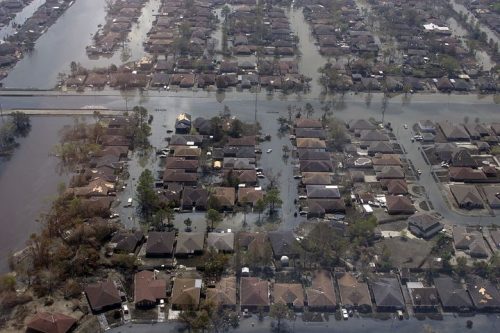 Power outage data from hurricane Katrina (depicted in this photograph) contributed to the project. Credit: pixabay-180538.
The United States Department of Energy project was the work of researchers at Sandia National Laboratories and Los Alamos National Laboratory in collaboration with stakeholders from New Orleans.
Need to make grid more resilient
New Orleans’ present electrical power grid is not sufficiently robust to stop interruption of supply during extreme events, especially if they cause flooding.
Hurricane Katrina in 2005 cut off many citizens from essential services – such as clean water, food, medical treatment, and dry shelter – because of power failure.
The Grid Modernization project report proposes an approach to keeping these services supplied with power during extreme events.
Microgrids and “resilience nodes”
The report suggests placing microgrids at “22 draft resilience node locations” to ensure that the citizens of New Orleans can continue to access essential infrastructure services should the main power grid cut out.
A microgrid is a resilient sub-unit of a large-scale electrical power grid that keeps working when shut off from the main power grid.
It continues to supply electrical power to the local buildings and services that are connected to it, when disconnected from the main grid.
To ensure such robustness and self-sufficiency, microgrids have their own means of generating power and a control system that responds automatically to demand.
Advantages of microgrids
The electrical power in a microgrid can come from conventional generators that burn fuels, or from renewables – such as wind turbines and solar panels. It can also include batteries in which to store surplus energy from renewables.
Depending on where the energy comes from and which control system it uses, a microgrid could supply electricity on its own, without help from the main grid, for a very long time.
Communities are getting more and more interested in microgrids: not only because they are useful in emergencies. They can also cut costs and use power plants that are too small and unreliable for a main grid.
Resilience against localized flooding
The project report calls microgrids “resilience nodes” to reflect the fact that they respond to grid disruptions and ensure local services continue to run.
“I would say,” says Robert Jeffers, a Sandia systems scientist and co-author of the report, “that in a large majority of the cases, the breakdown in providing services during and after severe weather can be traced back to localized flooding and a loss of electrical power.”
“When you figure out how to keep the power on, you also enable all the other services the facilities could provide,” he adds.
Computer simulations
The data for the computer model was based on two extreme weather events: Katrina in 2005 and an earlier, 1947 storm with no name.
The researchers included the earlier storm because it came from the southeast and up the Mississippi River, where many critical services are based.
They ran computer simulations of the two storms and the routes they followed and calculated their impact. By changing the intensity and speed of the storms, and the amounts of rainfall, they created a number of scenarios.
Each scenario had a different pattern and severity of impact on essential infrastructures and lifeline services.
The model also took account of changes that have been made since Katrina. These include improvements made by the City of New Orleans, the Army Corps of Engineers, plus various utilities and private firms.
‘Primary resilience goal’
The model’s main aim is to keep the number of New Orleans citizens who might be left without “lifeline services” as small as possible.
This is line with the city’s “primary community resilience goal.”
This states that, in the event of a major weather event, citizens’ access to crucial infrastructure services is restored “as quickly and reliably as possible.”
The team also developed new algorithms that help to identify where microgrids or some other modernization would have the greatest effect in securing this goal for different storm conditions.
