

In a successful test on Wednesday, NASA fired the most powerful rocket booster ever built for two minutes, producing 3.6 million pounds of thrust. The super-powerful booster will hopefully be used in future missions to help NASA’s Space Launch System (SLS) rocket and Orion spacecraft.
Orion, NASA’s new exploration spacecraft, will one day carry astronauts into deep space, including Mars and an asteroid.
Wednesday’s test was carried out at commercial partner Orbital ATK’s test facility at the Promontory, Utah. It is one of two tests planned to qualify the rocket booster for flight.

The most powerful rocket booster ever made was successfully tested by NASA on Wednesday. (Image: NASA)
As soon as it is qualified, the flight booster hardware will be ready to be shipped to NASA’s Kenedy Space Center in Florida for its first SLS flight.
William Gerstenmaier, NASA’s associate administrator for human exploration and operations, said:
“The work being done around the country today to build SLS is laying a solid foundation for future exploration missions, and these missions will enable us to pioneer far into the solar system.”
“The teams are doing tremendous work to develop what will be a national asset for human exploration and potential science missions.”
Testing propellant temperature range
Rocket scientists say it took months to heat the 1.6 million pound booster to 90°F (32.22°C) to check its performance at the top end of its accepted propellant temperature range.
In early 2016, they will carry out a similar test at the low end of the propellant temperature range (40°F or 4.44°C).
The results of the two tests can then be fed into analytical models, factoring in the full temperature range, helping determine how the booster performs.
Temperatures inside the booster exceed 5,600 degrees during the test.
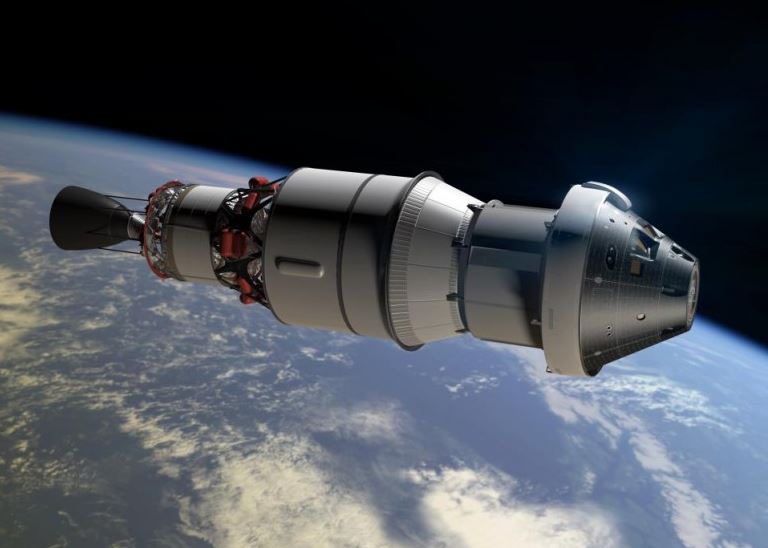
The booster tested yesterday will provide 75% of the thrust need for spacecraft Orion (above) to escape the gravitational pull of the Earth. (Image: Blogs NASA)
SLS program manager Todd May said:
“This test is a significant milestone for SLS and follows years of development. Our partnership with Orbital ATK and more than 500 suppliers across the country is keeping us on the path to building the most powerful rocket in the world.”
During Wednesday’s test, scientists measured more than 531 instrumentation channels on the booster, the aim being to asses 102 design objectives.
The test results also showed that the booster met applicable ballistic performance requirements, such as pressure and thrust. “Other objectives included data gathering on vital motor upgrades, such as the new internal motor insulation and liner and an improved nozzle design,” NASA wrote.
When completed, the SLS will be powered by two five-segment boosters and four RS-25 main engines on its deep space missions.
During the first two minutes after takeoff, the 177-feet-long solid rocket boosters will operate together with the main engines, providing 75% of the thrust required for the rocket to escape the gravitational pull of the Earth.
NASA wrote:
“The first flight test of SLS will be configured for a 70-metric-ton (77-ton) lift capacity and carry an uncrewed Orion spacecraft beyond low-Earth orbit to test the performance of the integrated system. The SLS will later be configured to provide an unprecedented lift capability of 130 metric tons (143 tons) to enable missions farther into our solar system.”
