


Imagine never having to wash your clothes, car or windows ever again, and they remain spotlessly clean forever. This dream may soon become a reality, according to British and Chinese scientists who have created a self-cleaning, waterproof paint.
According to researchers from University College London, Imperial College London, and Dalian University of Technology in China, when the coating is applied to steel, clothes or paper, and mixed with adhesives, it maintains its self-cleaning properties even when scraped and scratched with a knife, rasped with sandpaper, or wiped with a cloth.
Most self-cleaning surfaces work because they are very water-repellent. However, they tend to become less effective when damaged or exposed to oil.
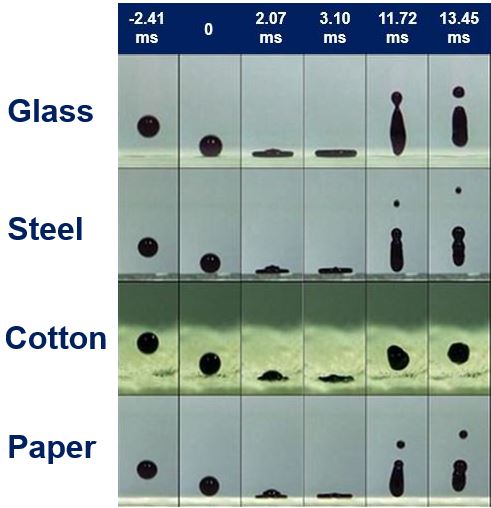
These time-lapsed photos show water droplets bouncing off different types of surfaces that have been treated with the special paint. (Image: Lu Yao, UCL)
This new coating creates a much more resilient surface that withstands everyday **wear and tear. The scientists say it could be used for numerous real-world applications, including cars, clothing, windows, etc.
** Wear and tear refers to the damage that occurs to something when it is used properly and ordinarily.
First author of the study, which has been published in the academic journal Science, Yao Lu, said:
“Being waterproof allows materials to self-clean as water forms marble-shaped droplets that roll over the surface, acting like miniature vacuum cleaners picking up dirt, viruses and bacteria along the way.”
“For this to happen, the surface must be rough and waxy, so we set out to create these conditions on hard and soft surfaces by designing our own paint and combining it with different adhesives to help the surfaces withstand damage.”
The paint, which is made from coated titanium dioxide nanoparticles, keeps a wide-range of materials clean, even if their surfaces are damaged or if they are immersed in oil.
Materials can become self-cleaning and totally waterproof by applying the paint in several different ways. The researchers coated steel and glass using and artist’s spray gun, paper was coated using a syringe, and cotton wool was dip coated.
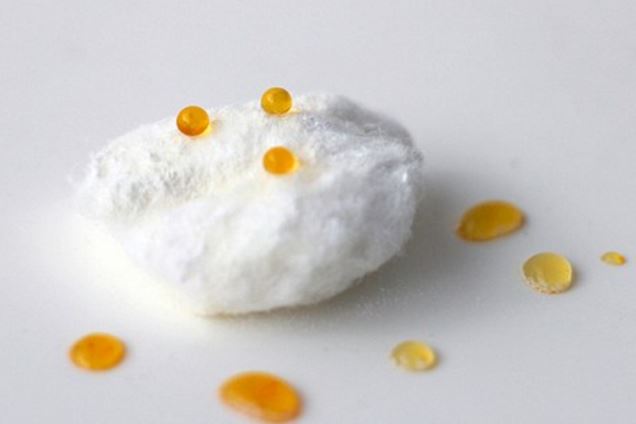
Any drop of water that touches this cotton wool turns into a ball and rolls away, cleaning up all dirt in its path. (Image: UCL)
Materials cleaned themselves and repelled water
After being coated with the paint, all the materials became both waterproof and self-cleaning. Water droplets of different sizes were observed bouncing off instead of wetting the surface, removing the dirt that had been applied by the researchers.
Even after the surfaces were deliberately damaged, their self-cleaning and waterproof properties were not affected.
Mr. Lu explained:
“Our paint worked extremely well for a variety of surfaces in tough conditions which were designed to simulate the wear and tear of materials in the real-world. For example, car paint frequently gets scuffed and scratched and we wanted to make sure our paint would survive that.”
“As well as practical uses, the paint could also be used creatively to make art with water which is something I have been exploring in my own time.”
The scientists filmed what happened with materials treated with the new paint versus controls (materials with no paint). Cotton wool can be seen being dipped into a blue-water solution, and then pulled out pristine white without any trace of the dye. After treated paper was exposed to water and dirt, it remained clean and dry.
Co-author, Prof. Claire Carmalt, from UCL Chemistry, said:
“The biggest challenge for the widespread application of self-cleaning surfaces is finding a way to make them tough enough to withstand everyday damage.”
“The surfaces tend to be mechanically weak and so rub off easily, but by pairing our paint with different adhesives, we’ve shown it is possible to make a robust self-cleaning surface. We used materials that are readily available so our methods can be scaled-up for industrial applications.”
Prof. Ivan Parking, Head of UCL Chemistry, said:
“Our work aims to characterise new materials at a very small scale so we can see how best to use them to improve our daily lives. The new paint fits into a broader portfolio of surfaces we are developing for different purposes, including antimicrobial coatings to combat hospital acquired infections, and we hope its discovery advances the widespread adoption of self-cleaning surfaces.”
Reference: Yao Lu, Sanjayan Sathasivam, Jinlong Song, Colin R. Crick, Claire J. Carmalt, and Ivan P. Parkin. “Robust self-cleaning surfaces that function when exposed to either air or oil.” Science. First published on 6th March, 2015. DOI:10.1126/science.aaa0946.
Video – Self-cleaning new paint
Researchers from UCL talk about the treatment they developed, which can turn many materials including metal, glass and fabric into water repellent and self-cleaning surfaces.
