
OECD and EU countries are facing intensifying challenges that political polarization is making harder to deal with. And, while Nordic countries remain the best equipped of the member states to solve the problems, their ability to do so appears to be wavering.
So conclude the Bertelsmann Foundation, a prominent German think tank in an assessment – based on 136 indicators – of government actions and reforms of all 41 countries of the Organization for Economic Co-operation and Development (OECD) and the European Union (EU).
 Over 100 international experts contribute to the Sustainable Governance Indicators report, which has been issued every year since 2009. It scores OECD and EU member states on 136 quantitative and qualitative indicators to give a comprehensive profile of their relative strengths and weaknesses.
The 2016 edition of Sustainable Governance Indicators finds that many of the problems facing the industrialized nations of the OECD and EU have intensified dramatically over the last 2 years.
And while Nordic countries still score highest on future viability, they appear to be wavering in the face of the social inequality that is rising in the region.
The report authors suggest the European project is experiencing the greatest strain in its history as social hardship resulting from the unresolved debt crisis – particularly in southern eurozone countries – and the biggest refugee migration since World War II harden divisions between countries.
As politics in many countries becomes more polarized, and national populism in Hungary, Poland, and France, as well as the UK, Germany and the U.S. grows, it becomes harder to find political solutions to the increasing number of international problems.
Terrorism, migration flows, climate change, the financial and economic crises are global problems, yet, as right-wing populist movements gain ground, so national isolationism increases, and there are fewer opportunities for countries to come together to solve these common problems.
National versus international interests
The Bertelsmann Foundation suggest the tendency to promote national interests ahead of developing joint international policies is growing. They cite examples, such as:
– the refusal of Hungary and Poland to participate in a fair distribution of refugees in Europe
– the influence of UKIP’s xenophobic campaign on the UK’s Brexit referendum vote to leave the EU
– the rising popularity of the right-wing extremist Front National party in France
– the new Alternative für Deutschland (AfD) party’s use of the refugee crisis to promote a right-wing smear campaign in Germany
Over 100 international experts contribute to the Sustainable Governance Indicators analysis, which has been issued every year since 2009.
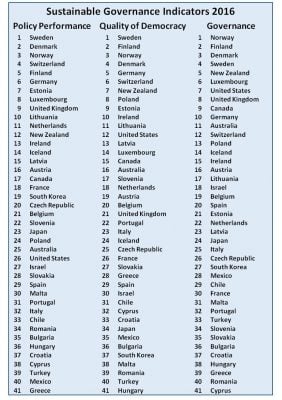 The report shows the relative positions of the 41 countries of the OECD and EU in: Policy Performance, Quality of Democracy, and Governance. Data from Sustainable Governance Indicators 2016.
The analysis scores OECD and EU member states on 136 quantitative and qualitative indicators to give a comprehensive profile of their relative strengths and weaknesses. While the overall instrument is called sustainable governance, it comprises three indices that measure:
– Policy Performance: this assesses a country’s policy performance in terms of economic, social and environmental sustainability
– Democracy: this measures the quality of a country’s rule of law and democratic framework using a grid of detailed criteria
– Governance: this assesses the executive capacity of a country’s government and the extent to which its citizens, parliaments and other groups can and do participate and oversee it
Could Nordic dominance be waning?
Overall, the Nordic countries occupy the top positions – with Sweden first, followed by Switzerland and Germany. Of the world’s largest economies, only two G7 countries – Germany and the UK – are in the top ten. The United States has gone up one position to remain below the middle at number 26, and Greece continues to languish at the bottom.
However, the dominance of the Nordic countries may be wavering, note the report authors. For example, Norway’s economy, because of heavy dependence on oil, is starting to suffer from falling prices. And, like Germany, Sweden’s refugee intake has reached the limits of its capacity.
Also, Sweden still has ongoing labour market problems (youth unemployment, for instance, is 22.9 percent), and there is a general trend of social inequality in the Nordic countries, which for decades have served as models of equality and social participation.
Aart De Geus, Chairman and CEO of the Bertelsmann Foundation, says:
“If the OECD and EU countries wish to improve their future viability, they must focus on strengthened cooperation and coordination as well as policies aiming for long-term solutions rather than national isolationism.”
He says that currently, the political systems in the Nordic countries and New Zealand – which dominate the top of the Sustainable Governance Indicators list – are still well-placed to do this. Other countries could follow their example as models of good governance and accountability.
The OECD is a Paris-based club whose 35 member states claim to be market economies that are committed to democracy.

Comments are closed.