

When managers respond to online reviews they risk triggering a large number of negative reviews, says a new study. When consumers believe their online reviews might have influence, they are more likely to engage in negative reviewing. In other words, if we think our comment may influence a specific company, we are more likely to write negatively about it.
Judith Chevalier and colleagues wrote about their study and findings in the journal Marketing Science (citation below). Chevalier is a William S. Beinecke Professor of Finance and Economics at the the Yale School of Management.
The other co-authors were Yaniv Dover and Dina Mayzlin. Prof. Dover is from the Hebrew University of Jerusalem, and Prof. Mayzline is from the USC Marshall School of Business.
Dynamic-quality online reviews
The researchers focused on online reviews of goods and services. Specifically ‘dynamic-quality‘ goods and services. Hotel and hospitality/travel services are, for example, ‘dynamic-quality’ rather than ‘static-quality’ goods and services.
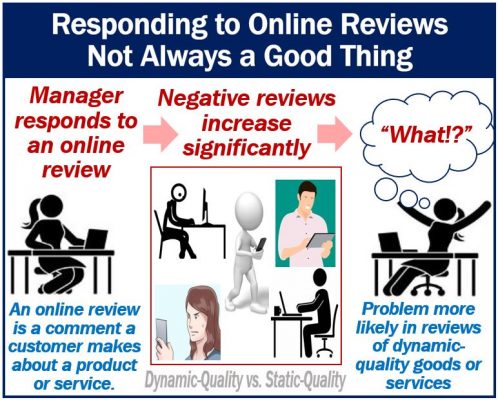
Direct managerial involvement influences the consumer less in static-quality than dynamic-quality goods and services. In other words, over-responsiveness is less likely to be a problem in online reviews of static-quality goods and services.
The researchers wanted to determine how effective managers’ responses to online reviews were.
They also wanted to learn more about what motivates consumers to engage in online reviewing.
Hotel reviews
The research team gathered and analyzed data from online reviews including Hotels.com, Expedia, and TripAdvisor.
They focused on drivers for word-of-mouth that managerial responses (or lack of) to online reviews influence.
The researchers found that when managers respond, they are more likely to trigger reviewing activity.
Prof. Dover explained that online reviews of dynamic-quality goods and services had two audiences. Static-quality reviews, on the other hand, had just one.
Prof. Dover said:
“In the case of static-quality goods and services, such as a review of a product purchase on Amazon, the reviewer’s audience is more than likely other consumers. But when reviewing dynamic-quality goods and services, the reviewer could be motivated by an intent to impact the manager and not just other consumers.”
“The entry of the firm’s manager into the conversation potentially changes the nature of the discourse, which in turn affects the customers’ incentives to post reviews. The response functionality transforms a peer-to-peer review system into a hybrid system that includes both peer review and a customer feedback avenue.”
When managers respond to online reviews
Why do people engage in online reviewing in response to managerial posts? They do so partly because they believe that they can influence the targeted company, the authors wrote.
Prof. Dover said:
“Based on our research, we believe that managerial response activity disproportionately stimulates negative review production since the negative feedback may be seen by reviewers as particularly impactful.”
Goods and services
Goods are things, in other words, products, that we make for consumers to buy (consumer goods). The term may also refer to things we purchase to make other things (capital goods).
‘Services‘ refers to the non-physical part of the economy. We cannot touch or handle services, but we can touch goods. A computer programmer offers clients a service. Apple Inc., on the other hand, sells computers and smartphones – it sells goods.
Citation
“Channels of Impact: User Reviews When Quality Is Dynamic and Managers Respond,” Judith A. Chevalier, Yaniv Dover, and Dina Mayzlin. Marketing Science 2018. https://doi.org/10.1287/mksc.2018.1090.
