

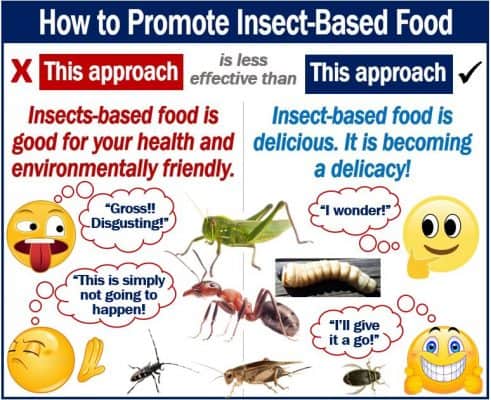
If you want to promote insect-based food, focus on the nice taste rather than the health benefits. Taste also matters more than whether insect-based food is environmentally friendly. It matters more if you want to attract new consumers, says a team of researchers from Switzerland and Germany.
They published their research and findings in the journal Frontiers of Nutrition (citation below). Their work is part of a Special Research Collection on food systems.
This is the first study, the authors claim, to compare promotional methods for insect-based food.
If promotion efforts concentrate on how tasty insects are, people’s attitudes could change. Promoters could even present insect-based food as an exotic delicacy. Subsequently, there would be more sustainable food production and healthier diets.
Greenhouse gas emissions
Twenty-five percent of all human greenhouse gas emissions come from food production. Cattle and other livestock are huge contributors to these emissions.
Policymakers and scientists are trying to develop and promote other ways to produce animal protein. Specifically, more environmentally friendly and sustainable ways. One controversial option is eating insects, and also farming them.
Greenhouse gases are gases that absorb and emit radiation, i.e., they keep the planet’s surface warm. Methane and carbon dioxide, for example, are greenhouse gases. There is a worldwide effort to reduce greenhouse gas emissions.
Insect-based food – many benefits
Sebastian Berger said:
“Insects have numerous health benefits as a source of protein and dramatically outperform conventional meats in terms of greenhouse gas emissions. Therefore, insect-based food might help in the fight against climate change.”
Berger is an Assistant Professor at the University of Bern in Switzerland.
People in Western countries, however, rarely eat insect-based food, despite the benefits.
Many of us are wary of eating insects. Some are also disgusted at the thought.
However, Westerners will happily eat crayfish or lobster, which look like insects. Therefore, it is possible that such attitudes can change.
Before this study, nobody had investigated the best way to market or promote insects. This is the first study to look at the best way to make insect-based food more appealing.
Most of us would assume that highlighting their health and environmental benefits is a good idea. Such labels as ‘fair trade’ and ‘eco-friendly’ appeal to consumers.
Insect-based food – people’s attitudes
Prof. Berger and colleagues set out to determine what factors influence our attitudes towards insects. Specifically, our attitudes towards insects as something to eat.
The researchers asked people in Cologne in Germany to take part in a study. At the beginning of the study, the participants watched an advertisement for a company that offered insect-based food.
Some of the ads focused on the health and environmental benefits. Others, on the other hand, focused on pleasurable aspects, such as the insects’ nice taste.
The researchers were surprised at how effective the ads that focused on pleasure and taste were. They were much more effective than the ads that highlighted the health and environmental benefits.
Participants were more likely to try an insect-based food – a truffle – after watching a ‘pleasure and taste’ advert. After watching such adverts, they were also more likely to rate the truffles more highly.
Insect-based food different from other foods
Why do insects differ from other foods where social issues have helped boost sales?
As far as Westerners are concerned, better health and environmental protection do not help consumers overcome the insect ‘disgust’ factor.
Our aversion to eating insects is not rational; it is emotional. Therefore, it makes sense to focus on consumers’ emotions rather than using rational arguments. Pleasure, for example, is an emotional phenomenon. Better health and protecting our environment are rational topics.
The authors say their findings suggest that marketing campaigns should target consumers’ emotions. Marketers should portray insect-based food as tasty, luxurious, and even trendy. Only then is there a chance that people’s eating habits might change.
The researchers said we need to carry out further studies to determine whether large-scale switching from animal protein to insect-based food is feasible.
Citation
“Advertising Content and the Uptake of Insects as Food,” Sebastian Berger, Christian Bärtsch, Christina Schmidt, Fabian Christandl, and Annika M. Wyss. Frontiers in Nutrition, 02 October 2018 | https://doi.org/10.3389/fnut.2018.00088.
