
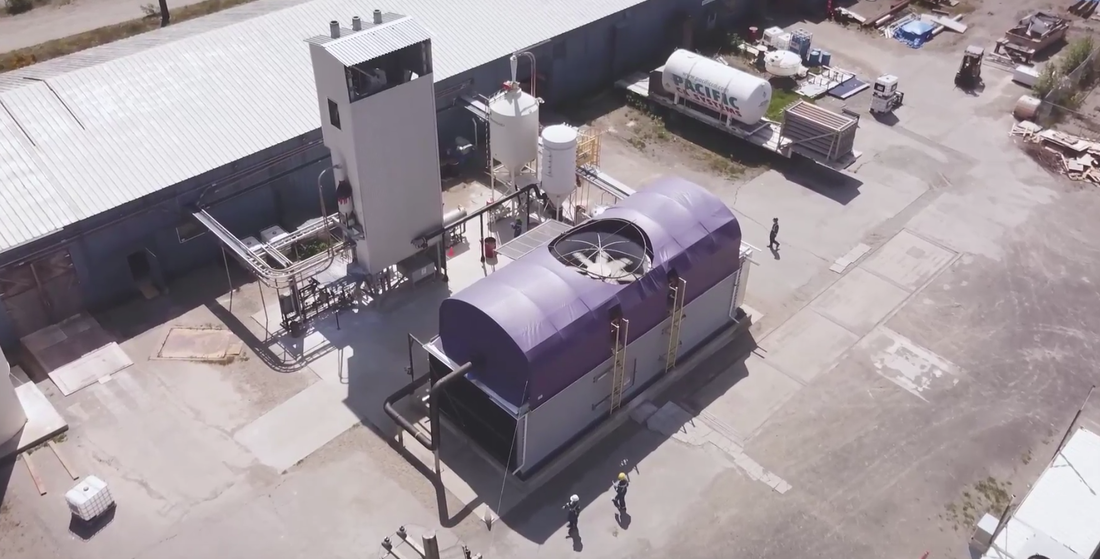
Researchers have designed and fully costed a scalable industrial plant – based on direct air capture technology – for removing carbon dioxide from the air.
The team – from the Canadian-based “clean energy” firm Carbon Engineering (CE) – describes the design along with a cost analysis in a study paper published in the journal Joule.
 CE’s pilot plant has been removing CO2 from the air since 2015. Credit: Carbon Engineering
CE hail the study as a “climate change breakthrough” and claim it is the first to show a “commercial engineering cost breakdown” for a direct air capture (DAC) scalable industrial plant.
The end product is pure CO2 that can then be used to make “carbon-neutral hydrocarbon fuels.”
A carbon-neutral economy is one in which the carbon emissions from combustion of carbon-based fuels – such as through release of carbon dioxide (CO2) into the air – is balanced by removal of the carbon from the air, resulting in no net increase of carbon into the atmosphere.
Commercially viable
The team suggests that it is possible – using DAC technology – to capture CO2 from the atmosphere for under US$100 per ton.
This cost is significantly lower than the US$600 per ton suggested by previous DAC research, says lead study author David Keith, who is a Harvard professor and founder of CE.
He and his team claim that the new costings – based on 3 years of research at their pilot DAC plant in in Squamish, British Columbia – show that DAC is commercially viable.
“At CE,” says Keith, “we’ve been working on direct air capture since 2009, running our pilot plant since 2015, and we now have the data and engineering to prove that DAC can achieve costs below US$100 per ton.”
In their paper, they explain that a DAC plant has two roles. First, by removing carbon from the atmosphere it cuts emissions and reduces climate change, and second, it provides CO2 for making carbon-neutral hydrocarbon fuels.
The DAC process that they describe can be scaled up to a commercially-viable plant that removes one million tons of CO2 per year. This is roughly the amount of CO2 emitted per year by 250,000 cars.
‘Two closed chemical loops’
The process comprises four major reactions that operate continuously to capture CO2 from the air and deliver a “purified, compressed stream of CO2.”
The four reactions work as “two closed chemical loops” as follows:
1 – CO2 from the air is sucked into the plant and is passed through a structure that looks like a cooling tower that houses a “wet scrubbing air contactor” containing a strong potassium hydroxide solution. This reaction produces aqueous potassium carbonate.
2 – A “pellet reactor” mixes the aqueous potassium carbonate with calcium hydroxide. This reaction makes calcium carbonate, which precipitates as pellets, leaving potassium hydroxide in the water. The calcium carbonate pellets are then dried and the potassium hydroxide is returned to the air contactor, closing the first chemical loop.
3 – The calcium carbonate pellets are heated to decomposition temperature in a “circulating fluid bed calciner” to make pure CO2 and calcium oxide.
4 – The calcium oxide is then mixed with water in a “slaker” to produce calcium hydroxide, or slaked lime, that is then returned to the pellet reactor, closing the second chemical loop.
The heat for reaction 3 – the calciner – comes from burning natural gas. The CO2 from this is also cleaned up and dried to produce pure CO2, thus avoiding emissions from using natural gas. The plant design also allows for other, greener energy sources, such as clean electricity or biogas.
CE are now commercializing their DAC technology by combining it with another technology that produces synthetic “clean liquid hydrocarbon” fuel for use either blended with or instead of conventional hydrocarbon fuels.
Clean liquid hydrocarbon fuels are likely to be of interest to transport sectors that are proving difficult to decarbonize by electrification, such as aviation.
