

Sick Days Canadians

Why do Saskatchewan civil servants get sick so often?

Published: 07:34, November 7, 2014

Why do Saskatchewan provincial government civil servants take so many sick days, the Canadian Taxpayers Federation (CTF) is asking after releasing data on Thursday obtained by a Freedom of Information request.

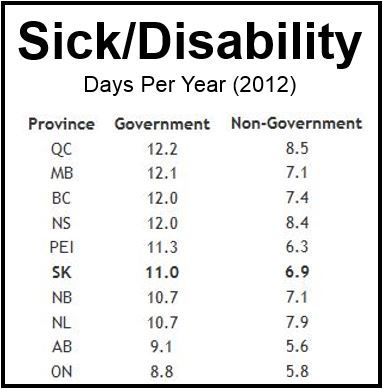
The average Saskatchewan employee working outside government took 6.9 sick days in 2012, compared to 11 days on average taken by municipal, provincial and federal workers in the prairie province.

Commenting on the strange coincidence between spikes in sick days and important local or national events, CTF Prairie Director, Colin Craig, said:

“Definitely looks like a few of these spikes in sick days aren’t a coincidence. The government could save a healthy amount of tax dollars if it tackled high sick day usage by government employees.”

Mr. Craig said nobody should be expected to have to come to work when they were really sick. However, when those “sick days” mysteriously coincide with sporting events, vacations or video game releases, it is evident that some civil servants should be using vacation days instead, he added.
Sick days Canada

In every single province in Canada, civil servants take more sick days than non-government employees. (Source: CTF)

Sick days peaked among civil servants working in Saskatchewan in 2012 on (in order) January 6, January 8 (1st Wednesday after Xmas holidays), November 4 (year’s first winter storm), January 2nd (day after New Year’s Day), September 23 (follows Riders home game), November 27 (follows Grey Cup parade), December 16 (CFL expansion draft), and September 17 (the release of Grand Theft Auto 5 video game).

The CTF also wondered why 44% of all sick days were Mondays.

Employees working at the Department of National Defense took 18.6 sick days in the 2011/12 fiscal year, on top of their paid vacations. Workers at Veterans Affairs took 24.2 sick days.

Veronica Salvador Avatar

Other News

Bank of Japan raises policy rates to 1.25%. What higher borrowing costs mean

Sep 18, 2026

UK retail sales rise 0.5% in August as online stores recover

Sep 18, 2026

Mistras agrees $866 million sale to H.I.G. Capital

Sep 18, 2026

US industrial output stalls in August as manufacturing slips

Sep 18, 2026

Japan’s household financial assets hit a record ¥2,519 trillion. What that measures

Sep 17, 2026

Canada welcomes EU associate-member proposal, but terms are undefined

Sep 17, 2026

Softcat agrees $1.05B GDT acquisition to expand US data-centre services

Sep 17, 2026

Bank Rate held at 3.75% in the UK as energy prices sharpen inflation risk

Sep 17, 2026

East African Community trade reaches $52.3bn as exports drive surplus

Sep 16, 2026

Canada says its investment summit mobilised nearly C$500bn. What does that actually mean?

Sep 16, 2026

May Mobility agrees $1.4B SPAC deal, bets on asset-light robotaxi model

Sep 16, 2026

Fed raises rates to 3.75% to 4.00% as inflation remains elevated

Sep 16, 2026

IBM-backed Anderon finalizes up to $1B US quantum foundry award

Sep 16, 2026

WTO puts the cost of trade fragmentation at up to 10% of global GDP

Sep 15, 2026

Salesforce launches Koa, a CRM reasoning model built on Nvidia’s Nemotron

Sep 15, 2026

Could humanoid AI companions ever replace human partners?

Sep 15, 2026

IEA forecasts record global coal demand after gas prices climb

Sep 15, 2026

UK government to pursue public acquisition of Speciality Steel UK

Sep 15, 2026

IMF says global current-account gaps widened in 2025, led by China and the United States

Sep 14, 2026

Alan Lovell takes over as British Steel chair as government pursues turnaround

Sep 14, 2026