
For the first time, scientists have observed an increase in the greenhouse effect from carbon dioxide at the Earth’s surface. The study, led by researchers from the Lawrence Berkeley National Laboratory (Berkeley Lab), measured the increasing capacity of atmospheric CO2 to absorb heat emitted from the Earth’s surface over an 11-year period at two locations in North America.
They believe the higher levels of CO2 are due to fossil fuel emissions.
The impact of carbon dioxide on the planet’s energy balance, i.e. the balance between energy coming in from the Sun and heat leaving the Earth, is well established. However, this effect has only been confirmed experimentally within the lab, until now.
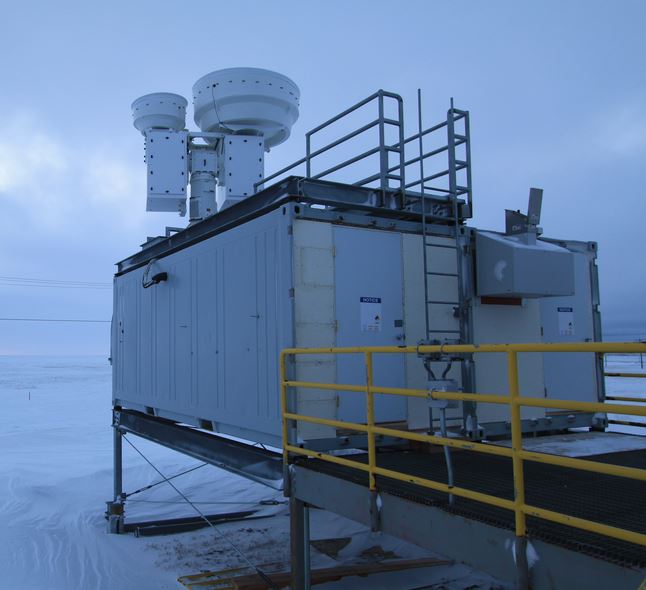
The research site on the North Slope of Alaska near the town of Barrow. (Credit: Jonathan Gero)
This latest observation has been published in the academic journal Nature (citation below).
The findings agree with theoretical forecasts of the greenhouse effect due to human activity. The research also backs up the calculations used in current climate models showing the impact of CO2.
Radiative forcing measured at two locations
Lead author, Daniel Feldman, a scientist in Berkeley Lab’s Earth Sciences Division, and colleagues measured atmospheric carbon dioxide’s contribution to radiative forcing at two locations: 1. The North Slope of Alaska, and 2. In Oklahoma. They monitored the two sites from 2000 to the end of 2010.
Radiative forcing measures how much atmospheric changes have affected the planet’s energy balance. Positive radiative forcing, for example, occurs when the Earth absorbs more incoming heat from the sun than it emits back into space.
In both locations, the researchers found that carbon dioxide was responsible for a significant increase in radiative forcing, approximately 0.2 of a Watt per square meter per decade.
They linked this increase to the 22 parts-per-million rise in atmospheric carbon dioxide over the 11-year period. According to a modeling system that monitors CO2 sourced across the world, much of this carbon dioxide is from burning fossil fuels.

Daniel Feldman is a Geological Project Scientist at the Climate Sciences Department, Berkeley Lab. (Image: Berkeley Lab)
“We see, for the first time in the field, the amplification of the greenhouse effect because there’s more CO2 in the atmosphere to absorb what the Earth emits in response to incoming solar radiation.”
“Numerous studies show rising atmospheric CO2 concentrations, but our study provides the critical link between those concentrations and the addition of energy to the system, or the greenhouse effect.”
He conducted the research with Berkeley Lab colleagues Margaret Torn and Bill Collins, as well as Eli Mlawer of Atmospheric and Environmental Research, Timothy Shippert of Pacific Northwest National Laboratory, and Jonathan Gero of the University of Wisconsin-Madison.
They used super-accurate spectroscopic instruments operated by the Atmospheric Radiation Measurement (ARM) Climate Research Facility.
These instruments, located at ARM research sites in Alaska and Oklahoma, measure thermal infrared energy as it comes through the Earth’s atmosphere to the surface. They are able to detect the unique spectral signature of infrared energy from carbon dioxide.
Other state-of-the-art instruments at the two sites can detect the unique signatures of phenomena that can also emit infrared energy, such as water vapor and clouds. With all these measurements combined, the researchers were able to isolate signals attributed solely to carbon dioxide.
Dr. Feldman said:
“We measured radiation in the form of infrared energy. Then we controlled for other factors that would impact our measurements, such as a weather system moving through the area.”
The result is two time-series from two completely different sites. Each series spans an 11-year period (2000-2010), and includes 8,300 measurements from Oklahoma and 3,300 from Alaska.
The authors wrote:
“Both series showed the same trend: atmospheric CO2 emitted an increasing amount of infrared energy, to the tune of 0.2 Watts per square meter per decade. This increase is about ten percent of the trend from all sources of infrared energy such as clouds and water vapor.”
They linked the carbon dioxide-attributed radiative forcing upswing to fossil fuel emissions and fires.
They were also able, for the first time, to gauge the influence of photosynthesis on the balance of energy at the Earth’s surface. They reported that carbon dioxide-attributed radiative forcing declined in the spring as photosynthetic activity pulled more of the greenhouse gas from the atmosphere.
Citation: “Observational determination of surface radiative forcing by CO2 from 2000 to 2010“ D. R. Feldman, W. D. Collins, P. J. Gero, M. S. Torn, E. J. Mlawer & T. R. Shippert. Nature. February 25, 2015. DOI: 10.1038/nature14240.
