
Scientists have detected some unusual signals from deep space that could be a sign of the existence of dark matter.
Dark matter is one of the most difficult substances in the universe to prove its existence. Seventy years ago the theory of dark matter was first theorized and it is thought to make up more of our Universe than ordinary matter.
Despite years of scientific research it has been extremely difficult to detect its actual existence. However, researchers at Leiden University in The Netherlands and the EFPL Laboratory of Particle Physics and Cosmology in Switzerland have picked up a very distinct transmission pattern.
The finding will help scientists better understand dark matter and the role it plays in our universe.
A spectrum of light was found emerging from both the Andromeda Galaxy and a galaxy cluster present in the Perseus constellation were found to emit anomalous spikes from areas where nothing is believed to exist.
“[T]he signal’s distribution within the galaxy corresponds exactly to what we were expecting with dark matter, that is, concentrated and intense in the center of objects and weaker and diffuse on the edges,” Oleg Ruchayskiy of EPFL said.
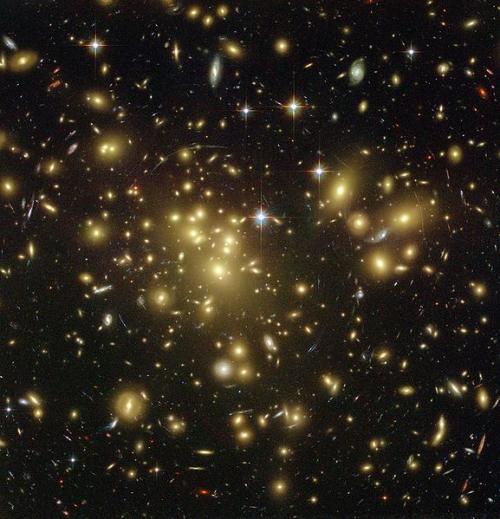
A massive cluster of yellowish galaxies, seemingly caught in a red and blue spider web of eerily distorted background galaxies. Photo Credit: NASA, N. Benitez (JHU), T. Broadhurst (Racah Institute of Physics/The Hebrew University), H. Ford (JHU), M. Clampin (STScI),G. Hartig (STScI), G. Illingworth (UCO/Lick Observatory), the ACS Science Team and ESA
Dark matter is undetectable and invisible. These regions of space are have the largest concentrations of where dark matter is thought to exist. The study team believes that their findings may be evidence of the decay of dark matter.
According to Dr. Oleg Ruchayskiy, this discovery could revolutionize astronomy and be a brand new era for science, helping unveil the secrets of space.
“Confirmation of this discovery may lead to construction of new telescopes specially designed for studying the signals from dark matter particles. We will know where to look in order to trace dark structures in space and will be able to reconstruct how the Universe has formed,” Alexey Boyarsky of Leiden University stated in a press release.
The study is going to be published in an upcoming issue of the journal Physical Review Letters.
