
Self-scan and pay technology is linked to a high rate of loss for retailers. Allowing shoppers to purchase goods without having to interact with a shop assistant at the checkout increases the likelihood of theft.
This was the conclusion criminologists at the University of Leicester came to after studying millions of shopping trips from major retailers in the UK, the US, and mainland Europe.
One of the report authors, Professor Adrian Beck, says one of the reasons retailers like self-scan and pay technology is because they see it as a way to reduce the rather large cost of staffing checkouts.
However, he says their research found the technology is leading to some “potentially rather worrying long term consequences.”
 Criminologists find that introduction of self-scan and pay technology, which removes the need for human contact in the shopping process, is linked to a high rate of loss for retailers.
Images: Scandit, Tesco, Toshiba.
The researchers suggest some choices that businesses make can trigger behaviour and lead to results they did not foresee and thus prove to be rather more costly than they imagined.
For example, they found that by making it easy to avoid paying for items, self-scan and pay technology is turning people who would not normally steal from shops into thieves.
By removing human interaction from the shopping process, self-scan and pay reduces customers’ perception of the legal consequences, say the researchers.
Self-scan and pay schemes also give offenders ready excuses such as blaming the scanners or the barcodes, or the opportunity to claim they don’t know how to use the new technology properly.
Self-scan and pay linked to 122 percent higher losses
The researchers say it is difficult for retailers to spot whether customers are simply being absent-minded, are poor at scanning consistently, or deliberately do not scan items to avoid paying for them.
The result, they say is that self-scanning technology generates over 122 percent higher losses than the average.
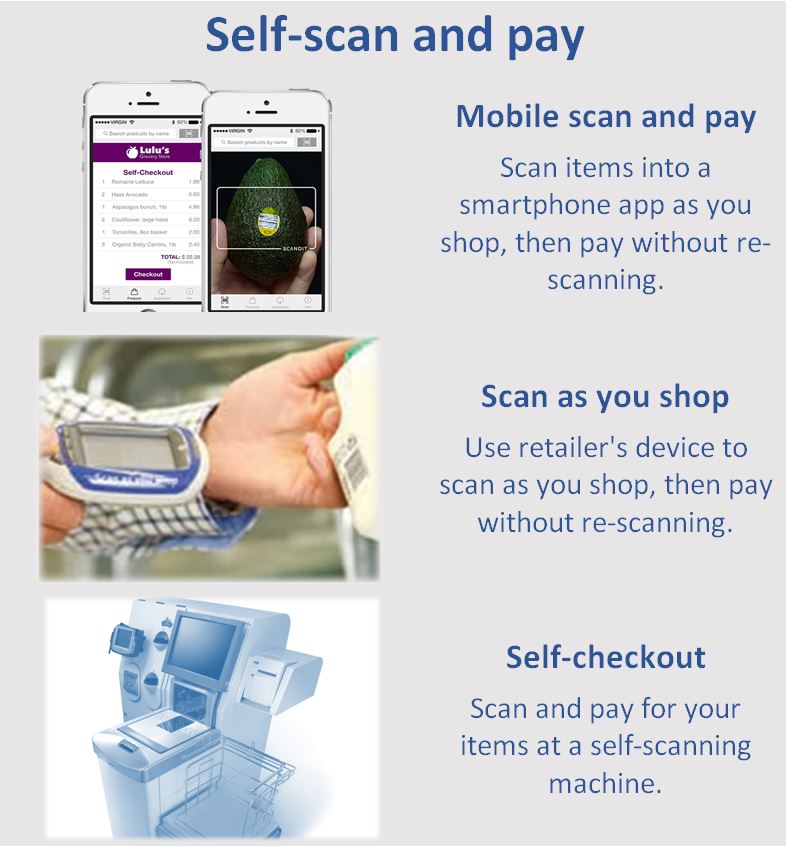
There are three main types of self-scan and pay schemes: self-checkout – where you scan and pay at a machine at the end of your shop; scan as you shop – where you use a device to scan items as you shop; and mobile scan and pay – where you scan items into your smartphone as you shop.
Waitrose, who first introduced their “Quick Check” scan as you shop scheme in the UK 10 years ago, have recently introduced a smartphone app version.
Rob Collins, retail director at Waitrose, said earlier this year that they are finding increasingly that customers think it’s a weakness not to provide self-scan and pay facilities. Adding the mobile pay and scan option simply gives customers more choice.
However, the German discount chain Aldi is taking a different approach. They are
focusing on making checkout queues faster rather than installing self-service checkouts.
