
Small island countries could greatly reduce their vulnerability to natural disasters and climate change by making transport more resilient.
This was the key message from the World Bank in a recent report on how a resilient transport sector can reduce disaster losses in small island countries, or what they term “Small Island Developing States (SIDS).”
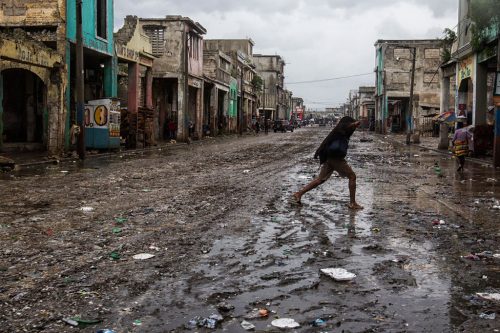 A woman crosses a street in Port-au-Prince, Haiti, after Hurricane Matthew on 4 October 2016.
Credit: UN/Logan Abassi
SIDS in Africa, the Caribbean, Indian, and Pacific Ocean are likely to face greater exposure to storm surges, hurricanes, flooding, and extreme winds as a result of climate change, say the World Bank.
Transport represents large share of public assets
The new report reveals that damage to the transport infrastructure of these small island countries, particularly to roads and bridges, can result in huge strains on their economies.
“The effects of hurricanes Irma and Maria on the Caribbean are a stark reminder of how natural disasters can set vulnerable small countries back by decades,” says Franz Drees-Gross, World Bank’s director for Transport and Digital Development.
Compared to larger nations, transport represents a bigger share of public assets in small island countries.
Consequently, disasters have a larger cost of recovery because of the critical role that transport plays in all areas of their economies.
For example, in the Caribbean island nation of Dominica, transport assets are valued at 82 percent of gross domestic product (GDP).
In Fiji – a country comprising over 300 islands in the South Pacific – around a third of government spending is on transport.
Need for ‘climate-smart solutions’
“Transport is critical to the economy and for the provision of services to remote communities,” explains Aiyaz Sayed-Khaiyum, Fiji Minister for Economy.
He says that they can already see the impact of climate change on the transport infrastructure of the islands, and that there is “an urgent need to develop tailored and climate-smart solutions to improve the resilience of this sector.”
The report shows how investing in transport in ways that take account of climate change can reduce disaster damage and costs in small island countries and make them less vulnerable.
It gives examples of how this can be done, such as: locating transport systems away from high risk areas; protecting infrastructure against physical hazards; using innovative construction design and materials; and installing early warning systems.
“As climate change increases the frequency and intensity of extreme weather,” says Drees-Gross, “small island developing states face the urgent need to adapt.”
Longer-term economic losses
Small island countries are vulnerable not only because of the physical damage that earthquakes, hurricanes, storms, and other disasters bring.
There are also longer-term economic losses and effects on population well-being due to loss of revenues from agriculture, tourism, and fishing, and from being cut off from essential services, schools, and hospitals.
The report gives an example of how improving transport resilience could significantly reduce such losses in the kingdom of Tonga, a nation of more than 170 Polynesian islands in the South Pacific.
Adopting a transport resilience package could reduce well-being losses in Tonga by as much as 25 percent.
The report gives case study examples of current good practice in small island countries in the different phases of the “transport infrastructure lifecycle.”
It also calls for greater efforts to help islands gain better access to financial tools and resources, such as the Global Facility for Disaster Reduction and Recovery (GFDRR) that is managed by the World Bank.
