
When it comes to smartphone lifespans, brand name matters much more than hardware, says a team of researchers.
Many people have criticized smartphone makers for producing phones than soon become obsolete. Their ‘planned obsolescence’ is costly not only for consumers but also the environment, critics say.
However, while many of us clamor for greater ‘repairability’ – and subsequently longer lifespans – for smartphones, a more important factor determines how long these devices stay in use. According to a new Yale-led study, the more important factor is brand cache.
Smartphone lifespan – brand vs. repairability or memory size
Researchers carried out an analysis of about 500,000 listings of secondhand Samsung and Apple phones.
The researchers found that brand, an intangible property, mattered more than memory size in extending the life of a smartphone. Brand was also more important than repairability.
The researchers wrote about their study and findings in the Journal of Industrial Ecology (citation below). The authors were Tamar Makov, Tomer Fishman, and Marian R. Chertow from Yale University; and Vered Blass from Tel Aviv University.
Smartphone lifespans – Apple beats Samsung
The researchers concluded that, on average, iPhones had an extra year of use compared to Samsung’s smartphones. This was despite the two brands being comparable in technological innovation and quality.
Tamar Makov, a doctoral student at the Yale School of Forestry & Environmental Studies (F&ES), said:
“I know that people bash the phone companies for ‘planned obsolescence’ of their products, but in most cases, phones are replaced when they are still working fine, so improving repairability won’t necessarily help much.”
“Perhaps we should be focused on what really makes us replace phones so quickly, or we should be angry at manufacturers for making really good commercials. But it’s likely that the problem is not the hardware.”
The findings illustrate the potential of using such intangible properties to encourage sustainable consumption, said Makov. Specifically consumption of smartphones, but also other consumer goods.
Consumer goods are products that we buy for our own use. We neither sell consumer goods nor use them to make things that we then sell.
Smartphones have penetration rates of nearly 90% in the advanced economies. They present a critical challenge regarding environmental sustainability.
Smartphone lifespans – environmental costs
A smartphone may have up to fifty different elements inside it. Some minerals, for example, that smartphone manufacturers use to make their products, are linked to civil unrest.
These devices also contain rare Earth metals which are becoming scarcer, as well as toxic metals. Toxic metals don’t just threaten public health but also the natural world.
The relatively short smartphone lifespans further exacerbate these environmental costs. Recent estimates suggest that the average smartphone has a use phase of under two years.
Resale performance of Apple and Samsung phones
Over the past few years, the secondhand market for smartphones has been growing. They have extended average smartphone lifespans. However, how much they extend lifespans depends on the brand.
The researchers examined the resale performance of Apple and Samsung smartphones. The two companies command approximately seventy percent of the smartphone market.
Apple and Samsung produce phones that are hard to repair. They also produce phones that are easy to repair.
Even though the two companies produce phones of similar quality, Apple ranks higher regarding brand equity. Apple is at the top of the most valuable brands in the world. Samsung, on the other hand, is hardly ever among the top ten.
Smartphone lifespans – 54.5 vs. 67 months
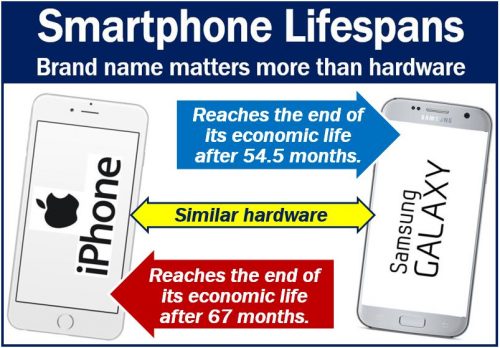
The researchers found that Samsung smartphones reached the end of their economic life, on average, after 54.5 months. Apple’s phones, on the other hand, reached the end of their economic life after about sixty-seven months. In other words, there was a difference of just over one year.
Apple’s smartphones had longer lifespans than Samsung’s even if they were the same age, size, and had the same functional capability.
Makov said:
“It’s not that technical specifications don’t matter. But no matter what combination of specs were included in our analysis, brand name had a substantial impact.”
“Some phones last longer, and it’s not just because they’re repairable or more functionally durable,” she added. “It’s also the psychological aspects that make them more durable. That’s important to remember.”
Citation
“What Affects the Secondhand Value of Smartphones: Evidence from eBay,” Tamar Makov, Tomer Fishman, Marian R. Chertow, and Vered Blass. Journal of Industrial Ecology (2018). DOI: https://doi.org/10.1111/jiec.12806.
