
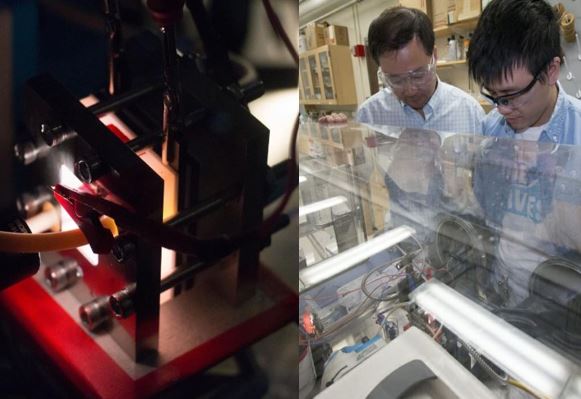
The solar flow battery is a device that harnesses the abilities of both a battery and a solar cell. The device that integrates solar cell and battery could store electrical energy outside the grid, scientists say. It soaks up sunlight and stores it efficiently as chemical energy. The chemical energy is subsequently available for later on-demand use.
Song Jin and colleagues wrote about their study and achievements in the journal Chem (citation below). Jin is a professor of chemistry at the University of Wisconsin-Madison in the USA. Prof. Jin built the device with the collaboration of Jr-Hau He. He is a professor of electrical engineering at King Abdullah University of Science and Technology (KAUST) in Saudi Arabia.
Solar flow battery solves one major problem
Solar energy or solar power involves capturing the Sun’s energy and converting that energy into electricity.
Over the past two decades, solar power has gained appeal as an abundant and clean energy source. However, it has one obvious limitation. It is not always sunny. It is never sunny at night, and some days are sunnier than others.
For solar energy to be practical, we must be able to store the energy that we generated when it was sunny. Normally, we would need two devices to do this – a battery and a solar cell.
The solar flow battery, however, which is just one device, does both things.
Prof. Jin said:
“Compared with separated solar energy conversion and electrochemical energy storage devices, combining the functions of separated devices into a single, integrated device could be a more efficient, scalable, compact, and cost-effective approach to utilizing solar energy.”
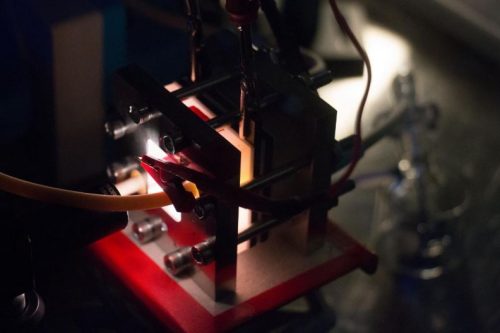
Solar flow battery – three modes
The solar flow battery has three different modes.
It is a solar cell
If you need energy immediately, like a solar cell, it immediately converts sunlight into electrical energy.
It stores energy
Otherwise, the solar flow battery can soak up solar energy when it is sunny and store it as chemical energy. It subsequently delivers that energy as electricity at night or when it is cloudy.
It is also a battery
If needed, it is also possible to charge the device with electrical energy. In other words, you can charge it like a typical battery.
The researchers say that their most recent solar flow battery model is more efficient than any other integrated device currently in existence.
The solar flow battery could help transcend the limitations of the grid by making electricity more readily available. Specifically, for people who live in rural areas. It could also provide an alternative energy source when traditional systems fail, Prof. Jin believes.
Prof. Jin said:
“These integrated solar flow batteries will be especially suitable as distributed and stand-alone solar energy conversion and storage systems in remote locations and enable practical off-grid electrification.”
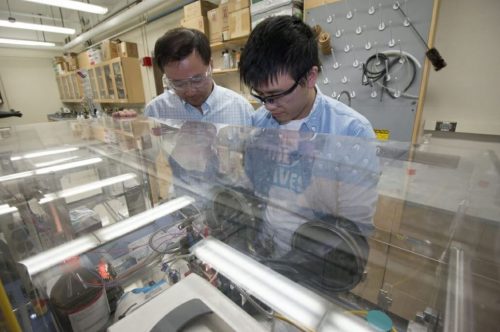
Manufacturing a solar flow battery
The current solar flow battery is still too expensive to manufacture for real-world markets. However, the researchers believe that simpler designs, technological improvements, and cheaper solar cell materials could help cut future costs.
Even though the latest model is relatively efficient, Prof. Jin and colleagues plan to make it even more efficient.
Some of the current solar flow battery’s voltage is still going to waste. The researchers say they may need to tweak the photoelectrode materials and redox species that work together to convert solar energy input into electrical energy output.
Prof. Jin believes that the solar flow battery has a future.
Prof. Jin said:
“We believe we could eventually get to 25% efficiency using emerging solar materials and new electrochemistry.”
“At this efficiency range, without using the expensive solar cells, it should be quite competitive with other renewable energy technologies. Then I think commercialization could be possible.”
Citation
“14.1% Efficient Monolithically Integrated Solar Flow Battery,” Wenjie Li, Hui-Chun Fu, Yuzhou Zhao, Jr-Hau He, and Song Jin. Chem – 7 September 2018. DOI: https://doi.org/10.1016/j.chempr.2018.08.023.
