

After failing to gain a decent market share, Sony abandons electronic readers, saying it has no plans to develop a successor model. PRS-T3, the last version made by Sony, will be available until stocks run out, according to German website Lesen.net (meaning “here” in German).
A few months ago Sony stopped selling electronic books, and directed visitors in the United States first, and then Europe and Australia to rival Kobo.
At the time, Sony said to its readers:
“Although we’re sorry to say goodbye to the Reader Store, we’re also glad to share with you the new, exciting future for our reads: Reader Store will transfer customers to Kobo – an admired eBook seller with a passionate reading community.”
Customers in Japan can continue purchasing books from its online Reader Store.
Not economically viable for Sony
Lesen.net quotes Sony as saying that its e-readers are not economically viable anymore.
Amazon’s Kindles plus the growing range of handheld mobile devices coming onto the market have virtually killed off Sony’s e-reader business.
According to the BBC, Amazon.com has about 90% of the UK’s e-reader market.
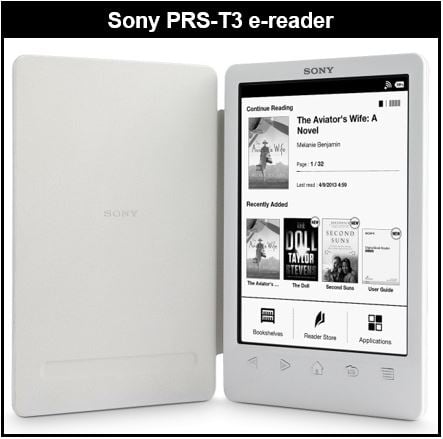
The Sony PRS-T3. When stocks run out will it become a collector’s item?
The pioneer throws in the towel
Sony pioneered the e-reader market with its E-ink technology. In 2004, it launched the Sony Librie; three years ahead of Amazon’s first Kindle. The Librie weighed 190g and could display over ten thousand pages on 4 AAA batteries; in its 10MB memory customers could store about 500 books.
Although Sony was the first, unfortunately as far as consumer are concerned, it failed to become the best. Analysts say its greatest mistake was not providing adequate support for its devices.
Amazon, with its Kindle, uses the company’s platform and publisher contacts to provide consumers with a virtually endless range of e-books, and in most cases at much lower prices compared to what Sony had to offer.
Compared to other companies that tried and failed in the e-book market – Entourage, Cool-ER, Pandigital, Foxit and Samsung – Sony lasted much longer.
Sony, which started off in Nihonbashi, Tokyo, in 1946, has been haunted by several problems recently. The company issued its third profit warning in six months last May.
