
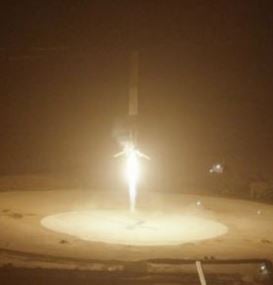
SpaceX makes history by blasting off a Falcon 9 rocket into space and landing its first stage in the same pad in an upright position – ready for future missions. The cost of launching rockets for space missions has just been slashed, giving SpaceX an almighty lead over its competitors regarding the price of placing satellites in orbit.
This is the company’s first mission since a cargo ship was destroyed in an accident in June this year. On Monday, a Falcon rocket was sent into orbit by SpaceX, with eleven satellites on board.
No rocket before has gone into space orbit and landed back intact, ready for future missions. The savings in time and money, by being able to use the same part of the rocket again and again, are considerable, says Elon Musk, CEO and CTO of California-based SpaceX.
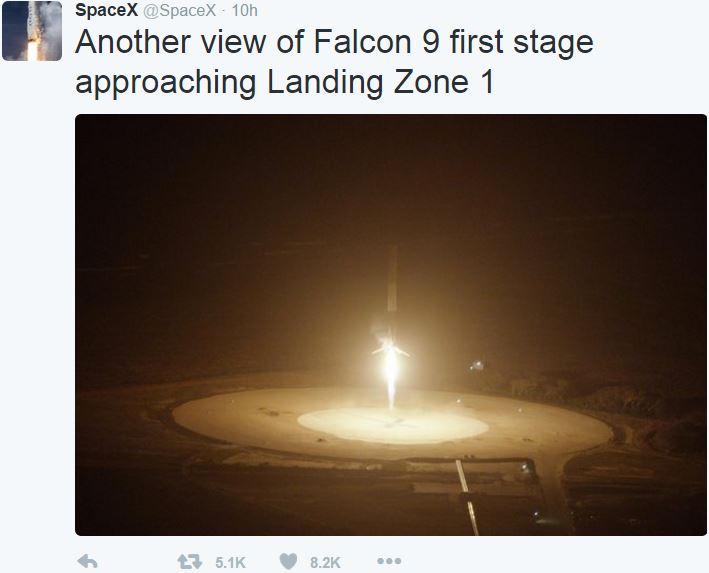 SpaceX makes history as its Falcon 9 rocket’s First Stage lands safely at Cape Canaveral. (Image: twitter.com/SpaceX)
SpaceX’s achievement easily beats Blue Origin’s
In November, Blue Origin, an American privately-funded aerospace developer and manufacturer, set up by Amazon.com founder Jeff Bezos, managed to send a rocket to the edge of space and land it back on the pad from which it blasted off.
That was an impressive accomplishment by Blue Origin, but SpaceX’s achievement this week has been done with a rocket destined for orbit – a considerably harder challenge. There is no comparison.
A SpaceX Falcon 9 rocket lifted off from Cape Canaveral in Florida, USA, at 01:29 GMT on 22nd December. Its first and second stages separated, with the second stage continuing into space carrying 11 satellites.
The first stage then flipped over, switched its engines back on to slow its descent, and headed back to where it had lifted off.
First stage landed upright and intact
Within ten minutes of the launch, the first stage could be seen in the Floridian night sky with its engines glowing brightly. It descended slowly and landed upright on a pad just a few miles from where it hard started.
A SpaceX employee could be heard exclaiming “Holy Shit! We did it!” as gleeful staffers hugged each other.
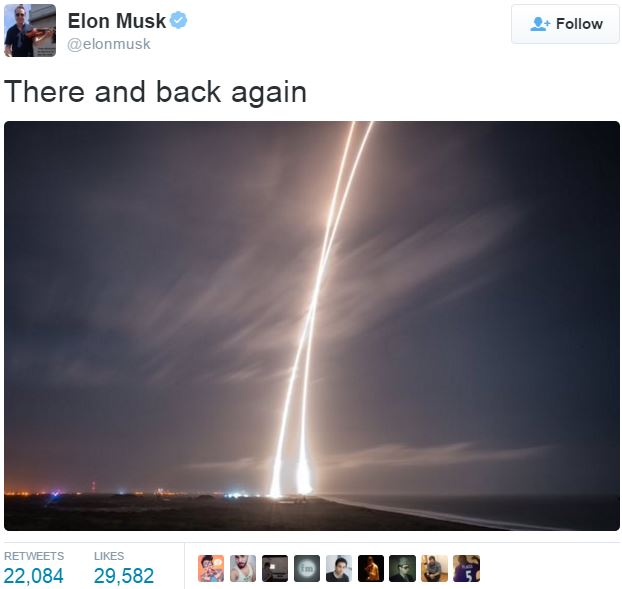 The Falcon 9 rocket shot up into the sky, and then part of it came back safely, ready to be used again. For SpaceX, the cost of rocket missions has just been reduced by 70%. (Image: twitter.com/elonmusk)
SpaceX had tried to land Falcon 9’s first stages in January and April this year on an ocean-going barge – both attempts were unsuccessful.
This week’s breakthrough is seen by many as the Holy Grail of sustainable and affordable space flight. Missions to space are incredibly expensive, partly because an entire rocket has to be made from scratch for each mission.
Imagine how expensive it would be if you had to buy a brand new car every time you made a journey, or build a new airplane for every passenger flight on Earth.
SpaceX will be able to offer much lower prices
Falcon 9’s first stage represents approximately 70% of the $54 million it costs to make an entire rocket. SpaceX charges about $60 million for every satellite launch.
SpaceX, which is already the cheapest satellite launcher on the market, will now be able to offer its services at an even lower price.
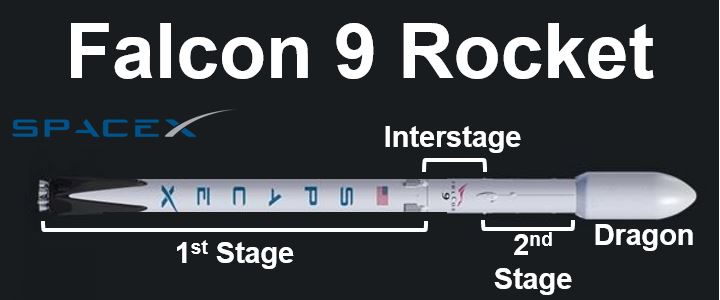 SpaceX can now launch its Falcon 9 rocket and get its 1st Stage back intact. The aim is to get the 2nd Stage back too. When it manages to recover and re-use both stages, the cost of launching rockets will be reduced by a factor of 100, says Elon Musk. (Image adapted from: spacex.com/about)
Its bulging order book, which includes NASA, the US Air Force, and many commercial satellite companies, is about to get much fatter.
Musk wants second stage to be re-usable
Mr. Musk wants to make the rocket’s second stage re-usable too. That is going to be much harder to achieve. By the time the second stage has completed its mission, it is much higher and travelling at a considerably faster speed than the first stage.
According to Mr. Husk, if the second stage can also be re-used, the cost of launching rockets could be lowered “by a factor of a hundred”.
SpaceX Video – Safe landing of Falcon 9 First Stage
In this video, taken from a helicopter near the landing pad, the first stage of SpaceX’s Falcon 9 rocket can be seen landing safely back at Cape Canaveral, in an upright position.
