

A special bikini made of a reusable material that scientists at the University of California, Riverside, call ‘Sponge’, won an international design competition. Sponge is derived from heated sucrose, a form of sugar. The special material has a highly porous structure that repels water (hydrophobic) while at the same time absorbs harmful contaminants.
Mihri Ozkan, an electrical engineering professor at UC Riverside’s Bourns College of Engineering, said:
“This is a super material that is not harmful to the environment and very cost effective to produce.”
Prof. Ozkan, along with Prof. Cengiz Ozkan (her husband), PhD. Student Daisy Patino, and Hamed Bay Ph.D., started developing Sponge about four years ago. Their aim was to create something that could clean up oil or chemical spills, or desalinize water.
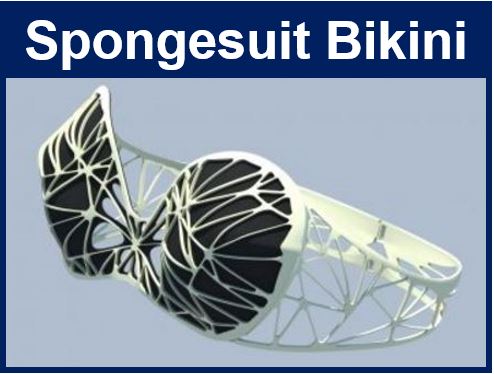 Spongesuit bikini created by engineers at UC Riverside and designers at Eray Carbajo. (Image: UCR Today. Illustration Credit: Eray Carbajo)
The material’s unique water-repelling nature could also be used in paint and applied to satellites and airplanes, or as part of electromagnetic shields for unmanned aerial vehicles.
Gonzalo Carbajo, Inanc Eray, and Pinar Guvenc, partners in an architecture and design firm based in Istanbul and New York, first thought of incorporating the material into wearable technology, such as the swimsuit.
They visited the Ozkan’s laboratories and worked with them to design the swimsuit. It won first place at the Reshape 15 Wearable Technology Competition, and was recognized at the Maker faire in Rome on October 16th.
The Sponge material was molded into a bikini shape, encapsulated in a net-like cage made of 3D-printed elastomer (a natural or synthetic polymer having elastic properties, e.g. rubber) that forms to the body.
Sponge may have many possible uses
The material could also be incorporated into wet suits, swimming caps, bathing suits and other wearable items, the scientists say.
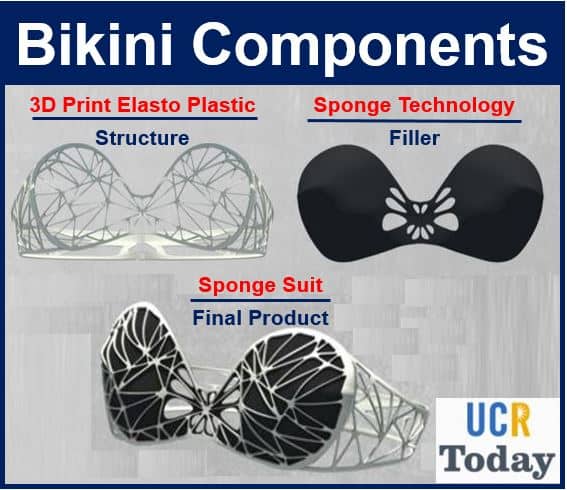 Components of the Spongesuit bikini. (Image: UCR Today. Illustration Credit: Eray Carbajo)
Sponge absorbs up to 25 times its own weight and only releases the absorbed materials when it is heated to more than 1,000 degrees Celsius.
The contaminants do not touch the wearer’s skin – they become trapped in the sponge material’s inner pores. After a number of uses, the sponge pad, which can be recycled, is replaced with a new one.
Tests at the Ozkans’ UC Riverside labs showed that the absorbent material can be used up to twenty times before it loses its absorbency.
The UC Riverside Office of Technology Commercialization says it has filed patents for the inventions described above.
