
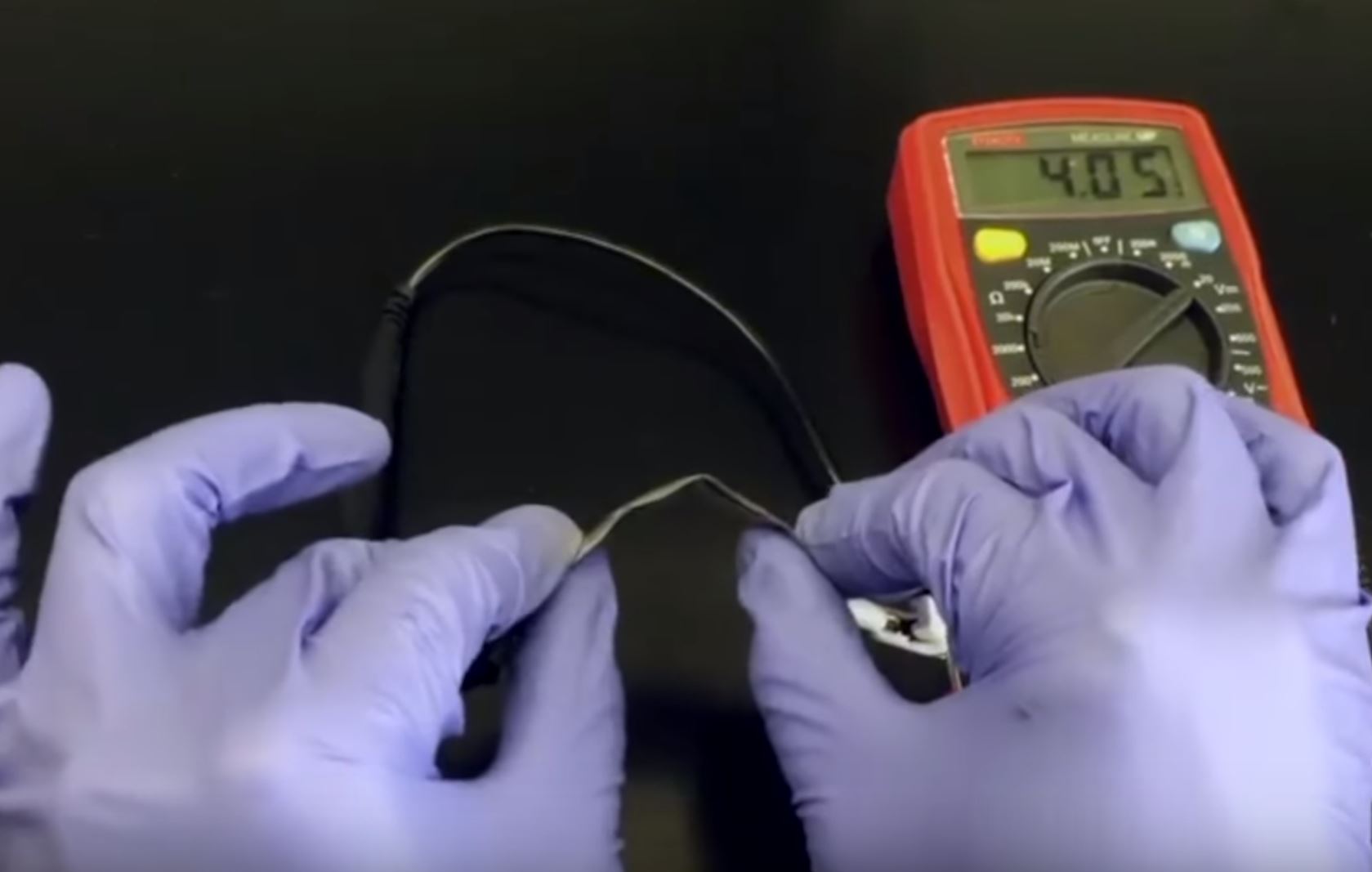
Scientists have developed a flexible lithium ion battery of high energy density that can bend and twist like the human spine while keeping its voltage stable.
The work, led by a team at Columbia University in the City of New York, and reported recently in the journal Advanced Materials, could be a significant step forward for wearable electronics.
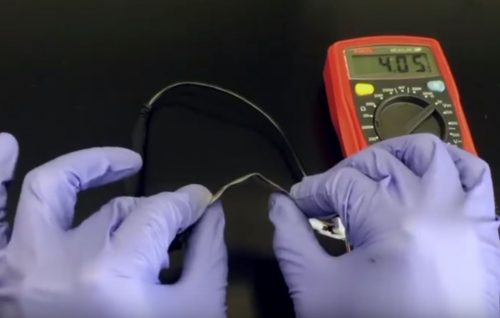 The researchers found that flexing and twisting the battery while it discharged, did not “interrupt the voltage curve.” Credit: Yuan Yang/Columbia Engineering
“We anticipate,” says Yuan Yang, assistant professor of materials science and engineering at Columbia University, “that our bio-inspired, scalable method to fabricate flexible [lithium ion] batteries could greatly advance the commercialization of flexible devices.”
Wearables need flexible, high performance batteries
The variety of thin-embedded and wearable electronic devices has broadened dramatically in recent years, with applications ranging from smart watches and other personal wearables, through healthcare, to e-textiles, smart glass, and even smart packaging.
Such devices require high performance batteries that store large amounts of energy and deliver it smoothly without being bulky and rigid.
However, until now, developers have not been able to create a flexible lithium ion battery that also has high energy density.
‘Promising’ first-generation flexible lithium ion battery
Yang says that their prototype has one of the highest energy densities reported so far.
The “simple and scalable” approach that they have developed, he explains, is designed to produce a “flexible spine-like lithium ion battery that has excellent electrochemical and mechanical properties.”
He suggests that it is a “very promising” first-generation candidate for a commercial, flexible lithium ion battery.
“We are now optimizing the design and improving its performance,” says Yang.
Designed inspired by human spine
Yang and his team were inspired to pursue their design by observing the flexibility of the human spine when performing sit-up exercises.
As well as being mechanically robust, the human spine can bend and flex, thanks to its combination of a soft marrow and interconnected hard vertebrae that are stacked to form the spinal column.
Their prototype battery is designed along similar lines: stacked electrodes form the “vertebrae” and they are wound around a flexible “marrow.”
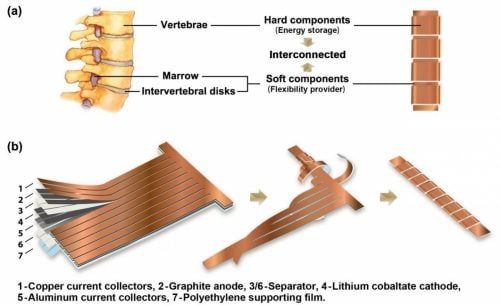 The design of stacked electrodes wound around a flexible material was inspired by the human spine. Credit: Yuan Yang/Columbia Engineering
To fabricate the spine-like structure, the team made a multilayer electrode (containing anode, separator, cathode, separator), cut it into strips, and then wound the strips around the flexible material “backbone.”
The high energy density is achieved because the active materials form a high proportion of the structure.
Flexible, mechanically robust, with high energy density
“As the volume of the rigid electrode part is significantly larger than the flexible interconnection, the energy density of such a flexible battery can be greater than 85 percent of a battery in standard commercial packaging,” says Yang.
He notes that their flexible lithium ion battery “also successfully survived a harsh dynamic mechanical load test because of our rational bio-inspired design.”
“Our spine-like design is much more mechanically robust than are conventional designs,” Yang concludes.
Video – flexible lithium ion battery
The following video from Columbia University shows the flexible lithium ion battery going through some tests while it is flexed and twisted.
