
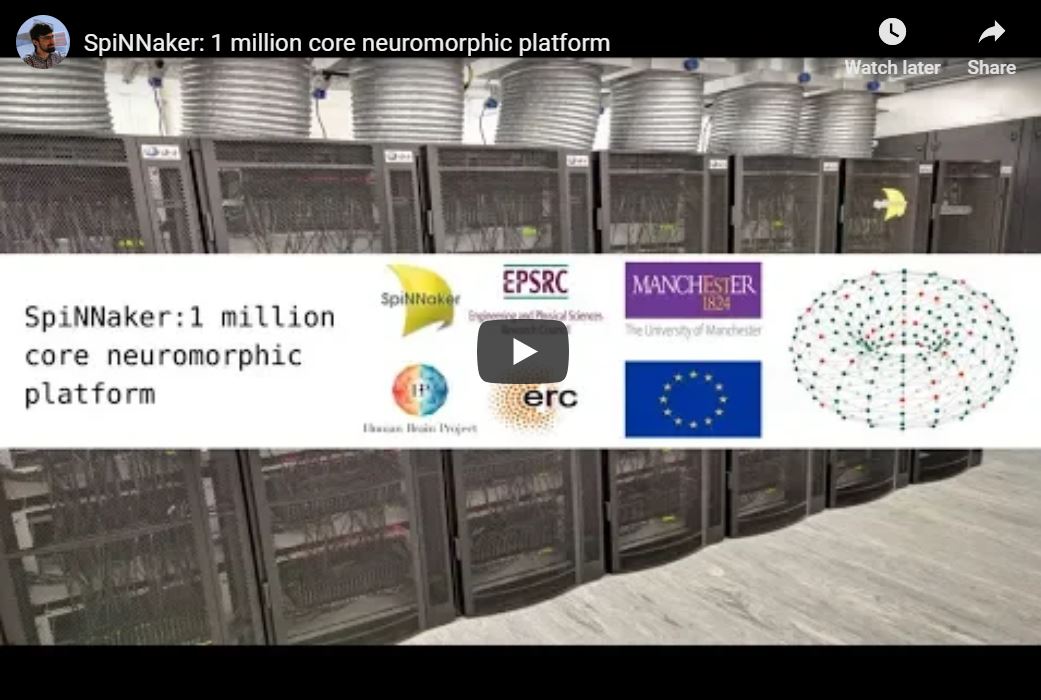
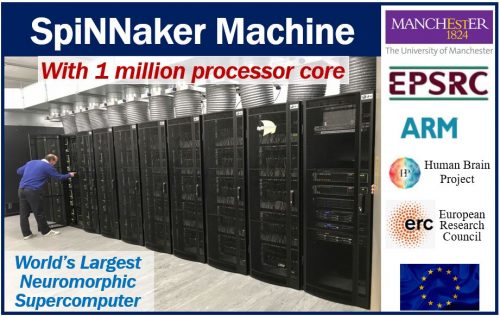
The million-processor SpiNNaker machine, the ‘human brain supercomputer,’ the world’s largest neuromorphic supercomputer, has been switched on for the first time. Engineers have designed and built it to work in the same way as the human brain.
The SpiNNaker machine can complete over 200 million million actions per second. Each of its chips has 100 million transistors. SpiNNaker stands for Spiking Neural Network Architecture.
According to a University of Manchester press release:
“To reach this point it has taken £15million in funding, 20 years in conception and over 10 years in construction, with the initial build starting way back in 2006. The project was initially funded by the EPSRC and is now supported by the European Human Brain Project.”
The SpiNNaker machine, which engineers from the School of Computer Science, the University of Manchester, built, can model more biological neurons than any other machine on Earth. And that is in real time.
Biological neurons
Biological neurons are basic brain cells. They are present in the nervous system. They communicate primarily by emitting ‘spikes’ of pure electro-chemical energy.
Neuromorphic computing utilizes large-scale computer systems that contain electronic circuits that mimic these spikes in an artificial device.
SpiNNaker is unique
SpiNNaker is unique because it doesn’t communicate by sending large amounts of data from point A to B through a standard network. This is what traditional computers do.
Instead, SpiNNaker mimics our brain’s massively parallel communication network. It sends billions of small amounts of data simultaneously to several thousand different destinations.
Stever Furber said:
“SpiNNaker completely re-thinks the way conventional computers work. We’ve essentially created a machine that works more like a brain than a traditional computer, which is extremely exciting.”
“The ultimate objective for the project has always been a million cores in a single computer for real-time brain modelling applications, and we have now achieved it, which is fantastic.”
Furber is an ICL Professor of Computer Engineering at the University of Manchester. Prof Furber conceived the initial idea for such a computer.
One billion biological neuron target
The supercomputer’s creators eventually hope to model up to one billion biological neurons in real time. They say that now they are a step closer.
To give an idea of scale, a mouse brain, for example, consists of approximately 100 million neurons. The human brain is one thousand times bigger than that.
One billion neurons represent merely 1% of the scale of our brains. The human brain consists of nearly 100 billion neurons or brain cells. They are highly interconnected via about one quadrillion synapses. One quadrillion = 1,000,000,000,000,000.
What is SpiNNaker for?
So, why do we want a million-core processor computer that mimics the way our brain works? For a start, neuroscientists can gain a better understanding of how the human brain works.
SpiNNaker runs incredibly large-scale real-time simulations which other machines simply cannot do.
For example, researchers have used SpiNNaker to stimulate high-level real-time processing in several different isolated brain networks. This includes a model of a segment of the cortex consisting of 80,000 neurons.
This part of the brain – in the outer layer – receives and processes data from the senses.
SpiNNaker has also simulated the Basal Ganglia, a region of the brain that Parkinson’s disease affects. The supercomputer, therefore, has massive potential for neurological breakthroughs. It could be used, for example, in pharmaceutical testing.
Using SpiNNaker to control a robot
Engineers have even harnessed SpiNNaker’s processing power to control the SpOmnibot.
According to TUM (Technische Universität München – Technical University of Munich):
“The “SpomniBot” is a small holonomic robot with various on-board sensors and actuators, equipped with on-board neuronal computing abilities.”
The SponmniBot uses the SpiNNaker system to interpret visual information in real time. The system allows it to navigate towards specific objects while ignoring others.
A robot is a device or machine that we usually program to do things. Most robots today have AI (artificial intelligence). Some robots are humanoid. In other words, they have arms, legs, a torso, and what looks like a head. However, most are not humanoid.
Regarding the potential uses of SpiNNaker, Prof. Furber added:
“Neuroscientists can now use SpiNNaker to help unlock some of the secrets of how the human brain works by running unprecedentedly large-scale simulations.”
“It also works as real-time neural simulator that allows roboticists to design large-scale neural networks into mobile robots so they can walk, talk and move with flexibility and low power.”
