

Deserts in Africa, South America and Asia are expanding, and so far nothing has managed to halt their spread, except for perhaps termites, says a team of researchers from Princeton University.
Termite mounds make the dry grasslands and savannas (drylands) of Asia, Africa and South America more resistant to climate change. They store moisture and nutrients, and via their system of internal tunnels allow water to penetrate the soil.
When termite mounds appear in the drylands, vegetation starts to flourish around them, which the scientists believe could stem the spread of deserts.
The researchers write in the journal Science (citation below) that drylands can survive with considerably less rainfall if there are termite mounds around. Their study focused on the fungus-growing termites of the genus Odontotermes. They believe that what they observed could apply to all types of termites.

Termite mounds may help the drylands resist the effects of climate change. (Image: Science)
Assistant professor in ecology and evolutionary biology at Princeton University, Corina Tarnita, said that termite mounds help preserve plant life and seeds, which help them rebound as soon as it starts to rain.
“The rain is the same everywhere, but because termites allow water to penetrate the soil better, the plants grow on or near the mounds as if there were more rain. The vegetation on and around termite mounds persists longer and declines slower.”
“Even when you get to such harsh conditions where vegetation disappears from the mounds, re-vegetation is still easier. As long as the mounds are there the ecosystem has a better chance to recover.”
Predictions ignore the complexity of nature
Aquatic microbiology professor and theoretical ecologist, Jef Huisman, who works at the University of Amsterdam, and is familiar with the Princeton study but was not involved in it, said the research shows that recently-proposed early-warning signals for desert-expansion may be too simple, and could result in future climate change forecasts that do not take into account the complexity of nature.
Savannas and grasslands go through five stages before they turn into deserts, with each one having a distinct pattern of plant growth. Scientists use satellite images to determine where along those five stages a savanna is in.
In this latest study, however, the researchers found that these plant-growth patterns occur on a far smaller scale than previously thought – one of centimeters. Overlaying them is the pattern of termite mounds which are covered by dense vegetation, which is on the scale of tens of meters.
However, the termite-mound pattern looks deceivingly similar to the fifth and most critical stage that marks the transition of grasslands and savannas to desert, Prof. Tarnita explained.
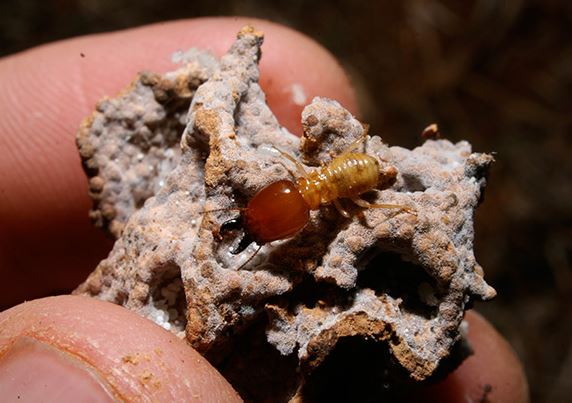
The research was inspired by fungus-growing termites from the genus Odontotermes. (Image: Princeton University)
The authors wrote about two different mechanisms for a similar pattern: 1. One stemming from vegetation self-organizing in response to limited rainfall. 2. The other resulting from bustling termite mounds which improved the lives of nearby vegetation. The mechanisms, however, are not necessarily mutually exclusive in drylands.
Professor Tarnita said:
“That made me wonder if more than one mechanism is responsible for vegetation dynamics in dryland ecosystems, as is often the case in nature. We created a mathematical model that revealed that these mechanisms can co-exist, but likely at different scales.”
“It pointed to where we should look in nature to find the nested patterns that eventually led us to empirically confirm that both mechanisms are indeed at play.”
The fifth stage may not be what it seems
According to Prof. Huisman, the Princeton team showed that vegetation patterns that may be seen as moving towards total desertification may not be going that way at all, thanks to termite mounds.
Prof. Huisman said:
“The coexistence of multiple patterns at these scales makes ecosystems more robust and less prone to collapse, and that is the significance of this study. In that sense, we have to adjust our models for drylands because these ecosystems are much more resistant to desertification than we previously believed.”
He added that climate models for every ecosystem need to take better account of such organisms as termites and mussels, creatures that “engineer their own environment.”
Prof. Huisman added:
“This is an eye-opening study that says we really need to investigate these ecosystems in more detail and incorporate all these other mechanisms before we can say what will lead to a catastrophic collapse in ecosystem function.”
“We should always be humble in our model predictions because nature can always be more complex than we initially anticipate.”
Can other mound-building creatures stem the desert spread?
Co-author Robert Pringle, an assistant professor in ecology and evolutionary biology at Princeton, said their findings regarding termite mounds in drylands may also apply to varying degrees to gophers, prairie dogs, ants and other mound-building creatures.
Prof. Pringle said:
“This phenomenon and these patterned landscape features are common. It’s not always termites causing them, but they may very well have similar effects on the ecosystem. However, exactly what each type of animal does to the vegetation is hard to know in advance.”
“You’d have to get into a system and determine what is building the mounds and what are the properties of the mounds.”
This latest study stems from a paper that was published in 2010 in PLOS Biology, of which Prof. Pringle was lead author. It reported that termite mounds were “hotspots” of plant growth and animal activity, which declined the farther one moved away from the mound.
They also discovered that termite mounds were spaced from one another evenly, thus creating a larger area of biological abundance.
Prof. Pringle said:
“I like to think of termites as linchpins of the ecosystem in more than one way. They increase the productivity of the system, but they also make it more stable, more resilient.”
First author, Prof. Juan Bonachela, a lecturer in the Department of Mathematics and Statistics at Strathclyde University in Scotland, explained that a mathematical model was developed for this latest study to determine how termite mounds might affect plant growth.
It allowed Prof. Bonachela and his team to apply small-scale observational data broadly to understand how vegetation growth and persistence respond to rainfall with termites either present or absent from an entire ecosystem.
Prof. Bonachela said:
“Similar studies would be extremely challenging to perform in the field and would require very long-term experiments. Models such as this allow us to study the focal system with almost no constraint of time or space, and explore a wide range of environmental conditions with a level of detail that cannot be attained in the field.”
Citation: “Termite mounds can increase the robustness of dryland ecosystems to climatic change,” Juan A. Bonachela, Robert M. Pringle, Efrat Sheffer, Tyler C. Coverdale, Jennifer A. Guyton, Kelly K. Caylor, Simon A. Levin, and Corina E. Tarnita. Science 6 February 2015: 347 (6222), 651-655. [DOI:10.1126/science.1261487]
