
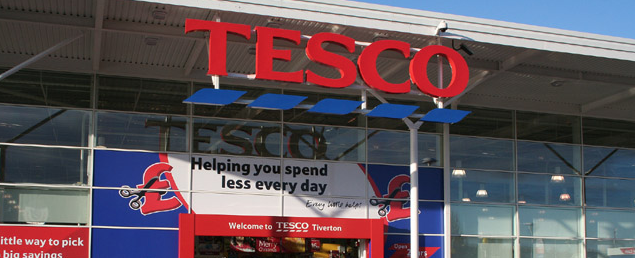
Tesco Supermarket

Tesco pledges to end edible food waste from its stores in 2018

Written by Joseph Nordqvist

Published: 17:19, December 23, 2017

UK retailer Tesco has pledged to end edible food waste from its stores by the end of February 2018.

Leftover food will be given to charities or used as animal food or fuel instead of going to waste.

Tesco boss Dave Lewis said in an interview with The Telegraph that food waste has been talked about “for years”.

He said: “Last year we sold 10 million tons [9.1 million tonnes] of food to the British public. But even if our waste is just 0.7% of the food, that’s still 70,000 tons [63,500 tonnes] of food.

“And so long as that food is fit for human consumption, I’d much prefer it to go to people than landfill, or animal feed or fuel,” he added.

Through changing Tesco’s social behaviour and ‘running a responsible business’, Lewis hopes the retailer will be able to reclaim shoppers’ trust in the company.

“When I joined, there was no trust”, he told the Telegraph. “But I believe you don’t talk your way out of it, you behave your way out of it.”
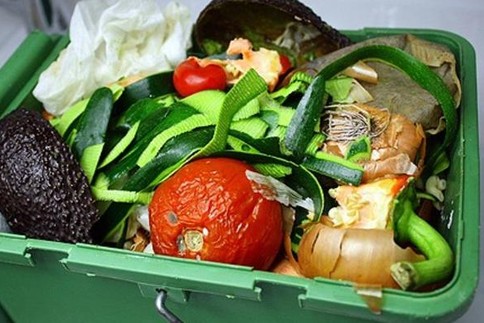
food_waste
According to the Environment, Food and Rural Affairs Committee, Britain throws away 8.1 million tons [7.3 million tonnes] of food every year.
Tesco uses an app called FoodCloud to scan and upload surplus food products at its stores. At the end of each day, the information is shared with registered charities that collect the food.

“That goes a long way in reducing charities’ bill burdens, so they can spend the money on other things, like the cost of housing two more addicts, or providing much more needed services,” Lewis said.

Mr Lewis urged other retailers to follow suit, stating:

“… If Tesco can make this work, with all of our different stores across the country, then why can’t everyone?”

Tesco, along with all other major UK supermarkets, signed the Courtauld Commitment 2025, a voluntary agreement to cut food waste by one fifth within a decade.

“In retail there will always be some surplus food,” Lewis said. “No matter how sophisticated the ordering systems are, it will be impossible to perfectly match the supply and demand for every one of our shops, 365 days a year, when there’s so much volatility.”

Joseph Nordqvist Avatar

Other News

When the next generation doesn’t want the family business

Oct 11, 2026

Cleveland Fed survey finds businesses unconvinced by stablecoins

Oct 11, 2026

Costs hold back commercial heat pump upgrades, California study finds

Oct 11, 2026

Rein Security raises $25 million to protect enterprise AI agents

Oct 11, 2026

Foreign trips take most of EU residents’ travel spending

Oct 11, 2026

Irish inflation rises to 4.1% as housing and transport costs climb

Oct 11, 2026

Safety reminders reduce unsafe choices in a clinical AI study

Oct 10, 2026

VEIR raises $110 million for superconducting data-center power systems

Oct 10, 2026

EU prepares €52.5 million in calls to help research reach the market

Oct 10, 2026

France secures EU approval for €40.5 million in fuel-cost loan schemes

Oct 10, 2026

EU selects 46 new projects for critical mineral supplies

Oct 10, 2026

Why a port disruption can reach factories far inland

Oct 10, 2026

Sorghum could diversify Europe’s feed crops as the climate warms

Oct 10, 2026

X-ray snapshots reveal how an enzyme builds penicillin’s rings

Oct 9, 2026

Thyssenkrupp opens Pune engineering center focused on vehicle software

Oct 9, 2026

Malaysia plans RM2,000 minimum wage with relief for smaller firms

Oct 9, 2026

Airtel Money’s London flotation puts its payments business in focus

Oct 9, 2026

More US families face heavy debt payments despite rising wealth

Oct 9, 2026

Can bikes and scooters make everyday city travel cheaper?

Oct 8, 2026

Workplace wearables: the safety promise and the privacy risk

Oct 8, 2026