
tesco_unilever

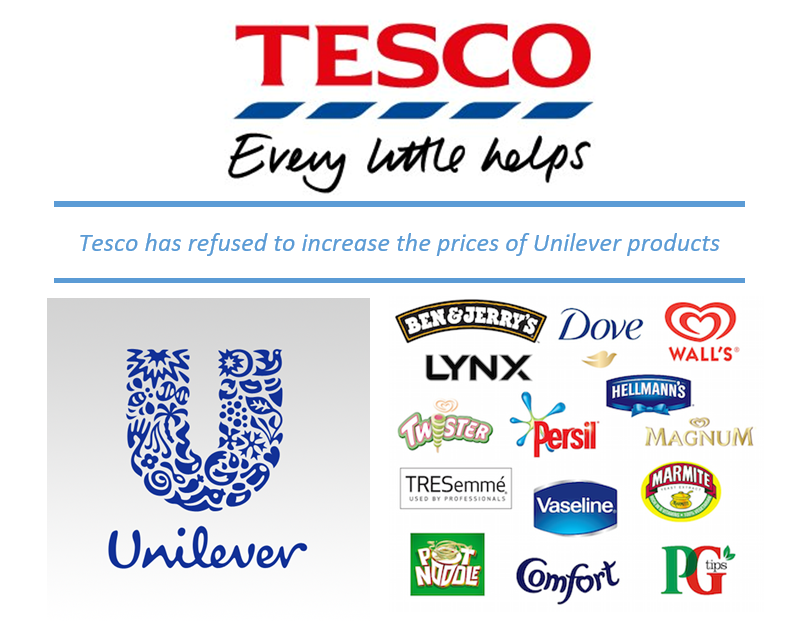
Tesco refuses to increase wholesale prices of Unilever products

Written by Joseph Nordqvist

Published: 07:34, October 13, 2016

The UK’s largest grocery chain, Tesco, is currently in a standoff with consumer goods giant Unilever.

Tesco reportedly refused to hike the wholesale prices of Unilever products by 10 percent – amid the falling value of the pound sterling. Wholesale prices are what wholesalers (the middle people) charge retailers (shops).

Unilever owns many famous brand names, including Persil, Surf, Dove, Comfort, Ben & Jerry’s ice cream, Elmlea, Colman’s, Helmann’s, Marmite, Knorr, Bertolli, Flora, Comfort and Pot Noodle.
tesco_unilever

The retailer has pulled products made by Unilever PLC from its online shopping site.

A Tesco spokesperson said: “We are experiencing availability issues on a number of Unilever products. We always work to ensure customers get the best possible prices and we hope to have this issue resolved soon.”

Since the Brexit vote in June the value of the pound sterling has dropped 16% against the euro.

According to The Guardian, a ‘well-informed source’ said: “Unilever is using Brexit as an excuse to raise prices, even on products that are made in the UK.”


Unilever has asked other major British retailers to increase prices too. Someone familiar with the matter told the WSJ that the firm similarly approached J Sainsbury PLC for a 10% hike on all its products.

Ged Futter, a retail consultant at IR Solutions, was quoted by The Guardian as saying: “A lot of suppliers have seen costs go up significantly because of currency. Some are covered until the end of the year but not beyond. Retailers are saying they can’t pass cost increases on to their shoppers but that has to happen, or they are not going to have any suppliers left.”

There is currently robust demand for Unilever products in the UK. If Tesco can’t find a way to work with them the retailer could suffer a significant loss in market share.

Video – What is a wholesaler?

Joseph Nordqvist Avatar

Other News

How describing the same food as having few ingredients can change interest

Nov 2, 2026

Suggested prices can change what marketplace sellers earn, Mercari experiment finds

Nov 2, 2026

A change of month can make a sale feel farther away, marketing study suggests

Nov 2, 2026

New and established brands drew different responses to advertising appeals in study

Nov 2, 2026

Community promotions gave lesser-known authors a sales lift in Quebec study

Nov 2, 2026

Believable price guarantees linked to greater trust in retailer survey

Nov 1, 2026

Where customers receive free samples can affect what they do next

Nov 1, 2026

Branded search ads showed no clear sales lift in small business tests

Nov 1, 2026

Tokenized markets promise faster trades, but legal rights and liquidity remain unresolved

Nov 1, 2026

Internet coverage alone cannot close the digital divide, World Bank says

Nov 1, 2026

Energy upgrades can save businesses money, but financing the work remains a hurdle

Nov 1, 2026

Why tighter credit can disrupt supply chains before orders disappear

Oct 31, 2026

South Africa plans a more open payments system as digital transactions grow

Oct 31, 2026

African cities face a jobs test as urban populations grow

Oct 31, 2026

Online platforms can open foreign markets, but sellers still face costs

Oct 31, 2026

Trade barriers beyond tariffs can keep Balkan exporters from growing

Oct 31, 2026

Off-grid solar reaches more customers, but affordability limits its growth

Oct 31, 2026

World Bank survey finds a wide gap in business innovation across economies

Oct 30, 2026

Air conditioning is adding a growing challenge for electricity grids

Oct 30, 2026

Fewer bidders can make public contracts harder for businesses and taxpayers

Oct 30, 2026