
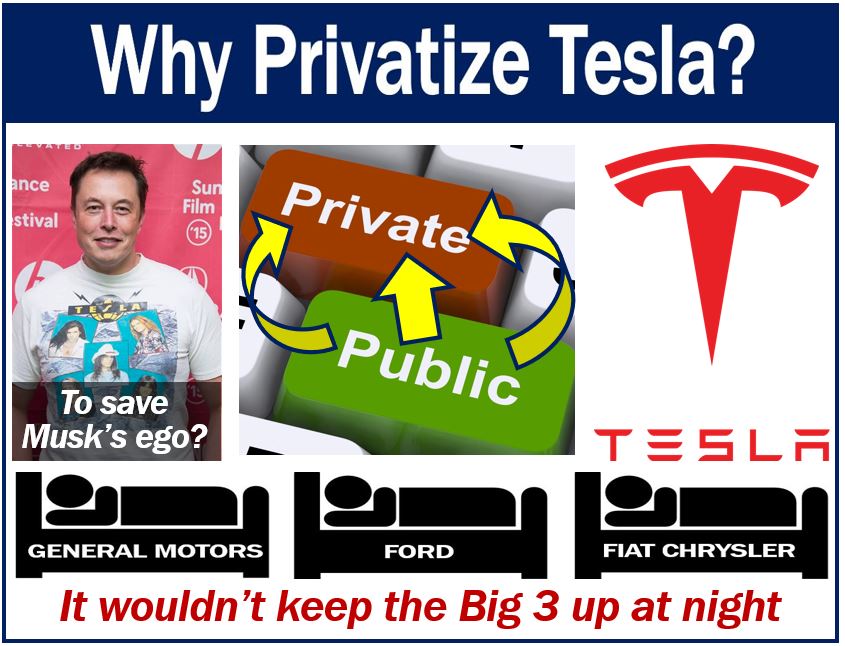
All a Tesla privatization may achieve is to boost Elon Musk’s ego. However, it won’t be able to challenge the Big Three. Professor Erik Gordon adds that a Tesla privatization might save Musk’s ego, but at the company’s expense. Ross is Clinical Assistant Professor at the University of Michigan’s Ross School of Business.
Tesla Inc., formerly Tesla Motors, is an American multinational company that specializes in electric vehicles and lithium-ion battery energy storage. The company, through the subsidiary company SolarCity, also specializes in solar panel manufacturing.
Martin Eberhard and Marc Tarpenning founded Tesla in 2003. However, the company also considers Ian Wright, Elon Musk, and JB Straubel as co-founders. Elon Musk is Tesla’s Chairman and CEO.
Musk recently indicated that he is considering taking the company private. A Tesla privatization would involve somebody or an entity buying out its public shareholders. In other words, to take the company private, Musk would need to organize a tender offer to purchase all or most of the company’s stock.
In this context, the term ‘stock‘ means the same as ‘shares.’ Hence, the term ‘stocks and shares.’
Tesla privatization ‘unlikely’
Prof. Gordon argues that a Tesla privatization is unlikely to happen. In a new op-ed essay in The Hill, Prof. Gordon writes that even if it did happen, the ‘Big Three’ would be under no threat.
The Big Three, in this article, refers to America’s biggest three automakers – Fiat Chrysler, Ford, and General Motors.
Regarding credible threats for the Big Three, Prof. Gordon writes:
“The triumph so heralded by Musk, turning out 5,000 cars that sell for $70,000 by working day and night in a circus tent, is a worthy accomplishment, but at best, it is a quarter of what it takes to keep the Big Three up at night.”
“To be a real threat, Tesla has to mass produce four or five times that many cars and sell them for $35,000.”
Private company would have too much debt
If Musk manages to borrow the money for a Tesla privatization, that won’t happen, Prof. Gordon writes.
Prof. Gordon adds:
“The newly-private company will be so loaded with debt that it won’t have enough money to buy a new two-person pup tent, much less build new factories.”
Rather than a sound business decision, Prof. Gordon argues that Musk’s move is probably driven by his personality. “He spends too much time and attention worrying about the disagreeing fools,” writes Prof. Gordon.
