
Thomas Cook is suffering the consequences of a devalued pound, terrorist attacks in Europe, plus political instability in Turkey, as holidaymakers either choose destinations in their home country or opt for safer locations. There has been a growing tendency for people to shun Turkey as their holiday spot for seemingly safer locations, such as the Canary or Balearic Islands and the United States.
Before this summer, Turkey was Thomas Cook’s second most popular holiday destination. During the summer, there was a failed military coup in Turkey as well as a number of terrorist attacks in its capital Ankara, Istanbul and other cities.
Thomas Cook Group plc, a 175-year-old British global travel company based in Peterborough, says its summer bookings have declined.
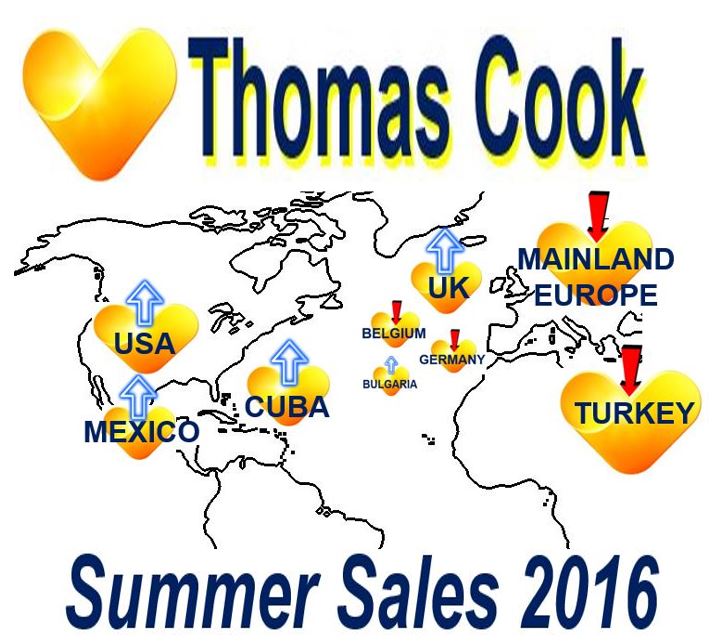 Thomas Cook said sales in its second-most popular destination – Turkey – were steeply down compared to 2015. However, winter bookings are holding up as are advanced bookings for 2017 summer vacations.
Sales across continental Europe plummeted by 9% over the summer, with bookings for Belgium being ‘significantly down’ after the terrorist attacks in March at Brussels airport. Summer bookings in Germany were 6% down compared to summer 2015.
Thomas Cook suffering with others
Most UK-based airlines and travel companies have had a bad summer, mainly for two reasons:
1. Brexit Vote: on 23rd June the British people voted for Brexit – Britain Exiting the European Union – in a Referendum. Since then, the pound sterling has devalued by 10%. Whenever a country’s currency devalues, the cost of travelling abroad becomes relatively more expensive for its citizens.
2. Terrorism: the terrorist attacks this year in France, Germany, Belgium and Turkey have scared many Britons into staying at home or choosing a holiday destination within their home country this year.
Thomas Cook said bookings for UK destinations increased by 1%, i.e. *staycations have increased. However, overall bookings – including UK and international locations – have declined by 4% compared to summer 2015.
 The devaluation of the pound and fear of a terrorist attack have discouraged many Britons from going on holiday abroad this year.
* According to the Oxford Living Dictionary, a ‘staycation’ is:
“A holiday spent in one’s home country rather than abroad, or one spent at home and involving day trips to local attractions.”
Business excluding Turkey up
Total bookings excluding Turkey, however, increased by 8% in summer of 2016, compared to the same period last year.
The shift away from Turkey forced Thomas Cook to lower its profit guidance range by 3% to 10% in July. Since that announcement, its stock has been on the slide.
Peter Fankhauser, CEO of Thomas Cook, said he is still optimistic – he reported that business figures for the summer ‘progressed largely as expected’.
Regarding consumer preference, Mr. Fankhauser said:
“There is still a strong desire among holidaymakers to go abroad, with the exception of Turkey, where demand continues to be volatile in light of the terror threats there.”
This year we celebrate our 175th Anniversary, find out #WhereWeStarted pic.twitter.com/RijaDXp04k
— Thomas Cook (@ThomasCookUK) July 5, 2016
The travel company says it expects operating profits to be £300 million for the twelve months to 30th September.
Winter bookings so far are about the same as they were at this time last year, Thomas Cook informed. It said twenty-seven percent of its winter portfolio has been sold so far, with bookings in the UK 8% higher than at this time last year, while demand in Germany and Belgium is especially weak.
However, consumers are already booking for the summer of next year at higher volumes than one year ago.
On Monday, the owner of Monarch, a British low-cost carrier, revealed that it is in talks regarding a possible takeover of the company and is considering throwing a multi-million-pound lifeline.
Earlier this year, Low Cost Holidays collapsed, affecting over 140,000 customers.
Video – UK tourism boosted after Brexit vote
The post-Brexit vote weak pound means more Britons are staying in the UK for their holiday, and a greater number of foreign tourists are coming to Britain.
