
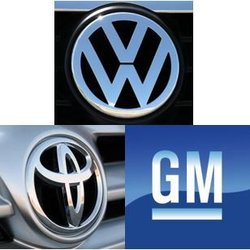
While Toyota retained first place in global vehicle sales during the first six months of 2014, Volkswagen jumped into second, pushing recall-fraught GM down to third place.
In 2013, Toyota was the world’s largest seller of cars, followed by GM and then Volkswagen. Including truck sales, Volkswagen was in second place in 2013, totaling 9.73 million cars and trucks deliveries compared to 9.71 million posted by GM.
Toyota Motor Corporation announced today that H1 2014 sales, including its Hino Motors Ltd. and Daihatsu Motor Co. vehicles, reached 5.097 million automobiles, a 4% increase on H1 2013. Sales increased in Europe, the United States, Asia and in Japan.
Toyota has benefited from US consumers’ growing preference for sport utility vehicles (SUVs), which are set to outsell sedans for the first time. Increasing deliveries of the new Lexus GX and Toyota Highlander helped push up market share in the US, while VW posted lower US sales.
All car sales rose during the first half of this year in Japan as consumers rushed to beat the consumption tax hike that kicked in on April 1.
Toyota reported the following H1 2014 increases in vehicles sales in its major markets:
- China: +20%,
- North America: +5%,
- Europe: +8%.

Toyota’s SUVs helped push up sales in the United States.
Volkswagen outpaced GM
With first half sales reaching 4.97 million vehicles, Volkswagen outpaced GM’s 4.92 million.
Volkswagen, Germany’s largest carmaker, posted much faster-growing sales, compared to GM, which is struggling with 29 million recalls related to defective ignition switches. Toyota has also recalled millions of cars because of a fault originating from a Japanese parts supplier.
Experts say Volkswagen is set to become the global leader soon, as it pushes hard with its expansion drive in China, while Toyota concentrates on improving quality and curbs growth.
Reuters quoted Yoshiaki Kawano, a Tokyo-based analyst at IHS Automotive, who said
“China is the driving force of the global market, and the degree to which a company is focused on that region is linked to the global sales performance.”
For the whole of 2014, IHS forecasts that Volkswagen will sell 9.91 million automobiles, beating Toyota’s 9.47 million. The two rivals predict sales exceeding 10 million vehicles (each) for this year.
VW has pledged to become the largest automaker worldwide by 2018, and has an aggressive growth plan in the United States and some other markets. Earlier this month, the German automaker said it plans to build a new midsize SUV at its factory in Chattanooga, Tennessee.

Will VW eventually leave the other two behind? Many analysts think so.
GM slipping after 7 decades
GM had retained the number 1 global spot for over seventy years, before losing the title to the Japanese automaker in 2008. In 2011, the earthquake and tsunami disaster in northeastern Japan affected Toyota’s production, during which GM retook first place.
In 2012, Toyota pushed GM back into second place and has remained top dog ever since.
Toyota, Volkswagen and GM are in fierce competition to gain market share in the rapidly-growing emerging markets.
