
UK exports are heading for their fastest growth in three years, with a weaker pound sterling pushing up global demand for British goods, says a new survey compiled by the Engineering Employers’ Federation (EEF), Britain’s largest sectoral employers’ organisation.
According to EEF’s Manufacturing Outlook – 2017 Quarter 2, the manufacturing recovery that has been taking root since the end of 2016 is now gaining ground. Manufacturers seem confident that this positive growth will continue into the second half of 2017.
The EEF survey is not alone in portraying a strong and expanding manufacturing sector. According to the Office for National Statistics (ONS), there was 2.6% growth in output in the first quarter of 2017 compared to the same period last year.
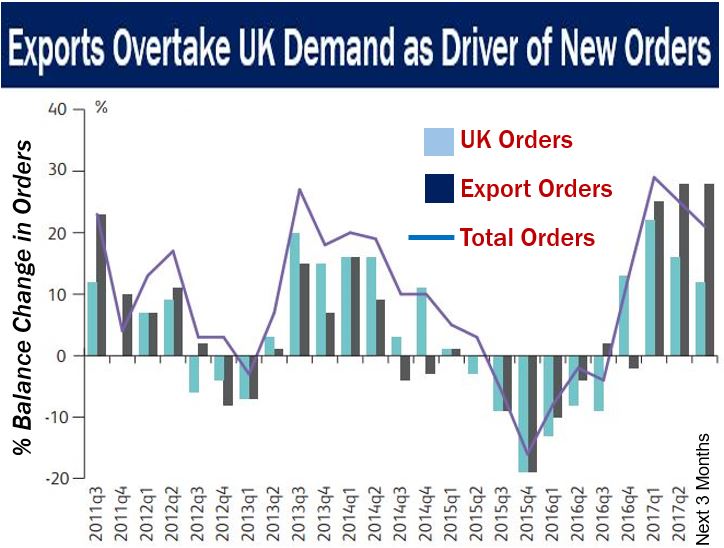 New orders are being driven by a surge in exports, and not by domestic demand, the EEF reports. (Image: adapted from eef.org.uk)
The authors of the report say that Brexit-related uncertainty has been presenting “less of a drag than previously expected”. The majority of firms are reporting output growth and new order balances.
A combination of a weaker pound and enduring healthy demand, especially in the European markets, should see UK exports continue rising, the EEF wrote. Sixty-one percent of manufacturing companies in the UK said they have experienced an increase in demand.
In the Report, the authors wrote:
“With the balances for our key output and orders indicators remaining firmly positive (+26% and +25% respectively), and well above their historic averages, in the past three months, there are plenty of reasons to be confident that manufacturing will be chalking up further quarters of output expansion over the remainder of this year.”
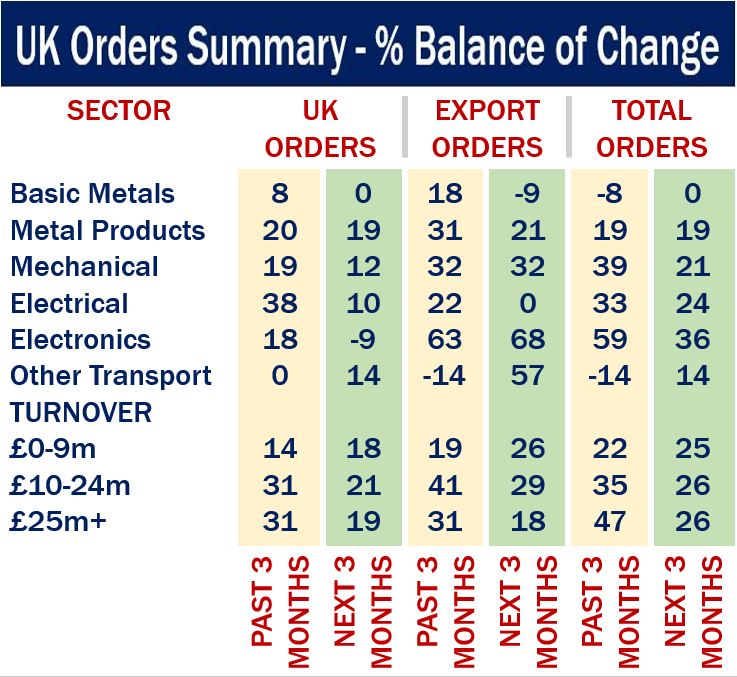 As you can see in the chart above, an important proportion of total orders over the last and next three months are coming from export orders. (Image: adapted from eef.org.uk)
Factors underlying UK exports growth
The factors underlying the improved performance of UK exports and manufacturing remain the same as in the previous quarter. One of the major developments for British manufacturers over the past year has been the upswing in virtually all markets across the globe.
Demand in the emerging economies, the US, and the Eurozone has been rising. Much of that demand, thanks to a weaker pound sterling, has been directed at British products, i.e. growth in global demand and a cheaper pound have helped push up UK exports.
According to EEF:
“The export orders balance in the past three months hit a six year high and fewer than one in six companies has seen no improvement in demand in overseas markets, down from one in four a year ago.”
Political uncertainty not harming UK exports
Political uncertainty does not appear to have undermined positive expectations for the year ahead, EEF added.
While the risks related to Britain’s Brexit negotiations with Brussels and EU member states have not diminished, news of a snap election does not appear to have had a negative impact on how manufacturers see their business conditions – or even the whole UK economy – evolving over the next year.
Manufacturing buoyant on global upswing, see our Q2 survey out today with @BDOManufacture https://t.co/cy7NqzNNJq #ukmfg
— EEF Press Office (@EEF_Press) June 5, 2017
In the Report’s Foreword, Lee Hopley, EEF’s Chief Economist, and Tom Lawton, Head of BDO Manufacturing concluded:
“As actions often speak louder than words, the still subdued investment picture suggests that manufacturers are wary of storm clouds appearing on the horizon. Indeed, our survey points to companies opting to increase their workforce to meet additional demand rather than investment in physical assets.”
“This will support a growing sales pipeline, but will do less to support longer term productivity gains. And right up there, in terms of priorities for the new government, will be outlining its productivity goals for the next parliament and embedding them in an industrial strategy white paper.”
