
UK GDP grew 0.8% in Q1 2014, according to the Office for National Statistics (ONS). The increase was largely driven by the service sector, which expanded by 0.9%. With five successive quarters showing economic growth, it is the longest non-stop expansion period since the 2008/2009 financial crisis.
Q1 2014 GDP was 3.1% higher than in Q1 2013. In the last quarter of 2013 GDP grew by 0.7%.
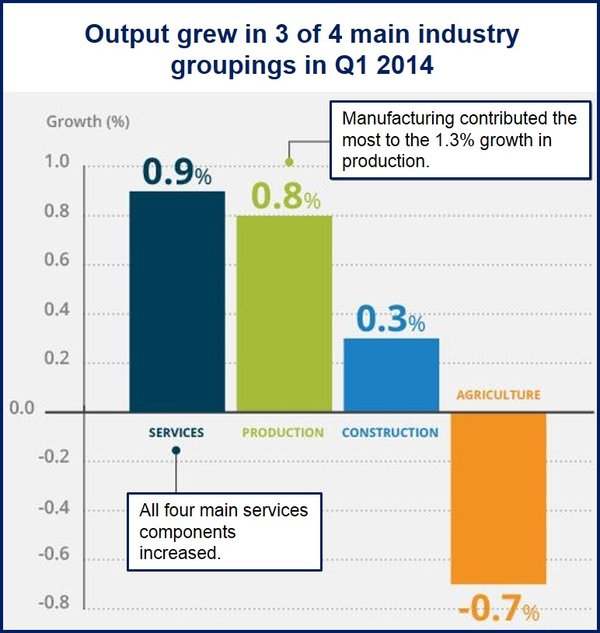
Three of the four main aggregates increased in Q1 2014:
- Services: +0.9%.
- Production: +0.8%.
- Construction: +0.3%.
- Agriculture: (minus) -0.7%.
Production’s 0.8% increase added a 0.11 percentage point to GDP growth, with manufacturing growing by 1.3% after expanding by 0.6% in the previous quarter.
In an interview with the BBC, Jeremy Cook, chief economist at currency brokers World First, said:
“While this figure has missed estimates, slightly, the overall feeling is still one of strength in the UK. In fact, this is the kind of news the economy needs – solid but not spectacular.”
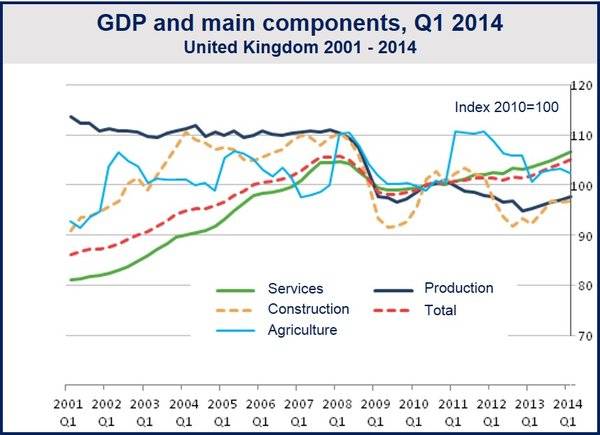
Since 2000 services have outpaced production
The British economy grew steadily from 2000 until the beginning of 2008, at which point the global financial crisis put the brakes on global GDP growth, including the UK’s. Services had continued to expand steadily up until that point, while production had plateaued over the same period.
(Source: Office for National Statistics)
Construction activity expanded strongly during the early 2000s, and although there was a short period of decline in the mid-2000s, business picked up by the end of 2007. “The deterioration in general economic conditions during 2008/09 was more acute in the construction and production industries, but less pronounced in the services industries,” the ONS wrote.
Post-2009 growth much slower
Towards the end of 2009 overall economic growth appeared to have returned, but at a much slower pace compared to the pre-2008 years.
The services industries expanded progressively, if slowly, during this period, with faster growth by Q3 2013 compared to the pace previously seen in early 2008.
Production and construction, on the other hand, expanded in 2010 but their growth was not sustained and are still below their pre-downturn peaks.
(Source: Office for National Statistics)
Broader growth since Q1 2013
Growth has been widespread since the beginning of 2013, with the service industries remaining the major and steadiest contributor to GDP growth. In the first quarter of 2014 GDP was estimated to be about 0.6% below the peak in the first quarter of 2008.
UK GDP shrank by 7.2% between Q1 2008 and Q2/Q3 2009. Previous recessions in the early 1980s and early 1990s did not have the same level of impact as the Great Recession. During the 1979-1981 recession GDP shrank by 5.9%, and by 2.9% between Q2 1990 and Q3 1991.
George Osborne, the UK’s Chancellor of the Exchequer said of today’s figures:
“Britain is coming back. (However)) the impact of the Great Recession is still being felt, but the foundations for a broad based recovery are now in place. The biggest risk to economic security would be abandoning the plan that is laying those foundations.”
Ed Balls, the Shadow Chancellor (opposition Labour party’s equivalent) said:
“Millions of hardworking people are still feeling no recovery at all. Now that growth has finally returned, the question is whether ordinary working people will properly feel the benefit and we have a balanced recovery that’s built to last.”
Earlier this week, the ONS published figures showing that UK March retail sales grew by 4.2% versus March 2013. Q1 2014 retail sales increased 3.8% compared to Q1 2013.
In March, the British Chambers of Commerce upgraded the UK’s GDP growth forecast to 2.7% for 2014 from its previous 2.4% prediction.
