
An ultra thin silk solution has been shown to keep fruits fresh for over a week at room temperature – the solution is also edible. It is so thin as to be effectively invisible, say scientists from Tufts University. They say the silk is a promising alternative to cling film for the preservation of perishable foods, using a naturally-derived material and a water-based process.
According to FAO (the Food & Agriculture Organization of the United Nations), half of all the fruit and vegetable crops globally are lost during the food supply chain, mainly because of they deteriorate prematurely, i.e. they rot before they can be eaten or stored.
The Tufts University scientists explained in the journal Scientific Reports (citation below) that they demonstrated that fruits can stay fresh for over one week – without being refrigerated – if they are coated with a biocompatible, odorless silk solution.
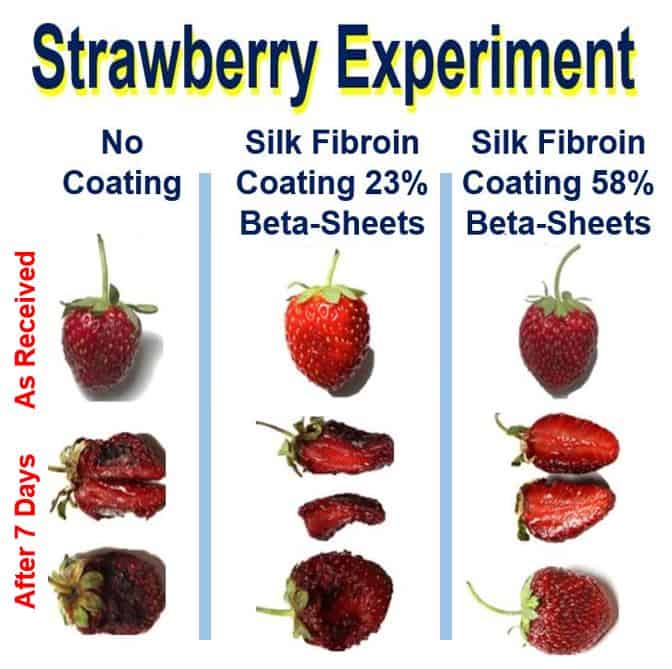 After seven days stored at room temperature (22°C), silk fibroin coating showed to significantly improve the quality of the strawberries. (Image: Scientific Reports)
Silk is an incredibly tough material
Silk has a unique crystalline structure, making it one of the toughest natural materials we know of. Fibroin, an insoluble protein in silk created by spiders, has a surprising ability to stabilize and protect other materials while being fully *biodegradable and biocompatible (not harmful to whatever it is touching).
* Biodegradable means it is capable of being decomposed by bacteria or other living organisms, i.e. it does not pollute.
In this study, Prof. Fiorenzo G. Omenetto and colleagues dipped freshly picked strawberries in a solution of 1% silk fibroin protein – they repeated the coating process up to four times. The fibroin-coated strawberries were then treated for varying lengths of time with water vapour under vacuum (water annealed) to create different percentages of crystalline beta-sheets in the coating.
The longer the fruits were exposed, the higher the percentage of beta-sheets and the more robust the fibroin coating was. The coating was between 27 microns and 35 microns thick. One micron equals one-millionth of a metre, or one thousandth of a millimetre.
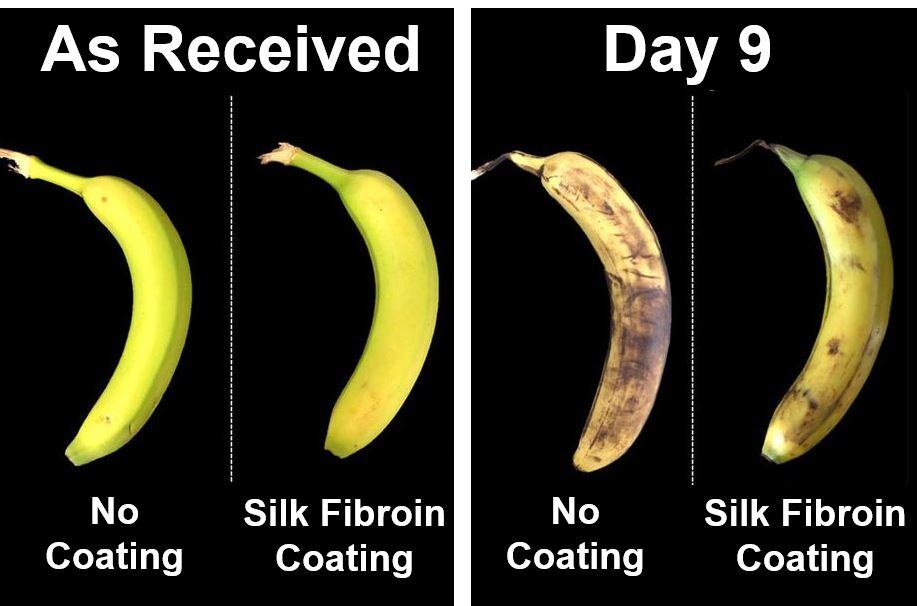 The bananas coated with silk fibroin lasted much longer at room temperature (22°C) than the controls with no coating, the scientists reported. (Image: Scientific Reports)
They then stored the strawberries at room temperature. The control strawberries – the ones with no coating – were compared over time with the fruits that had been dipped in varying numbers of coats of silk that had been annealed for different durations.
Coated strawberries still fresh after one week
After seven days, the strawberries coated with higher beta-sheet silk were still firm and juicy, while the uncoated ones were discoloured and dehydrated.
Tests showed that fruit respiration was significantly slowed down by silk coating, thus the strawberries remained fresh and firm for much longer.
Study author, Fiorenzo Omenetto, Associate Dean for Research, School of Engineering, a Frank C. Doble Professor, said regarding the silk coating:
“The beta-sheet content of the edible silk fibroin coatings made the strawberries less permeable to carbon dioxide and oxygen. We saw a statistically significant delay in the decay of the fruit.”
Coating slowed down banana ripening
The authors carried out similar experiments on bananas, which unlike strawberries can ripen after they are harvested. They found that the bananas with the silk coating ripened at a much slower rate compared to the uncoated controls. The coated bananas also remained firm for longer.
The study did not look into whether taste was affected by the silk coating. However, the scientists reported that it did not affect fruit texture.
First author, Benedetto Marelli, Assistant Professor at MIT’s Department of Civil and Environmental Engineering, who was formerly a post-doctoral associate in the Omenetto lab, said:
“Various therapeutic agents could be easily added to the water-based silk solution used for the coatings, so we could potentially both preserve and add therapeutic function to consumable goods without the need for complex chemistries.”
In an Abstract in the journal, the authors wrote:
“Silk fibroin coatings enhance fruits’ shelf life at room conditions by reducing cell respiration rate and water evaporation.”
“The water-based processing and edible nature of silk fibroin makes this approach a promising alternative for food preservation with a naturally derived material.”
The study was supported by a grant from the Office of Naval Research in Arlington, Virginia, USA.
Citation: “Silk Fibroin as Edible Coating for Perishable Food Preservation,” B. Marelli, M. A. Brenckle, D. L. Kaplan & F. G. Omenetto. Scientific Reports 6, Article number: 25263. 6th May, 2016. DOI: 10.1038/srep25263.
