
Declining unemployment bolstered tax receipts helping the US to post its lowest budget deficit as a percentage of GDP since 2007, and the smallest in total value since 2008, according to figures published by the Treasury Department on Wednesday.
The budget deficit during the 12-month period ending September 30th fell to 2.8% of GDP from 4.1% a year earlier.
The shortfall over a one-year period ending September 30th was $483.4 billion, compared to $680.2 billion in the previous year. While expenditure rose by 1.4%, revenue increased 8.9%.
Jacob J. Lew, Treasury Secretary, said the lower deficit was partly due to stronger growth and an unemployment rate that fell from 7.2% in September 2013 to 5.9% last month.
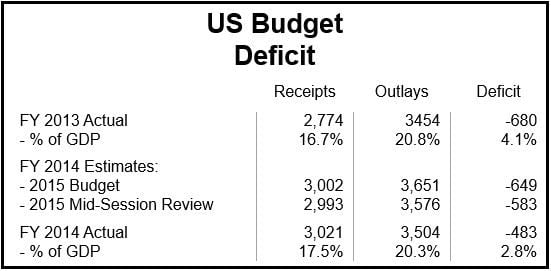
(Data Source: US Department of the Treasury)
Mr. Lew said:
“The President’s balanced approach to deficit reduction has made our tax code more fair, reduced spending and made critical investments to help drive U.S. competitiveness and growth,” said Treasury Secretary Lew. “The President’s policies and a strengthening U.S. economy have resulted in a reduction of the U.S. budget deficit of approximately two-thirds – the fastest sustained deficit reduction since World War II.”
“This economic and fiscal progress underscores what is possible if we continue to invest in growth and opportunity,” said OMB Director Donovan. “To build a more durable economy, Congress needs to act on the President’s proposals that would put our debt and deficits on a sustainable trajectory, while making critical investments in areas such as education, innovation and infrastructure that will create jobs, economic growth, and opportunity for all Americans.”
The Congressional Budget Office, however, warns that the budget deficit will soon start growing as an aging population pushes up Social Security and health care spending.
The US government posted a $105.8 billion surplus in September 2014 which was considerably higher than the $75.1 billion registered in September 2013.
Total Federal borrowing from the public grew by $798 billion during the 2014 fiscal year to $12,779 billion, or 74.2% of GDP. The higher borrowing included $483 billion to finance the deficit and $314 billion related to other transactions that impacted the US Government’s financing requirements, including payments for direct student loans and other Federal credit programs.
