

The Organization for Economic Cooperation and Development (OECD) forecasts that US all-items inflation will be 4.2% in 2026. This compares to the previous forecast of 2.8% for the same period. Federal Reserve officials had an even lower prediction of 2.7%. The Federal Reserve (Fed) is the central bank of the United States.
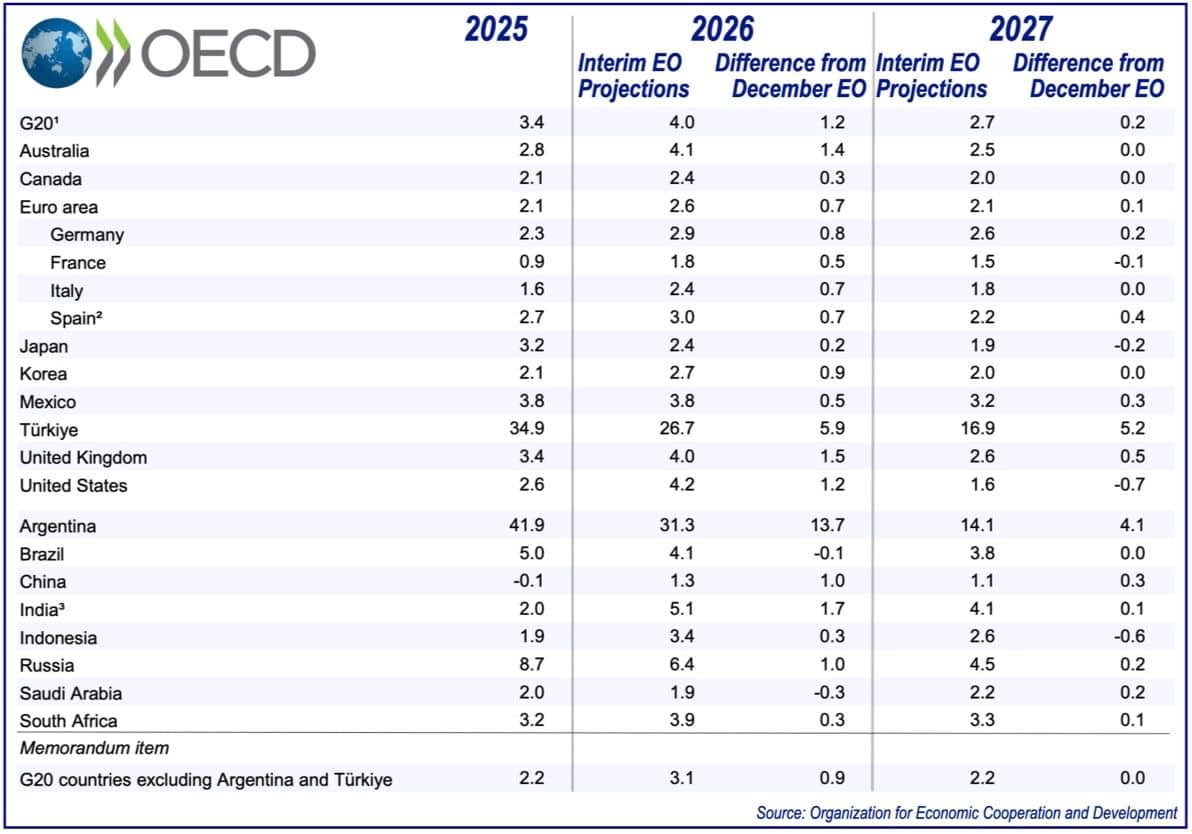
The OECD advised the US Fed to be vigilant against threats of inflation. The Iran war has pushed up the price of gasoline (UK: petrol), diesel, natural gas, and other petroleum products. Economists say that US tariffs continue to push up prices even though they are currently lower than before.
In their periodic update, the OECD wrote:
“The breadth and duration of the conflict are very uncertain, but a prolonged period of higher energy prices will add markedly to business costs and raise consumer price inflation, with adverse consequences for growth.”
Inflation and Interest Rate Forecasts for 2027
Next year, however, should see a sharp decrease in the inflation rate to 1.6% and 2.2%, according to the OECD and the Fed, respectively. The Fed’s core inflation forecast is 2.8% for 2026 and 2.5% for 2027.
US interest rates are most likely to remain flat in 2027, and GDP growth is projected to be solid, the OECD added.
The OECD wrote:
“The current supply-induced rise in global energy prices can be looked through provided inflation expectations remain well-anchored, but policy adjustment may be needed if there are signs of broader price pressures or weaker labour market conditions.”
UK Inflation Forecasts
The OECD forecasts that the inflation rate in the United Kingdom (UK) will be 4% in 2026. It adds that the UK could have the second-highest inflation rate in the G7 this year. Higher forecasts in the UK, US, and most other countries are mainly due to the consequences of the US-Israeli war on Iran.
The UK’s Office of National Statistics reported that the country’s inflation rate stood at 3.2% in the 12 months to February 2026, which was unchanged from the 12 months to January.
The UK is much more vulnerable to changes in oil and gas prices than the US. CNBC made the following comment regarding how energy prices affect Britain’s economy:
“The U.K. is more exposed to the global energy price shock than many other nations, as the country imports most of its oil and natural gas, and has limited gas storage facilities.”
All Items Inflation vs. Core Inflation
All items inflation refers to the price changes of everything we buy, including food, energy (gasoline, electricity, cooking gas), rent, clothes, etc.
Core inflation does not include food and energy prices. Economists and policymakers are interested in core inflation because energy and food prices are very volatile, that is, they change a lot. Core inflation helps us determine what the “real direction” of inflation is.
